Introduction
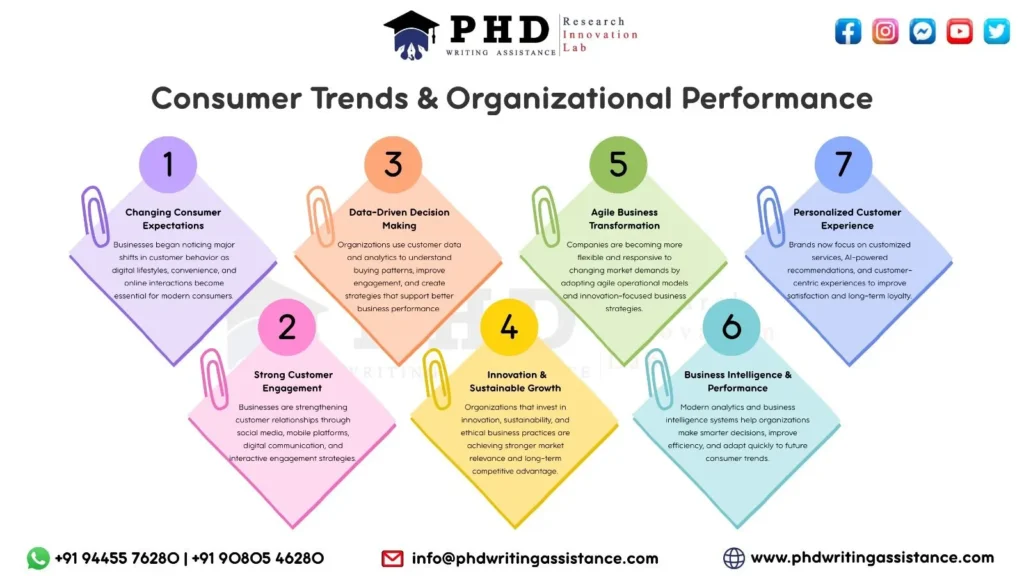
In today’s highly competitive business environment, understanding changing consumer behavior has become essential for long-term business success. Rapid technological advancements, shifting market expectations, and evolving digital lifestyles are continuously reshaping how customers interact with brands. As a result, organizations must respond strategically to these changes to maintain relevance, improve operational efficiency, and strengthen customer loyalty.
The relationship between consumer trends and organizational performance has become increasingly significant in modern business management. Organizations that fail to adapt to new customer expectations often struggle to maintain market share, while businesses that embrace innovation and customer-focused strategies are more likely to achieve sustainable growth. Modern consumers now expect convenience, transparency, personalization, and socially responsible business practices from the brands they engage with.
The rise of digital platforms, e-commerce, and mobile technology has further accelerated changes in consumer behavior. Customers are now more informed, connected, and selective than ever before. This transformation has encouraged businesses to adopt advanced technologies such as data analytics in business, artificial intelligence, and customer intelligence systems to understand customer preferences more effectively.
This article explores how organizations can respond to emerging consumer expectations through innovation, agility, and strategic adaptation. It also examines the importance of customer engagement strategies, personalized customer experience, and business intelligence and analytics in improving overall organizational performance and maintaining competitive advantage.
Understanding Modern Consumer Trends
Consumer trends are shaped by various social, technological, and economic influences. Over the last few years, businesses have witnessed major shifts in customer priorities, particularly after the global pandemic accelerated digital transformation across industries.
Modern consumers increasingly value:
- convenience and speed
- digital accessibility
- sustainability and ethical business practices
- personalized interactions
- transparency and trust
These expectations have transformed how organizations design products, communicate with customers, and deliver services.
For example, the rapid growth of e-commerce changed customer purchasing behavior significantly. Consumers now prefer flexible shopping experiences that combine convenience with fast delivery services. Companies such as Amazon and Target successfully adapted to these changes by strengthening their digital infrastructure and improving customer service experiences.
Understanding these evolving preferences is critical because the connection between consumer trends and organizational performance directly impacts revenue growth, customer retention, and brand reputation.
The Role of Data Analytics in Business
One of the most effective ways organizations can adapt to changing consumer behavior is through data analytics in business. Data-driven insights allow companies to identify patterns, predict customer preferences, and make informed strategic decisions.
Modern businesses collect large amounts of customer data from:
- websites
- mobile applications
- social media platforms
- online purchases
- customer feedback systems
By analysing this information, organizations can better understand:
- purchasing behavior
- customer interests
- market trends
- engagement levels
- buying motivations
Companies such as Amazon use advanced recommendation algorithms to personalize customer experiences based on browsing and purchasing history. This approach improves customer satisfaction while increasing sales performance.
Similarly, Spotify leverages data analytics to create personalized playlists and music recommendations for users. Features like “Discover Weekly” use listening behavior to deliver customized content, which strengthens customer engagement and platform loyalty.The integration of business intelligence and analytics enables organizations to transform raw data into actionable insights that support operational improvement and strategic planning.
Agile Business Strategies and Organizational Adaptation
Organizations operating in fast-changing markets must remain flexible and responsive to evolving consumer expectations. This is where agile business strategies become increasingly valuable.
Agile methodologies focus on:
- continuous improvement
- rapid adaptation
- customer feedback integration
- iterative decision-making
- collaborative innovation
Businesses that adopt agile approaches can respond more effectively to market disruptions and customer demands.
Zara is widely recognized for its agile operational model. The company continuously monitors fashion trends and customer preferences, allowing it to introduce new collections rapidly. This ability to respond quickly helps Zara maintain relevance in the highly competitive fashion industry.
Airbnb also demonstrated organizational agility during the pandemic. As travel restrictions impacted global tourism, the company shifted its focus toward promoting local experiences and long-term stays. This strategic adaptation allowed Airbnb to remain relevant while addressing changing customer behavior.The connection between agility and consumer trends and organizational performance is particularly important because businesses that adapt quickly are more likely to maintain customer trust and operational stability during periods of uncertainty.
Building a Personalized Customer Experience
Today’s consumers expect businesses to understand their preferences and provide customized experiences that align with their needs. Creating a strong personalized customer experience has therefore become a major competitive advantage.
Personalization involves using customer data to:
- recommend relevant products
- customize marketing messages
- improve service interactions
- enhance user experiences
- increase customer satisfaction
Netflix is a leading example of personalization in digital business. The platform uses viewing history and behavioral data to recommend movies and television shows tailored to individual preferences. This strategy significantly improves user engagement and retention.
Sephora has also enhanced customer experiences through personalized beauty recommendations and virtual product testing tools. These innovations help customers make informed purchasing decisions while improving brand loyalty.
Personalization not only improves customer satisfaction but also strengthens the relationship between consumers and brands, positively influencing organizational performance.
Effective Customer Engagement Strategies
Strong customer engagement strategies are essential for maintaining long-term customer relationships in today’s digital marketplace. Engaged customers are more likely to:
- remain loyal to a brand
- make repeat purchases
- recommend products to others
- participate in brand communities
Organizations now interact with customers through multiple digital channels, including:
- social media
- email marketing
- mobile applications
- live chat systems
- online communities
A multi-channel engagement strategy helps businesses maintain consistent communication and improve customer experiences across platforms.
Nike effectively uses digital engagement through its mobile applications, social media campaigns, and loyalty programs. By delivering personalized offers and interactive content, Nike strengthens customer relationships and brand loyalty.
Coca-Cola also demonstrates successful customer engagement by maintaining consistent messaging across television, social media, and digital advertising campaigns. This integrated communication strategy reinforces brand recognition and customer connection.Strong engagement practices directly support consumer trends and organizational performance by improving customer satisfaction and increasing long-term business value.
The Importance of Business Intelligence and Analytics
Modern organizations increasingly rely on business intelligence and analytics to improve strategic decision-making and operational efficiency.
Business intelligence systems help organizations:
- monitor performance metrics
- identify market opportunities
- forecast consumer behavior
- optimize marketing campaigns
- improve resource allocation
These systems combine data analysis tools with real-time reporting capabilities to support faster and more accurate business decisions.
Companies that integrate business intelligence into their operations are better positioned to:
- respond to market changes
- reduce operational risks
- improve customer targeting
- enhance profitability
In highly competitive industries, the use of analytics-driven strategies can significantly improve organizational adaptability and long-term performance.
Innovation and Sustainable Business Growth
Innovation plays a critical role in helping organizations respond to changing consumer expectations. Businesses that continuously innovate are more likely to remain competitive and relevant in dynamic markets.
Tesla is an example of a company that successfully aligned innovation with consumer demand for sustainability and advanced technology. Its electric vehicles combine environmental responsibility with technological innovation, attracting environmentally conscious consumers worldwide.
Unilever has also strengthened its market position by developing sustainable product lines focused on ethical sourcing and environmentally friendly production practices. Brands such as Dove and Seventh Generation appeal to consumers who prioritize sustainability and corporate responsibility.
Organizations that align innovation with consumer values often achieve stronger brand loyalty and long-term business growth.
Creating a Customer-Centric Organizational Culture
Adapting to consumer trends requires more than technology and marketing strategies. Organizations must also develop a customer-centric internal culture.
A customer-focused culture encourages employees to:
- prioritize customer satisfaction
- respond proactively to feedback
- improve service quality
- support innovation
- collaborate effectively
Training programmes focused on communication, empathy, and customer service can improve employee performance and strengthen organizational relationships with customers.
Google is well known for fostering innovation and employee creativity through initiatives that encourage experimentation and idea development. This culture has contributed to the creation of highly successful products and services.
Organizations that align internal culture with customer expectations are better equipped to adapt to changing market demands and improve organizational performance.
Conclusion
In an increasingly digital and competitive business environment, organizations must continuously adapt to evolving customer expectations to remain successful. The growing relationship between consumer trends and organizational performance highlights the importance of innovation, agility, and customer-focused business strategies.
By investing in data analytics in business, adopting agile operational models, improving customer engagement strategies, and delivering a strong personalized customer experience, organizations can strengthen customer loyalty and improve overall business performance.
Additionally, the integration of business intelligence and analytics enables companies to make data-driven decisions that improve efficiency, responsiveness, and long-term competitiveness.
Organizations that remain flexible, customer-centric, and innovation-driven will be better prepared to navigate future market challenges and achieve sustainable growth in the evolving global business landscape.
References
1. Assen, M. F. V. (2020). Training, employee involvement and continuous improvement – the moderating effect of a common improvement method. Production Planning & Control, 32(2), 1–13. Tandfonline. https://www.tandfonline.com/doi/full/10.1080/09537287.2020.1716405 (customer needs)
2. Baena, V. (2024). The shift from fast fashion to socially and sustainable fast fashion: The pivotal role of ethical consideration of consumer intentions to purchase Zara. Corporate Social-Responsibility and Environmental Management. https://doi.org/10.1002/csr.2803 (design and production)
3. Basu, R., Lim, W. M., Kumar, A., & Kumar, S. (2023). Marketing analytics: The bridge between customer psychology and marketing decision‐making. Psychology & Marketing, 40(12). https://doi.org/10.1002/mar.21908 (consumer trends)
4. Bi, Q. (2019). Cultivating loyal customers through online customer communities: A psychological contract perspective. Journal of Business Research, 103(1), 34–44. https://doi.org/10.1016/j.jbusres.2019.06.005 (customer retention)
5. Chandra, S., Verma, S., Lim, W. M., Kumar, S., & Donthu, N. (2022). Personalization in Personalized marketing: Trends and Ways Forward. Psychology & Marketing, 39(8), 1529–1562. Wiley. (social media)
6. Dong, H., Dacre, N., Baxter, D., & Ceylan, S. (2024). What is Agile Project Management? Developing a New Definition Following a Systematic Literature Review. Project Management Journal. https://doi.org/10.1177/87569728241254095 (agile methodologies)
7. Hall, C. M., Prayag, G., Safonov, A., Coles, T., Gössling, S., & Koupaei, S. N. (2022). Airbnb and the sharing economy. Current Issues in Tourism, 25(19), 1–11. https://doi.org/10.1080/13683500.2022.2122418 (agility)
8. Han, J. (2021). How Does Tesla Motors Achieve Competitive Advantage in the Global Automobile Industry? Journal of Next-Generation Convergence Information Services Technology, 10(5), 573–582. https://doi.org/10.29056/jncist.2021.10.09 (sustainability)
9. Kiberg, H., & Spilker, H. (2023). One More Turn after the Algorithmic Turn? Spotify’s Colonization of the Online Audio Space. Popular Music and Society, 46(2), 1–21. https://doi.org/10.1080/03007766.2023.2184160 (data analytics)10. Reuters. (2024, August 21). Target raises 2024 profit forecast as price cuts draw shoppers. Mint. https://www.livemint.com/news/target-raises-2024-profit-forecast-as-price-cuts-draw-shoppers-11724258452527.html (Target)
Frequently Asked Questions
1. How do consumer trends affect organizational performance?
Consumer trends influence purchasing behavior, customer expectations, and market demand. Organizations that successfully adapt to these trends often improve customer satisfaction, loyalty, and overall business performance.
2. Why is data analytics important in modern business?
Data analytics in business helps organizations understand customer behavior, identify trends, and make informed strategic decisions that improve operational efficiency and customer experiences.
3. What are effective customer engagement strategies?
Effective customer engagement strategies include personalized communication, multi-channel marketing, loyalty programmes, social media interaction, and community-building initiatives.
4. How does personalized customer experience improve business performance?
A strong personalized customer experience increases customer satisfaction, strengthens brand loyalty, and encourages repeat purchases by delivering tailored products and services.
5. What is the role of business intelligence and analytics in organizations?
Business intelligence and analytics support better decision-making by transforming business data into actionable insights that improve marketing, operations, customer targeting, and overall organizational performance.