Introduction
Writing the methodology and data analysis chapters is one of the most critical stages of a doctoral dissertation. These chapters demonstrate the scientific rigor of your research and provide evidence that your findings are reliable, valid, and based on a systematic process. Many doctoral candidates struggle with PhD methodology and data analysis writing because they are unsure how to explain research methods, justify methodological choices, or present data analysis clearly.
A well-written methodology chapter explains how the research was conducted, while the data analysis chapter demonstrates how the collected information was examined to answer the research questions. Together, these sections form the backbone of a PhD thesis and significantly influence how examiners evaluate the quality of the research.
Understanding How to write methodology chapter in phd thesis is essential because this section allows readers to assess the credibility and reproducibility of the study. Similarly, mastering Data analysis in research methodology helps researchers present findings logically and connect results to the study objectives.
This comprehensive guide provides practical strategies, examples, and expert recommendations for writing strong methodology and data analysis chapters that enhance the overall quality of a doctoral dissertation.
Understanding the Importance of Methodology and Data Analysis
Every successful PhD thesis relies on a robust research design and a clear analytical framework. The methodology chapter explains the research process, while the data analysis chapter demonstrates how collected information was interpreted.
These chapters help:
- Establish research credibility
- Demonstrate academic rigor
- Justify research decisions
- Ensure transparency
- Support research findings
- Improve thesis quality
Strong PhD methodology and data analysis writing shows that the researcher followed a structured process rather than relying on assumptions or personal opinions.
What is a PhD Methodology Chapter?
The methodology chapter describes the research approach, methods, and procedures used to conduct the study. It explains how data was collected, analyzed, and interpreted.
A methodology chapter typically answers questions such as:
- What research design was used?
- Why was this approach selected?
- How was data collected?
- Who participated in the study?
- How was the data analyzed?
- What ethical considerations were followed?
Understanding How to write methodology chapter in phd thesis involves providing clear explanations and justifications for every methodological decision.
Key Components of a Methodology Chapter
Research Philosophy
Research philosophy refers to the beliefs and assumptions that guide the research process.
Common research philosophies include:
Positivism
Focuses on objective measurement and quantitative analysis.
Interpretivism
Explores subjective experiences and meanings through qualitative methods.
Pragmatism
Combines quantitative and qualitative approaches to address research problems effectively.
Researchers should explain why a specific philosophy aligns with their study objectives.
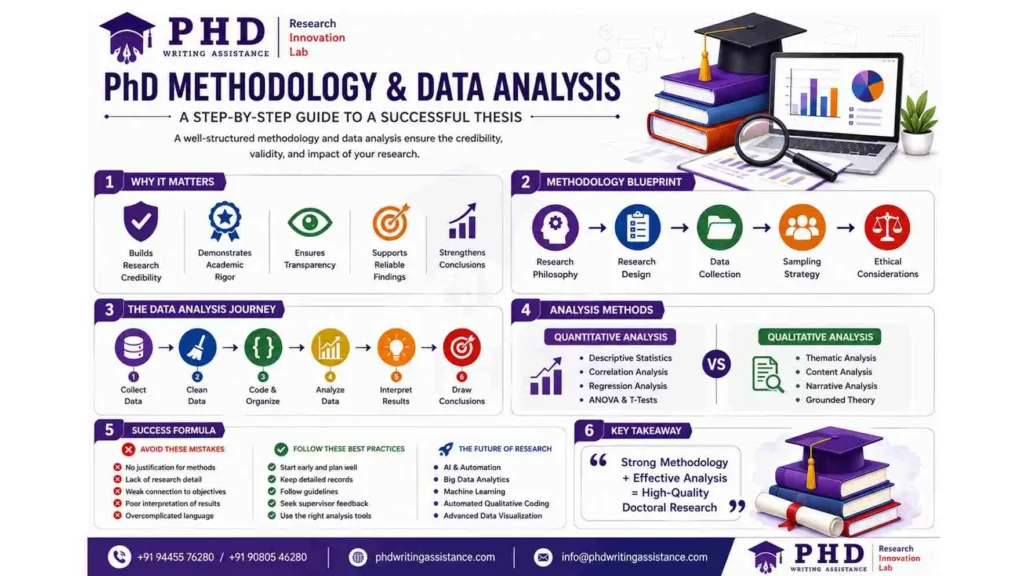
Research Approach
The research approach determines how knowledge is developed during the study.
Deductive Approach
A deductive approach begins with existing theories and tests hypotheses through data collection.
Inductive Approach
An inductive approach develops theories based on observed data and emerging patterns.
Choosing the appropriate approach is an essential part of PhD methodology and data analysis writing.
Research Design
Research design provides the overall framework for conducting the study.
Common research designs include:
Descriptive Research
Describes characteristics, behaviors, or trends within a population.
Exploratory Research
Investigates new or under-researched topics.
Explanatory Research
Examines cause-and-effect relationships between variables.
Researchers must justify why a particular design supports their research objectives.
Data Collection Methods
Selecting suitable data collection methods is crucial for obtaining reliable information.
Primary Data Collection
Primary data is collected directly from participants.
Examples include:
- Surveys
- Interviews
- Focus groups
- Observations
Secondary Data Collection
Secondary data comes from existing sources such as:
- Journal articles
- Government reports
- Industry publications
- Databases
Researchers should explain how their chosen methods support the research goals.
Sampling Strategy
Sampling determines how participants are selected.
Common sampling techniques include:
Probability Sampling
Every member of the population has an equal chance of selection.
Non-Probability Sampling
Participants are selected based on specific characteristics or accessibility.
Researchers should justify sample size and sampling methods to strengthen research validity.
Ethical Considerations
Ethics play a vital role in doctoral research.
Researchers should discuss:
- Informed consent
- Participant confidentiality
- Data security
- Voluntary participation
- Ethical approval procedures
Addressing ethics demonstrates professionalism and research integrity.
How to Write Methodology Chapter in PhD Thesis
Many researchers find How to write methodology chapter in phd thesis challenging because they must balance technical accuracy with readability.
The following strategies can help:
Clearly Explain Research Decisions
Avoid simply listing methods. Explain why specific approaches were chosen and how they contribute to achieving research objectives.
Use Academic Language
Maintain a formal and scholarly tone throughout the chapter.
Provide Justifications
Every methodological choice should be supported by academic reasoning and relevant literature.
Be Transparent
Describe the research process in sufficient detail so that others could replicate the study.
Maintain Logical Flow
Present information in a structured sequence that guides readers through the research process.
Understanding Data Analysis in Research Methodology
Once data has been collected, researchers must analyze it systematically to answer research questions.
Data analysis in research methodology involves organizing, interpreting, and evaluating information to identify meaningful findings.
Effective data analysis helps researchers:
- Identify patterns
- Test hypotheses
- Evaluate relationships
- Generate insights
- Support conclusions
The analysis process depends on whether the study uses quantitative, qualitative, or mixed methods.
Quantitative Data Analysis Techniques
Quantitative research focuses on numerical data and statistical analysis.
Common techniques include:
Descriptive Statistics
Descriptive statistics summarize data using:
- Mean
- Median
- Mode
- Standard deviation
- Frequency distributions
Inferential Statistics
Inferential statistics help researchers draw conclusions from sample data.
Examples include:
- Regression analysis
- Correlation analysis
- T-tests
- ANOVA
- Chi-square tests
Researchers should explain why each statistical method was selected.
Qualitative Data Analysis Techniques
Qualitative research focuses on understanding experiences, opinions, and behaviors.
Common analysis methods include:
Thematic Analysis
Identifies recurring themes and patterns within data.
Content Analysis
Examines the frequency and meaning of specific concepts or words.
Narrative Analysis
Analyzes stories and personal experiences shared by participants.
Clear explanations of coding procedures and theme development strengthen research credibility.
PhD Data Analysis Chapter Guide
A strong PhD data analysis chapter guide includes a clear structure that presents findings logically and effectively.
Introduction to Data Analysis
Begin by outlining the purpose of the chapter and summarizing the analytical approach used.
Example:
“This chapter presents the analysis of data collected from participants and evaluates the findings in relation to the research objectives.”
Data Preparation
Describe how data was prepared before analysis.
This may include:
- Data cleaning
- Coding procedures
- Handling missing values
- Data transformation
Providing these details improves transparency.
Presentation of Findings
Present findings systematically.
Use:
- Tables
- Charts
- Graphs
- Statistical outputs
Visual representations improve clarity and help readers understand results more easily.
Interpretation of Results
Do not simply report findings.
Explain:
- What the results mean
- How they relate to research questions
- Whether hypotheses were supported
- How findings compare with previous studies
Interpretation is a critical aspect of Data analysis in research methodology.
Linking Findings to Literature
Connect results to existing academic research.
Discuss:
- Similar findings
- Contradictory findings
- New contributions
This demonstrates critical thinking and scholarly engagement.
Analyzing a Research Paper to Improve Thesis Writing
One of the most effective ways to improve methodology and analysis chapters is by Analyzing a research paper from a high-quality journal.
When reviewing research papers, examine:
Research Design
How was the study structured?
Data Collection
What methods were used to gather information?
Analysis Techniques
How was the data analyzed?
Presentation Style
How were findings presented and interpreted?
Academic Writing
How did the authors justify methodological decisions?
Regularly Analyzing a research paper helps PhD students understand academic expectations and improve their own writing.
Common Mistakes in Methodology and Data Analysis Chapters
Avoiding common mistakes can significantly improve dissertation quality.
Insufficient Justification
Researchers often explain what they did but fail to explain why they did it.
Lack of Detail
Incomplete descriptions reduce transparency and credibility.
Misalignment with Research Objectives
Methods and analysis should directly support research questions.
Overcomplicated Explanations
Use clear language rather than unnecessary technical jargon.
Weak Interpretation
Simply presenting statistics without explaining their meaning weakens the chapter.
Tips for Writing Strong Methodology and Data Analysis Chapters
Start Early
Do not wait until data collection is complete before planning the chapter.
Maintain Detailed Records
Document all research decisions throughout the project.
Follow University Guidelines
Different institutions may have specific formatting requirements.
Seek Supervisor Feedback
Regular feedback helps identify weaknesses and improve clarity.
Use Research Software Effectively
Tools such as SPSS, NVivo, R, and Excel can improve analysis accuracy and presentation quality.
Future Trends in Research Methodology and Data Analysis
Modern doctoral research increasingly incorporates advanced analytical tools and technologies.
Emerging trends include:
- Artificial intelligence in data analysis
- Big data analytics
- Machine learning techniques
- Automated coding for qualitative research
- Data visualization software
Researchers who understand these developments can strengthen their analytical capabilities and produce more impactful research.
Conclusion
Effective PhD methodology and data analysis writing is essential for producing a high-quality doctoral thesis. The methodology chapter establishes research credibility by explaining how the study was conducted, while the data analysis chapter demonstrates how findings were generated and interpreted.
Understanding How to write methodology chapter in phd thesis allows researchers to justify methodological decisions clearly and professionally. Likewise, mastering Data analysis in research methodology helps transform raw data into meaningful insights that support research objectives.
By following this PhD data analysis chapter guide, doctoral students can structure their chapters effectively, avoid common mistakes, and present their research with confidence. Additionally, regularly Analyzing a research paper can provide valuable insights into best practices and strengthen academic writing skills.
Strong methodology and data analysis chapters not only improve dissertation quality but also enhance the credibility, reliability, and overall impact of doctoral research.
Frequently Asked Questions
1. What is the purpose of a methodology chapter in a PhD thesis?
The methodology chapter explains how the research was conducted, including the research design, data collection methods, sampling strategy, and analytical techniques used to achieve the study objectives.
2. How do I write a strong PhD methodology chapter?
A strong methodology chapter clearly explains and justifies all research decisions, follows a logical structure, and demonstrates how the selected methods support the research objectives.
3. What is data analysis in research methodology?
Data analysis in research methodology refers to the process of organizing, interpreting, and evaluating collected data to answer research questions and generate meaningful findings.
4. How should findings be presented in a PhD data analysis chapter?
Findings should be presented using tables, charts, graphs, and detailed explanations that clearly connect results to research objectives and existing literature.
5. Why is analyzing a research paper useful for PhD students?
Analyzing a research paper helps students understand research design, methodology, data analysis techniques, and academic writing standards that can improve their own thesis chapters.