Introduction
A well-written literature review is the foundation of every successful research project. Whether you are preparing a research proposal, writing a dissertation, or completing a PhD thesis, understanding how to develop a comprehensive literature review is essential for producing high-quality academic work. A literature review is more than a summary of previous studies it is a critical evaluation of existing research that helps identify knowledge gaps, establish the relevance of your study, and provide a strong theoretical foundation.
Many students search for a literature review example because they find it challenging to organize research findings, compare different studies, and present a logical academic argument. Instead of simply describing previous research, a literature review should analyze, synthesize, and evaluate scholarly evidence to demonstrate how your research contributes to the existing body of knowledge.
Another important purpose of a literature review is to highlight the importance of literature review in research. It enables researchers to understand what has already been investigated, identify unanswered questions, avoid duplicating previous work, and justify the significance of their study. A well-structured literature review also supports the development of research objectives, research questions, and methodology.
This guide explains what a literature review is, provides a practical literature review example, discusses the significance of literature review in research, explores its role in a literature review dissertation, and explains how the theoretical framework in research strengthens academic studies.
What Is a Literature Review?
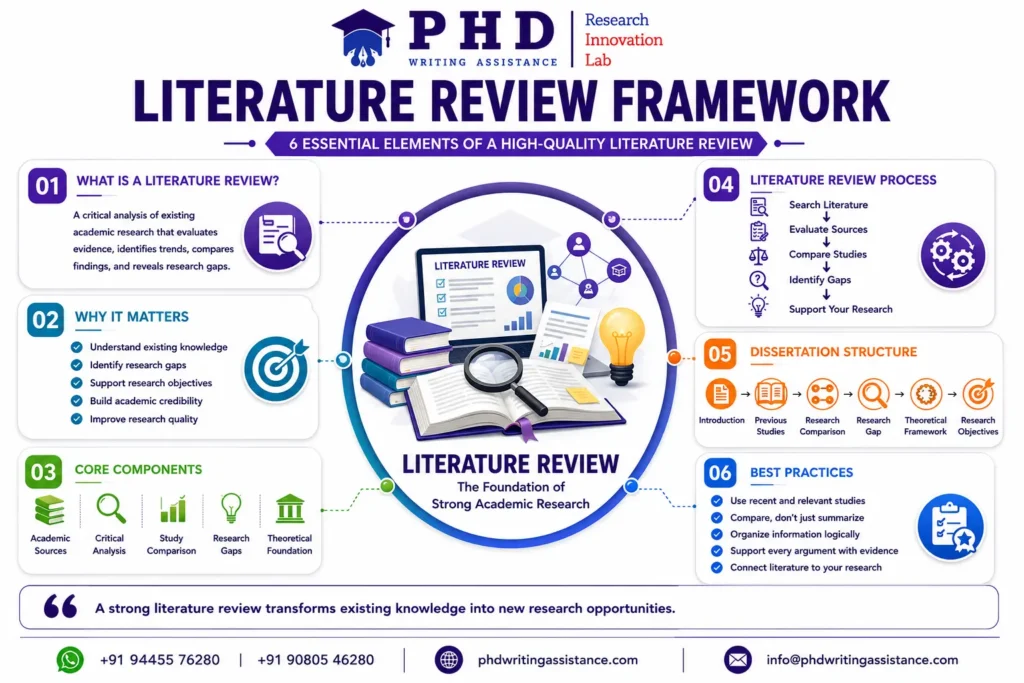
A literature review is a structured analysis of published academic sources related to a specific research topic. It examines books, peer-reviewed journal articles, conference papers, reports, and other credible sources to understand current knowledge, identify trends, compare findings, and reveal research gaps.
Unlike a simple summary, a literature review critically evaluates previous studies by identifying similarities, differences, strengths, limitations, and opportunities for future research.
The primary objectives of a literature review are to:
- Understand existing knowledge on a research topic.
- Identify research gaps.
- Support the research problem.
- Develop research objectives.
- Establish the study’s theoretical foundation.
- Demonstrate the originality of the research.
A comprehensive literature review shows that the researcher has thoroughly examined the existing evidence before conducting a new study.
Why Is a Literature Review Important?
The importance of literature review in research extends far beyond collecting references. It helps researchers build a strong academic foundation and ensures that their study contributes meaningful knowledge to the field.
A literature review enables researchers to:
Understand Existing Research
Reviewing previous studies helps researchers become familiar with current theories, concepts, and methodologies. This understanding prevents unnecessary duplication and provides valuable insights into the topic.
Identify Research Gaps
One of the most significant benefits of a literature review is identifying unanswered questions or underexplored areas. These gaps often become the basis for new research.
Support Research Objectives
A strong literature review demonstrates why the research is necessary by connecting existing evidence with the proposed study’s objectives.
Improve Research Quality
Critically analyzing previous studies helps researchers select appropriate methodologies, avoid common mistakes, and design stronger research projects.
Build Academic Credibility
Using recent, peer-reviewed, and credible sources strengthens the reliability and trustworthiness of the research.
For these reasons, universities expect every dissertation and thesis to include a comprehensive literature review.
Literature Review Example
Many students learn best by examining a practical literature review example. The following example demonstrates how to critically discuss previous studies instead of simply summarizing them.
Research Topic
Artificial Intelligence in Healthcare
Example
Recent studies have demonstrated that artificial intelligence significantly improves disease diagnosis and patient care. Smith et al. (2023) reported that AI-assisted diagnostic systems increased diagnostic accuracy in radiology by reducing human error. Similarly, Johnson and Lee (2022) found that machine learning algorithms improved early disease detection in cancer patients. However, both studies primarily focused on large urban hospitals with advanced technological infrastructure.
In contrast, Kumar et al. (2024) investigated AI implementation in rural healthcare facilities and identified several challenges, including limited digital infrastructure, inadequate technical expertise, and financial constraints. These findings suggest that although AI has proven beneficial in developed healthcare systems, further research is needed to examine its effectiveness in resource-constrained environments.
This comparison demonstrates a clear research gap regarding AI adoption in rural healthcare settings and provides a strong justification for future investigation.
Why This Example Works
Notice that the example does not merely summarize previous studies. Instead, it:
- Compares multiple research findings.
- Highlights similarities and differences.
- Identifies limitations.
- Reveals a research gap.
- Establishes the need for further research.
This analytical approach is expected in postgraduate and doctoral research.
Significance of Literature Review in Research
Understanding the significance of literature review in research helps researchers appreciate why it is considered one of the most important chapters of any thesis or dissertation.
Identifies Research Gaps
A literature review enables researchers to recognize areas where knowledge is incomplete or inconsistent. These gaps justify the need for new research.
Supports Evidence-Based Research
Academic research must rely on credible evidence rather than assumptions. Reviewing scholarly literature ensures that research decisions are informed by existing knowledge.
Develops Critical Thinking
Instead of accepting previous findings without question, researchers evaluate methodologies, compare results, and assess the strengths and weaknesses of different studies.
Establishes Context
A literature review places the current study within the broader academic conversation, showing how it contributes to the field.
Improves Research Design
Understanding previous research methods helps scholars select appropriate research designs, sampling techniques, and analytical approaches for their own study.
These benefits explain why the literature review is often regarded as the backbone of academic research.
Literature Review Dissertation
A literature review dissertation is considerably more comprehensive than literature reviews prepared for coursework or journal assignments. In a dissertation, the literature review demonstrates the researcher’s ability to critically evaluate extensive scholarly evidence and establish a clear rationale for the study.
A dissertation literature review typically includes:
- Introduction to the research topic.
- Review of major theories.
- Analysis of previous empirical studies.
- Comparison of research findings.
- Identification of research gaps.
- Development of the conceptual or theoretical framework.
- Summary linking the literature to the research objectives.
Unlike undergraduate assignments, a dissertation literature review should present a coherent academic argument rather than a collection of article summaries. Every section should contribute to explaining why the proposed research is necessary and how it advances existing knowledge.
A well-organized literature review dissertation strengthens the credibility of the entire research project and provides a logical transition to the methodology chapter.
Theoretical Framework in Research
An important component of many literature reviews is the theoretical framework in research. A theoretical framework explains the theories or models that guide the study and help interpret the research findings.
The framework provides a scientific basis for understanding relationships between variables and supports the development of research questions, hypotheses, and methodology.
For example, a study examining employee motivation may use Maslow’s Hierarchy of Needs or Herzberg’s Two-Factor Theory as its theoretical framework. Similarly, research on technology adoption often relies on the Technology Acceptance Model (TAM) or the Unified Theory of Acceptance and Use of Technology (UTAUT).
Selecting an appropriate theoretical framework ensures that the study is grounded in established academic knowledge rather than personal assumptions.
Theoretical Framework Meaning
Understanding the theoretical framework meaning is essential for developing a well-structured research study. A theoretical framework is the set of established theories, concepts, or models that provides the foundation for your research. It explains why a particular phenomenon occurs and guides the researcher in interpreting the study’s findings.
In simple terms, the theoretical framework connects existing academic theories with your research objectives. It helps explain the relationship between variables and provides a logical basis for data collection and analysis.
For example, if your research examines customer satisfaction in online shopping, you may use the Expectation Confirmation Theory (ECT) to explain how customer expectations influence satisfaction levels. Similarly, studies on technology adoption often use the Technology Acceptance Model (TAM) to understand users’ willingness to adopt new technologies.
A strong theoretical framework offers several benefits:
- Provides a clear direction for the research.
- Supports the development of research questions and hypotheses.
- Helps interpret research findings using established theories.
- Improves the academic credibility of the study.
- Creates consistency throughout the research process.
Researchers should select theories that closely align with their research objectives rather than choosing popular models without proper justification. A carefully selected theoretical framework strengthens the overall quality and validity of the research.
Common Mistakes When Writing a Literature Review
Many research scholars make avoidable mistakes that reduce the quality of their literature review. Recognizing these issues early helps create a stronger and more persuasive academic document.
1. Summarizing Instead of Critically Analyzing
One of the most common mistakes is simply describing previous studies without comparing or evaluating them. A strong literature review should analyze similarities, differences, strengths, limitations, and research gaps.
2. Using Outdated Sources
Academic knowledge evolves continuously. Relying heavily on outdated references may weaken the relevance of your research. Whenever possible, prioritize recent peer-reviewed journal articles published within the last five years while including foundational studies where necessary.
3. Ignoring Research Gaps
The purpose of a literature review is not only to summarize existing knowledge but also to identify unanswered questions. Failing to highlight research gaps makes it difficult to justify your own study.
4. Weak Organization
Presenting studies in a random order creates confusion for readers. Instead, organize the literature thematically, chronologically, or methodologically to improve readability.
5. Lack of Theoretical Support
Some researchers discuss previous studies without explaining the theories that underpin them. Incorporating an appropriate theoretical framework strengthens the academic foundation of the research.
Avoiding these common mistakes improves the quality, originality, and credibility of your literature review.
Best Practices for Writing an Effective Literature Review
Producing a high-quality literature review requires careful planning, critical thinking, and systematic organization. The following best practices can help researchers develop a strong academic chapter.
Conduct a Comprehensive Literature Search
Use reputable academic databases such as Scopus, Web of Science, Google Scholar, and university library resources to locate relevant peer-reviewed studies.
Focus on Credible Sources
Prioritize journal articles, scholarly books, conference proceedings, and government publications from recognized publishers.
Organize Literature Logically
Arrange studies by themes, concepts, methodologies, or chronological development rather than discussing each article individually.
Compare and Synthesize Research
Instead of presenting isolated summaries, compare findings from multiple studies to identify patterns, contradictions, and emerging trends.
Support Every Argument with Evidence
Every major statement should be supported by credible academic references to strengthen the reliability of the review.
Link the Literature to Your Research
Each section should contribute to explaining why your study is necessary and how it addresses an identified research gap.
Following these practices ensures that the literature review provides a solid foundation for the entire research project.
Conclusion
A well-prepared literature review example demonstrates that academic research is much more than collecting references or summarizing previous studies. It requires critical analysis, logical organization, and the ability to identify research gaps that justify new investigations. Understanding the importance of literature review in research enables scholars to establish the relevance of their study, develop stronger research objectives, and build a solid academic foundation.
The significance of literature review in research extends beyond reviewing existing knowledge. It helps researchers identify unanswered questions, evaluate different research methodologies, and position their work within the broader academic conversation. For students preparing a literature review dissertation, developing strong analytical skills is essential for producing high-quality and original research.
Equally important is understanding the theoretical framework in research and the theoretical framework meaning, as these concepts provide the scientific foundation for interpreting research findings and guiding methodological decisions. Selecting an appropriate theoretical framework ensures that the study is supported by established academic theories and contributes meaningful insights to the field.
Ultimately, an effective literature review strengthens every stage of the research process. By critically evaluating existing studies, identifying research gaps, and integrating relevant theoretical perspectives, researchers can produce credible, impactful, and academically valuable work that advances knowledge within their discipline.
Frequently Asked Questions
1. What is a literature review?
A literature review is a critical analysis of existing academic research on a specific topic. It evaluates previous studies, identifies research gaps, and provides the foundation for new research.
2. Why is the literature review important in research?
The importance of literature review in research lies in helping researchers understand existing knowledge, identify research gaps, support research objectives, and avoid duplicating previous studies.
3. What should a literature review dissertation include?
A literature review dissertation should include relevant theories, critical analysis of previous studies, identification of research gaps, discussion of research trends, and a clear connection to the study’s research objectives.
4. What is the theoretical framework in research?
The theoretical framework in research is the collection of established theories or models that guide a study, explain relationships between variables, and support the interpretation of research findings.
5. How do I write a strong literature review?
To write a strong literature review, use credible academic sources, critically compare previous studies, organize the review logically, identify research gaps, integrate relevant theories, and connect the literature to your research objectives.