Introduction
In an increasingly competitive business environment, organisations are placing greater emphasis on customer-centric strategies to strengthen relationships and improve business performance. AI in CRM (Customer Relationship Management) is becoming an important part of this approach, helping businesses analyse customer information, understand purchasing patterns and make more informed decisions. One of its most valuable applications is predictive analytics, which uses historical data, machine learning algorithms and behavioural patterns to forecast future customer actions.
By integrating an AI-powered CRM system, organisations can identify potential sales opportunities, improve customer segmentation, strengthen retention strategies and make more accurate sales forecasts. These capabilities can contribute to increased revenue and improved customer lifetime value (CLV). However, successful implementation also requires organisations to consider data privacy, information quality and the importance of human judgement.
This article examines how AI-driven predictive analytics supports CRM performance, with particular attention to sales forecasting, customer retention, customer lifetime value and the ethical challenges associated with its adoption.
Understanding the Importance of Predictive Analytics in CRM
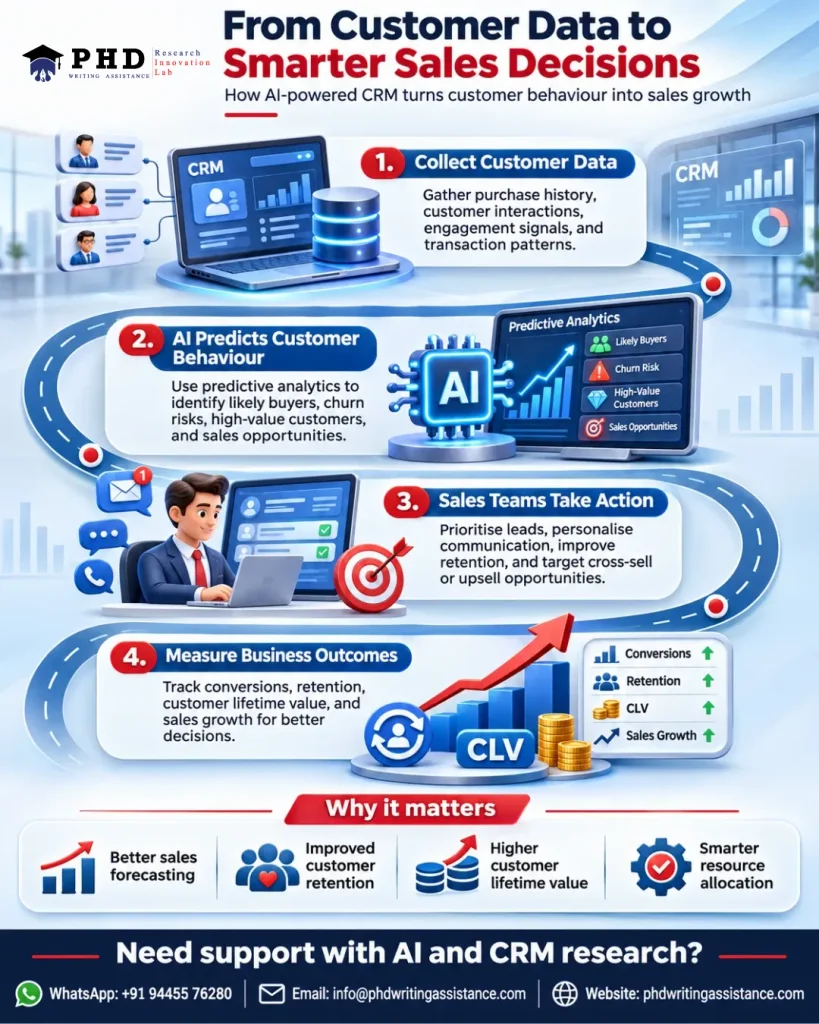
Predictive analytics is an important component of modern CRM because it enables organisations to use customer data to anticipate future behaviour. By analysing information such as customer demographics, purchasing history, engagement levels and transaction patterns, businesses can identify trends that support strategic decision-making.
Research by McKinsey indicates that organisations using data-driven decision-making effectively are more likely to acquire customers, retain existing customers and achieve profitability. These findings highlight the business value of using data to guide customer relationship strategies.
Within an AI-powered CRM, predictive analytics can support more accurate customer segmentation. Rather than relying only on broad demographic categories, organisations can analyse customer behaviour and identify groups with similar purchasing patterns, preferences and potential value.
For example, predictive models can identify customers who are more likely to respond to a particular promotion, purchase an additional product or engage with a personalised marketing campaign. Sales and marketing teams can then prioritise these opportunities and allocate resources more effectively. This approach can improve campaign relevance, customer engagement and return on investment (ROI).
How AI in CRM Improves Sales Forecasting Accuracy
One of the major applications of AI in CRM is improving sales forecasting. Traditional forecasting methods often depend on historical sales figures, manual estimates and general market trends. Although these methods provide useful information, they may not fully account for changing customer behaviour or rapidly developing market conditions.
AI-driven predictive analytics offers a more adaptive approach. It can process large volumes of historical and real-time customer data, identify patterns and update predictions as new information becomes available. This allows sales teams to make more informed assessments of future demand and potential revenue.
Research by Ledro et al. (2023) examines the integration of AI into CRM and highlights the challenges and guidelines associated with its implementation. AI-supported forecasting can help organisations evaluate sales opportunities, identify potential changes in demand and improve planning.
For example, an organisation can use predictive models to estimate which leads are most likely to convert into customers. Sales teams can prioritise high-potential prospects, identify opportunities that require follow-up and make better use of available resources.
Improved AI-driven sales forecasting can also support:
- Sales pipeline management: Identifying opportunities that are more likely to progress through different sales stages.
- Resource allocation: Helping organisations distribute sales resources according to predicted demand.
- Demand planning: Supporting inventory and operational decisions through more informed sales estimates.
- Performance monitoring: Comparing predicted sales outcomes with actual results to identify areas for improvement.
However, forecasting accuracy depends on the quality, relevance and completeness of the underlying data. Organisations should regularly evaluate predictive models to ensure that their outputs remain useful as customer behaviour and market conditions change.
Maximising Customer Lifetime Value Through AI-Powered CRM
Customer lifetime value (CLV) represents the total revenue a business expects to generate from a customer throughout the duration of the relationship. It is an important measure for evaluating customer profitability and developing long-term marketing and retention strategies.
An AI-powered CRM can help organisations understand the factors that influence customer lifetime value by analysing purchasing history, customer engagement, transaction frequency and other behavioural information.
Research by Ali and Shabn (2024) examines the relationship between customer lifetime value, strategic marketing success and organisational financial performance. This highlights the importance of understanding customer value when developing business strategies.
Predictive analytics can support CLV improvement in several ways:
1. Identifying high-value customers
Predictive models can analyse customer purchasing patterns and identify individuals or segments with a higher potential lifetime value. Organisations can use these insights to develop targeted engagement strategies and prioritise valuable customer relationships.
2. Predicting customer churn
Customer churn occurs when customers stop purchasing from or engaging with a business. Predictive analytics can identify behavioural indicators associated with potential churn, such as reduced purchase frequency or declining engagement. Organisations can use these signals to intervene before customers leave.
3. Supporting personalised customer experiences
CRM systems can analyse customer preferences, previous interactions and purchasing behaviour to support more relevant communications and product recommendations. Research by Tyrväinen et al. (2020) explores how personalisation contributes to customer experiences and loyalty in omnichannel retail.
4. Identifying cross-selling and upselling opportunities
By examining purchasing patterns and customer interests, predictive models can identify opportunities to recommend complementary products or suitable upgrades. When these recommendations are relevant to customer needs, they can contribute to repeat purchases and increased revenue.
Through these applications, predictive analytics can help organisations build stronger relationships, improve customer engagement and develop strategies that support long-term customer value.
The Role of AI in Customer Retention Strategies
Customer retention is an important part of sustainable business growth. Acquiring new customers can require significant marketing and sales investment, making it essential for organisations to maintain relationships with existing customers.
Customer retention strategies supported by AI in CRM allow businesses to move from reactive customer service towards more proactive relationship management. Instead of responding only after a customer expresses dissatisfaction or stops purchasing, organisations can use predictive insights to identify possible problems earlier.
For example, an AI-powered CRM can analyse customer interactions, purchase frequency, service requests and engagement patterns to identify customers who may be at risk of leaving. Businesses can then develop suitable interventions, such as personalised offers, follow-up communication or improved customer support.
Predictive analytics can also help organisations understand which retention activities are more likely to be effective for different customer segments. This enables businesses to avoid generic communication and focus on strategies that reflect individual customer needs.
However, retention decisions should not depend entirely on automated predictions. Sales and customer service teams should review relevant customer information, understand the circumstances behind behavioural changes and use their judgement when selecting appropriate responses.
Ethical Considerations and Challenges of AI in CRM
Although AI-driven predictive analytics offers significant opportunities, organisations must address ethical, technical and operational challenges when implementing these technologies.
Data privacy and customer consent
AI-powered CRM systems process substantial amounts of customer information, making data privacy an important consideration. Organisations must ensure that customer data is collected, stored and processed responsibly.
Regulations such as the General Data Protection Regulation (GDPR) and the California Consumer Privacy Act (CCPA) establish requirements relating to personal data protection and individual privacy rights. Businesses should implement appropriate data protection measures, maintain transparency about data usage and obtain consent where legally required.
Research by Bentotahewa et al. (2022) examines the normative influence of the GDPR and the development of data protection laws in South Asian countries. This provides relevant context for understanding the importance of responsible data governance.
Data quality and reliability
The effectiveness of predictive analytics depends heavily on the quality of the information used to train and operate models. Incomplete, outdated, duplicated or inaccurate customer records can produce unreliable predictions.
Organisations should therefore establish data governance procedures, regularly clean customer databases and monitor the quality of information entering their CRM systems. These practices help improve the reliability of predictive insights and reduce the risk of decisions based on incorrect information.
Algorithmic bias and transparency
Predictive models may reproduce biases present in historical customer data. For example, a model trained on unrepresentative information may produce unfair customer classifications or prioritise certain customer groups over others.
Organisations should evaluate model performance across relevant customer segments, monitor potential bias and ensure that important decisions can be reviewed. Transparency is particularly important when predictive outputs influence customer access, pricing or service decisions.
Balancing Automation with Human Insight
The successful integration of AI in CRM requires a balance between technological capabilities and human expertise. Although AI can process large datasets and identify patterns quickly, it cannot fully replace the contextual understanding, communication skills and emotional intelligence of experienced sales professionals.
Sales teams should interpret predictive insights alongside their knowledge of customer relationships. For example, a model may identify a customer as being at risk of churn because of reduced engagement. However, a sales representative may understand that the customer is temporarily inactive due to a business decision or seasonal purchasing pattern.
Chatterjee et al. (2021) examine the adoption of AI-integrated CRM systems in agile organisations in India. Their research provides a basis for considering how organisational flexibility and adaptation influence AI adoption.
An agile approach is particularly important because CRM integration is not a one-time implementation. Organisations must continuously evaluate system performance, respond to customer feedback, update predictive models and adapt their strategies as market conditions change.
Combining automated insights with human judgement enables organisations to use predictive analytics more responsibly and maintain meaningful customer relationships.
Conclusion
Integrating AI in CRM through predictive analytics provides organisations with opportunities to improve sales performance, strengthen customer relationships and make more informed business decisions. An AI-powered CRM can support more effective customer segmentation, while AI-driven sales forecasting helps businesses evaluate sales opportunities and plan resources more effectively.
Predictive analytics also contributes to strategies for maximising customer lifetime value and developing proactive customer retention strategies. By identifying high-value customers, recognising potential churn and supporting personalised engagement, organisations can build stronger and more sustainable customer relationships.
However, successful implementation depends on more than advanced technology. Businesses must address data privacy, data quality, algorithmic bias and transparency while maintaining an appropriate balance between automation and human insight. Ultimately, organisations that combine reliable predictive analytics with responsible data practices and human expertise can use AI in CRM to support sustainable sales growth and long-term business performance.
References
Ali, N., & Shabn, O. S. (2024). Customer lifetime value (CLV) insights for strategic marketing success and its impact on organizational financial performance. Cogent Business & Management, 11(1). https://doi.org/10.1080/23311975.2024.2361321
Bentotahewa, V., Hewage, C., & Williams, J. (2022). The Normative Power of the GDPR: A Case Study of Data Protection Laws of South Asian Countries. SN Computer Science, 3(3). https://doi.org/10.1007/s42979-022-01079-z
Chatterjee, S., Chaudhuri, R., Vrontis, D., Thrassou, A., & Ghosh, S. K. (2021). Adoption of artificial intelligence-integrated CRM systems in agile organizations in India. Technological Forecasting and Social Change, 168, 120783. https://doi.org/10.1016/j.techfore.2021.120783
Ledro, C., Nosella, A., & Pozza, I. D. (2023). Integration of AI in CRM: Challenges and guidelines. Journal of Open Innovation: Technology, Market, and Complexity, 9(4), 100151. https://doi.org/10.1016/j.joitmc.2023.100151
Tyrväinen, O., Karjaluoto, H., & Saarijärvi, H. (2020). Personalization and hedonic motivation in creating customer experiences and loyalty in omnichannel retail. Journal of Retailing and Consumer Services, 57, 102233. https://doi.org/10.1016/j.jretconser.2020.102233
Frequently Asked Questions
1. What is AI in CRM?
AI in CRM uses artificial intelligence and machine learning to analyse customer data, predict behaviour, automate processes and support better customer relationship decisions.
2. How does an AI-powered CRM improve sales growth?
An AI-powered CRM identifies potential customers, predicts purchasing behaviour, supports personalised marketing and helps sales teams prioritise promising opportunities.
3. How does AI-driven sales forecasting work?
AI-driven sales forecasting analyses historical sales information, customer behaviour and market trends to predict future sales performance and potential demand.
4. How can predictive analytics improve customer lifetime value?
Predictive analytics identifies high-value customers, anticipates churn risks and supports personalised recommendations that encourage repeat purchases and long-term engagement.
5. What are the challenges of using AI in CRM?
Key challenges include data privacy, poor data quality, algorithmic bias, regulatory compliance and the need to balance automated decisions with human judgment.