Introduction
A compelling business vision can inspire employees, attract investors and influence customers. Yet turning that vision into results requires more than a persuasive message. Different groups have different expectations, and their interests do not always point in the same direction. Effective stakeholder management helps leaders recognise those differences, establish shared priorities and translate organisational ambitions into coordinated action.
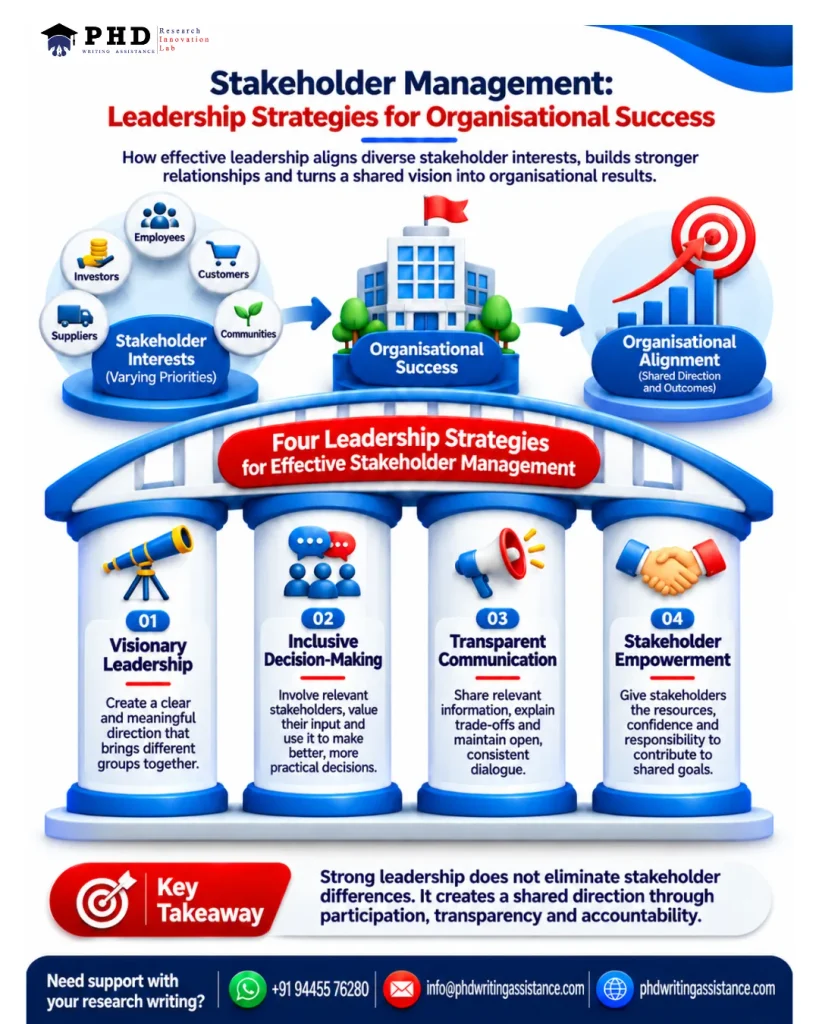
Stakeholders may include employees, customers, investors, suppliers and communities affected by an organisation’s decisions. The challenge for leadership is not to make every interest identical, but to create constructive relationships and make decisions that are understandable, fair and consistent with strategic objectives. This article critically examines four leadership strategies visionary leadership, inclusive decision-making, transparent communication and stakeholder empowerment using examples from Tesla, IBM, Starbucks and Unilever.
Understanding Stakeholder Management and Organisational Alignment
Stakeholder management involves identifying relevant groups, understanding their expectations and considering how organisational decisions affect them. Stakeholder Theory provides an important foundation: businesses operate within relationships involving multiple parties, rather than serving shareholders in isolation. Alignment occurs when leaders develop sufficient agreement about priorities, responsibilities and intended outcomes for these groups to work towards common objectives.
Alignment does not mean eliminating disagreement. An investor may prioritise financial returns, while employees seek fair working conditions and communities expect responsible environmental practices. Leaders must recognise such tensions and explain the reasoning behind trade-offs. Research on organisational culture and leadership development emphasises the importance of strategic alignment, feedback and learning in building resilient organisations (Idowu et al., 2024).
Leadership Strategies for Aligning Stakeholder Goals
Visionary Leadership: Giving Different Groups a Shared Direction
Visionary leadership begins with a clear explanation of what an organisation hopes to achieve and why it matters. A useful vision should connect everyday decisions with a longer-term purpose, while allowing stakeholders to understand their contribution. Repeating a slogan is not enough; leaders must demonstrate how investment, operational priorities and workplace behaviour support that stated direction.
Tesla offers an illustration. Its stated mission of accelerating the transition to sustainable energy helped frame its vehicle and energy activities around a recognisable purpose (Tesla, 2021). Employees, customers and investors could interpret their relationship with the business through that mission, even when their immediate priorities differed. The example shows how an overarching goal can communicate strategic direction, but it does not establish that every stakeholder was satisfied or that the vision alone produced commercial success.
For other organisations, the lesson is to make the vision specific enough to guide decisions and flexible enough to accommodate legitimate stakeholder concerns. Leaders also need to acknowledge when short-term actions appear inconsistent with long-term commitments.
Inclusive Decision-Making: Turning Participation Into Better Choices
Stakeholders are more likely to understand a decision when they have meaningful opportunities to contribute before it is finalised. Inclusive decision-making can reveal practical constraints, identify overlooked needs and create a stronger sense of ownership. However, consultation must have a clear purpose; inviting feedback without considering it can damage trust rather than strengthen alignment.
IBM provides an example through its co-creation approach, reflected in the IBM Garage method. Its collaborative processes bring together clients and specialists to explore problems, test ideas and develop solutions (IBM, n.d.). The approach illustrates how participation can help connect technological development with user needs. It should not, however, be treated as proof that any particular IBM product succeeded solely because of co-creation.
Leaders can apply the principle by seeking input from affected groups early, explaining the limits of their influence and reporting how feedback changed the final decision. Where interests conflict, the decision-making criteria should be explicit.
Transparent Communication: Building Trust Through Clarity
Good stakeholder communication requires more than regular announcements. Leaders need to provide relevant information, acknowledge uncertainty and communicate the reasons for decisions in language that different groups can understand. Transparency enables stakeholders to assess whether organisational actions reflect stated values, while consistent communication helps prevent rumours and unrealistic expectations.
Starbucks illustrates this approach through public reporting on sourcing, communities and environmental responsibilities. Its 2022 Global Environmental and Social Impact Report describes commitments, progress and areas requiring further work (Starbucks, 2023). Such reporting provides information stakeholders can scrutinise, although publication alone does not demonstrate complete accountability or universal stakeholder approval.
Effective communication also involves listening. Employees may raise concerns that formal reports miss, while suppliers and local communities may experience consequences differently from senior management. Leaders should therefore combine published information with accessible channels for questions, responses and corrective action.
Stakeholder Empowerment: Sharing Responsibility for Outcomes
Stakeholder empowerment means giving people the information, capabilities and appropriate authority to contribute to organisational objectives. Training, resources and participation in implementation can turn broad commitments into practical responsibilities. Empowerment is limited when individuals are held accountable for outcomes but lack the means to influence them.
Unilever’s Sustainable Living Plan, launched in 2010 and pursued through 2020, provides a historical example. It linked business activities with environmental and social objectives, including commitments affecting suppliers and livelihoods (Unilever, n.d.). The initiative shows how sustainability goals can be translated into expectations across an organisation and its supply chain. Its specific achievements and limitations should be assessed separately; the original plan should not be described as a current programme.
This example also highlights the need for shared accountability. Leaders should explain who is responsible for each commitment, provide appropriate support and review whether measures are producing meaningful changes.
Challenges in Stakeholder Alignment
Even carefully designed strategies face resistance. Stakeholders may have unequal influence, different information or competing priorities. A proposed cost reduction, for instance, might satisfy investors while creating concern among employees or suppliers. Leaders cannot resolve every disagreement through communication alone; some decisions require genuine negotiation and difficult compromises.
Organisational culture also matters. Research by Osobajo et al. (2023) highlights the influence of cultural differences on stakeholder engagement within multinational project environments. Practices that encourage participation in one setting may be less effective in another unless leaders account for local expectations and power relationships.
Resistance to change can arise when people fear losing responsibilities, resources or established ways of working. Addressing it requires early consultation, honest explanations and opportunities to question assumptions. A strategic leadership program may help managers develop skills in stakeholder analysis, conflict resolution and inclusive decision-making, but training must be supported by policies and behaviour across the organisation.
From Leadership Vision to Organisational Success
Successful alignment should be evaluated through observable practices rather than statements of intent. Leaders can examine whether stakeholders understand priorities, whether concerns receive responses and whether commitments lead to measurable action. Depending on the organisation, relevant indicators might include employee feedback, supplier participation, customer complaints or progress against sustainability objectives.
These measures should not be interpreted in isolation. High engagement does not guarantee agreement, and short-term performance may conceal longer-term risks. The central task of stakeholder management is to keep organisational direction and stakeholder relationships under continuous review, adjusting decisions when evidence or circumstances change.
How PhD Writing Assistance Supports Management Research
Research into leadership and stakeholder relationships often requires careful use of theory, organisational evidence and critical analysis. PhD Writing Assistance (PWA) offers guidance with literature reviews, research methodology and academic editing to help management researchers organise arguments and present their own findings clearly. Academic support should strengthen the researcher’s work while preserving responsibility for its interpretation and conclusions.
Conclusion
Effective leadership connects vision with the people whose decisions, resources and expectations influence organisational outcomes. Visionary leadership provides direction, inclusive decision-making improves participation, transparent communication supports trust and empowerment creates opportunities for shared responsibility. Tesla, IBM, Starbucks and Unilever illustrate different aspects of these approaches, but none offers a universal formula. Sustainable organisational success depends on acknowledging competing interests, evaluating outcomes and maintaining credible relationships over time.
References
- IBM. (n.d.). IBM Garage. https://www.ibm.com/garage
- Idowu, S. A., Al Hamad, N. M., Adewusi, O. E., Unachukwu, C. C., Osawaru, B., Onyebuchi, C. N., Omolawal, S. A., Aliu, A. O., & David, I. O. (2024). Organizational culture and leadership development: A human resources review of trends and best practices. Magna Scientia Advanced Research and Reviews, 10(1), 243–255. https://doi.org/10.30574/msarr.2024.10.1.0025
- Osobajo, O. A., Oke, A., Ajimmy, M., Otitoju, A., & Adeyanju, G. C. (2023). The role of culture in stakeholder engagement: Its implication for open innovation. Journal of Open Innovation: Technology, Market, and Complexity, 9(2), 100058. https://doi.org/10.1016/j.joitmc.2023.100058
- Starbucks. (2023). 2022 Global Environmental and Social Impact Report. https://stories.starbucks.com/uploads/2023/06/Starbucks-2022-Global-Environmental-and-Social-Impact-Report.pdf
- Tesla. (2021). Tesla 2021 Impact Report. https://www.tesla.com/ns_videos/2021-tesla-impact-report.pdf
- Unilever. (n.d.). Our history: 2010–2020. https://www.unilever.com/our-company/our-history-and-archives/2010-2020/
Frequently Asked Questions
1. What is stakeholder management in leadership?
It is the process of identifying stakeholders, understanding their interests and considering those interests when making and implementing organisational decisions.
2. How can leaders align stakeholder goals with organisational objectives?
Leaders can clarify shared priorities, consult affected groups, explain trade-offs and assign responsibilities that support agreed objectives.
3. How does visionary leadership support stakeholder alignment?
A clear vision gives different stakeholder groups a common direction and helps connect day-to-day activities with long-term organisational aims.
4. Why is stakeholder communication important for organisational success?
Clear, two-way communication builds understanding, reveals concerns early and helps stakeholders assess whether decisions match stated commitments.
5. What challenges do leaders face in managing conflicting stakeholder interests?
Common challenges include unequal power, competing priorities, cultural differences and resistance to change. Leaders need consultation, negotiation and transparent decision-making.