Introduction
AI in healthcare is transforming how medical services are delivered by improving accuracy, efficiency, and patient outcomes. The field of healthcare is undergoing rapid transformation, driven by technological advancements, personalised approaches, and an increasing emphasis on patient-centred care.
With the rise of digital health innovations, telemedicine benefits, and developments in artificial intelligence in healthcare, modern medicine is becoming more accessible and tailored to individual needs. These advancements are reshaping how patients interact with healthcare providers and how treatments are delivered.
Digital Health Innovations in Healthcare
Digital health innovations are redefining healthcare by improving accessibility, efficiency, and patient engagement.
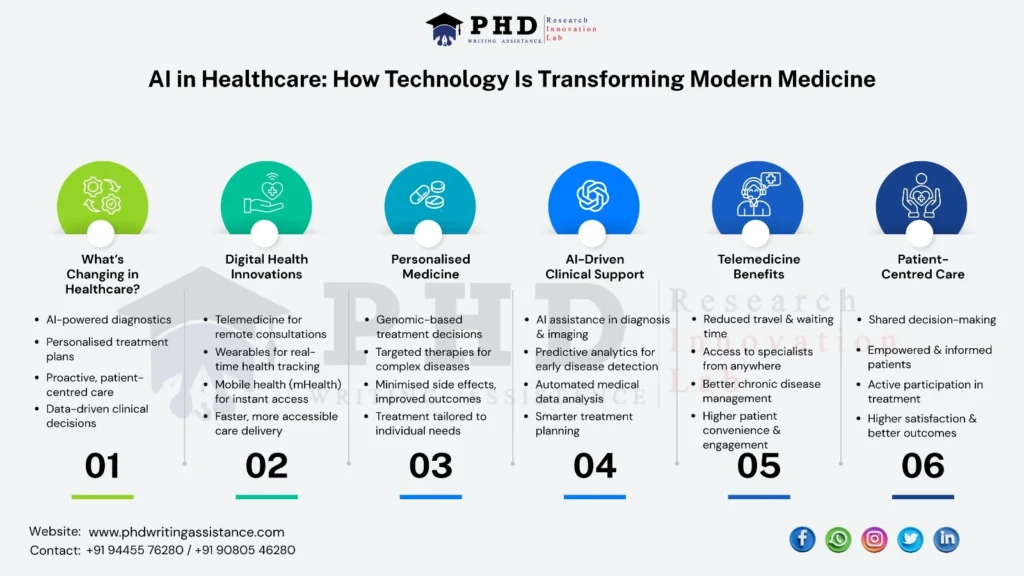
Technologies such as telemedicine, wearable devices, and mobile health applications (mHealth) are among the most impactful developments. Telemedicine benefits include enabling patients to consult healthcare professionals remotely, which is particularly valuable for individuals in rural or underserved areas. It reduces the need for in-person visits and minimises waiting times in healthcare facilities.
Wearable devices, including fitness trackers and smartwatches, allow individuals to monitor vital health metrics in real time. This data provides valuable insights for both patients and healthcare providers, encouraging proactive health management and early intervention in chronic conditions.
Advances in Personalised Medicine
Personalised medicine represents a significant shift from traditional one-size-fits-all approaches to healthcare.
This approach focuses on tailoring treatments based on an individual’s genetic, environmental, and lifestyle factors. In modern medicine, genomic data plays a crucial role in guiding treatment decisions, particularly in areas such as oncology.
Targeted therapies can address specific genetic mutations, improving treatment effectiveness while reducing harm to healthy cells. This advancement enhances outcomes for complex conditions such as cancer, diabetes, and cardiovascular diseases.
The Role of AI in Healthcare
Artificial intelligence in healthcare is becoming a critical tool in diagnostics, treatment planning, and predictive analysis.
AI-driven systems analyse large volumes of medical data, including imaging, patient records, and genetic information. This allows healthcare professionals to make more accurate and timely decisions.
For example, AI in healthcare is widely used in radiology and pathology to identify patterns that may not be easily detected by the human eye. Additionally, predictive analytics can help identify potential health risks and disease outbreaks, enabling early intervention and preventive care.
Telemedicine Benefits for Modern Healthcare
Telemedicine benefits both patients and healthcare providers by improving efficiency and accessibility.
Key advantages include:
- Reduced travel and waiting times
- Improved access to specialists
- Better management of chronic diseases
- Increased convenience for patientshttps://phdwritingassistance.com/
These benefits make telemedicine an essential component of modern healthcare systems.
Patient-Centred Care and Empowerment
Patient-centred care focuses on placing individuals at the core of healthcare decision-making.
This model encourages:
- Shared decision-making between patients and providers
- Increased patient education
- Greater involvement in treatment planning
Patients who actively participate in their care often experience improved outcomes and higher satisfaction levels. This approach fosters a more collaborative and supportive healthcare environment.
Conclusion
The integration of AI in healthcare, digital health innovations, and telemedicine benefits is transforming modern medicine into a more efficient and patient-focused system.
These advancements are not only improving healthcare delivery but also creating valuable opportunities for academic research. For students working on healthcare topics, accessing healthcare dissertation help UK can further support the development of high-quality research and writing.
Frequently Asked Questions
1. What is AI in healthcare?
AI in healthcare refers to the use of artificial intelligence technologies to analyse medical data, improve diagnostics, and support clinical decision-making.
2. How does artificial intelligence in healthcare improve patient care?
Artificial intelligence in healthcare improves patient care by increasing diagnostic accuracy, enabling early disease detection, and supporting more effective treatment planning.
3. What are digital health innovations?
Digital health innovations include technologies such as telemedicine, wearable devices, and mobile health applications that enhance healthcare accessibility and efficiency.
4. What are the telemedicine benefits?
Telemedicine benefits include improved access to healthcare services, reduced waiting times, and better management of chronic conditions.
5. Where can I get healthcare dissertation help in the UK?
Students can access healthcare dissertation help UK through professional academic writing services that provide support with research, writing, and editing.
References
1. Shan, R., Sarkar, S., & Martin, S. S. (2019). Digital health technology and mobile devices for the management of diabetes mellitus: state of the art. Diabetologia, 62(6), 877-887. https://doi.org/10.1007/s00125-019-4864-7 [Telemedicine, wearable devices, mobile health applications]
2. Seyhan, A. A., & Carini, C. (2019). Are innovation and new technologies in precision medicine paving a new era in patients centric care?. Journal of translational medicine, 17(1), 114. https://doi.org/10.1186/s12967-019-1864-9 [one-size-fits-all model]
3. Udegbe, F. C., Ebulue, O. R., Ebulue, C. C., & Ekesiobi, C. S. (2024). Precision Medicine and Genomics: A comprehensive review of IT-enabled approaches. International Medical Science Research Journal, 4(4), 509-520. https://doi.org/10.51594/imsrj.v4i4.1053 [genomic medicine]
4. Briganti, G., & Le Moine, O. (2020). Artificial intelligence in medicine: today and tomorrow. Frontiers in medicine, 7, 509744. https://doi.org/10.3389/fmed.2020.00027 [Artificial Intelligence]
5. Lee, M., Song, Y., You, M., Park, S. Y., & Ihm, J. (2023). Dentists’ attitudes toward patient-centered care and its predictors: a cross-sectional study in South Korea. BMC Oral Health, 23(1), 75. https://doi.org/10.1186/s12903-023-02791-9 [patient-centered model]
If you are working on a healthcare-related thesis or research project, expert guidance can significantly improve your results.
Get professional healthcare dissertation help UK and PhD writing assistance tailored to your needs.
https://phdwritingassistance.com/contact-us/