Introduction
Breast cancer remains one of the most prevalent cancers globally and continues to affect millions of women each year. Although improvements in early detection and treatment have contributed to better survival outcomes, breast cancer remains a complex and heterogeneous disease that requires continuous research and innovation. Recent developments have shifted breast cancer treatment towards more precise, personalised, and targeted approaches designed to improve outcomes while reducing unnecessary effects on healthy tissue.
Advances in targeted therapies, breast cancer immunotherapy, personalised medicine, genomic testing, and radiation therapy are changing how different breast cancer subtypes are managed. These developments are particularly important for cancers with limited treatment options, including triple-negative breast cancer (TNBC). At the same time, emerging approaches such as the breast cancer vaccine, liquid biopsy, and next-generation targeted therapies are being investigated as potential future strategies.
This critical review examines recent developments in breast cancer treatment, focusing on targeted therapies, immunotherapy, personalised medicine, and radiation therapy. It also considers current limitations and emerging directions within breast cancer research.
Recent Advances in Breast Cancer Treatment
Modern breast cancer treatment increasingly focuses on selecting therapies according to tumour characteristics rather than applying the same treatment strategy to every patient. This shift has been supported by advances in molecular diagnostics, genomic profiling, targeted therapies, and immune-based treatments.
The major areas of recent development include:
- Targeted therapies
- Immunotherapy
- Personalised medicine
- Genomic testing
- Cancer vaccines
- Liquid biopsy
- Advanced radiation therapy
Each approach offers potential benefits, but important limitations remain and require continued investigation.
Targeted Therapy in Breast Cancer
Targeted therapy breast cancer approaches focus on specific molecules or biological pathways involved in tumour growth and progression. Unlike conventional chemotherapy, which can affect both cancerous and healthy cells, targeted therapies are designed to act more selectively on cancer-related targets. This approach may reduce damage to normal tissue and potentially limit certain treatment-related side effects.
HER2-Positive Breast Cancer
HER2-positive breast cancer is characterised by overexpression of the HER2 protein. Significant progress has been made in treating this subtype through therapies directed at the HER2 pathway.
Agents including trastuzumab, pertuzumab, and T-DM1 have demonstrated benefits in improving survival and reducing recurrence. Research cited in the original review also describes improved overall survival associated with combinations of pertuzumab and trastuzumab in HER2-positive breast cancer.
However, resistance to HER2-targeted treatments remains an important challenge. Consequently, ongoing breast cancer research is investigating new treatment combinations and next-generation inhibitors to overcome resistance and improve long-term outcomes.
Hormone Receptor-Positive Breast Cancer
Hormone receptor-positive breast cancers can be treated using therapies directed towards estrogen and progesterone receptor pathways. Tamoxifen and aromatase inhibitors have traditionally played important roles in treatment.
More recently, CDK4/6 inhibitors such as palbociclib and ribociclib have expanded treatment options. Research indicates that combining CDK4/6 inhibitors with endocrine therapy can improve progression-free survival in patients with advanced hormone receptor-positive breast cancer. However, adverse effects, including neutropenia and gastrointestinal problems, require appropriate monitoring.
Breast Cancer Immunotherapy
Breast cancer immunotherapy has become an important area of research, particularly for triple-negative breast cancer. Immunotherapy works by enhancing the body’s immune response against cancer cells.
Triple-negative breast cancer presents particular treatment challenges because it lacks the hormone receptors and HER2 target used in several other breast cancer therapies.
Immune Checkpoint Inhibitors
Immune checkpoint inhibitors such as pembrolizumab and atezolizumab have demonstrated potential in treating TNBC. These therapies work by blocking proteins that suppress immune responses, allowing immune cells to attack cancer cells more effectively.
The original review notes encouraging findings from studies of checkpoint inhibitors in TNBC, including research involving atezolizumab combined with chemotherapy. However, response rates remain variable, highlighting the importance of identifying predictive biomarkers that can determine which patients are most likely to benefit.
Therefore, the future development of breast cancer immunotherapy depends not only on discovering new immune-based treatments but also on improving patient selection and understanding mechanisms of treatment response and resistance.
Breast Cancer Vaccine Research
The breast cancer vaccine is an emerging area of investigation within cancer immunotherapy. Researchers are exploring vaccines designed to stimulate the immune system to recognise and attack breast cancer cells.
The original review identifies cancer vaccines as an innovative but still developing strategy. Early-stage trials are investigating whether personalised cancer vaccines could provide additional treatment opportunities, particularly for aggressive or recurrent breast cancers.
Unlike established treatment approaches, vaccine-based strategies remain an emerging field. Further clinical research is required to determine their effectiveness, appropriate patient populations, long-term safety, and potential role alongside existing treatments.
The development of personalised vaccines could eventually become an important component of precision-based breast cancer treatment, although additional evidence is needed before their broader clinical application.
Personalised Medicine in Breast Cancer Treatment
Personalised medicine, also referred to as precision medicine, aims to match treatment decisions with the biological characteristics of an individual’s cancer.
Breast cancer is highly heterogeneous, meaning that tumours can differ substantially in their molecular characteristics and responses to treatment. Advances in genomic profiling and molecular diagnostics have therefore become increasingly important for treatment selection.
Genomic Testing and Biomarkers
Genomic testing can help identify characteristics of tumour cells that influence treatment decisions. Tests such as Oncotype DX and MammaPrint assess gene expression and can help estimate recurrence risk and potential benefit from chemotherapy.
The original review highlights evidence suggesting that Oncotype DX can identify some patients who may avoid chemotherapy without compromising their prognosis. Such approaches may reduce unnecessary exposure to chemotherapy-related toxicity while supporting more individualised treatment decisions.
Liquid Biopsy
Liquid biopsy is another developing area of breast cancer research. It involves detecting circulating tumour DNA and other biomarkers in blood samples.
Because liquid biopsy is minimally invasive, it may provide opportunities for monitoring tumour progression, detecting recurrence, and understanding changes in tumour biology over time.
However, the technology remains under development. Questions concerning sensitivity, specificity, validation, and clinical implementation require further research before its full potential can be established.
Advances in Radiation Therapy
Radiation therapy remains an important component of breast cancer treatment, particularly for early-stage disease and post-surgical management. Recent advances aim to improve treatment precision, reduce unnecessary exposure to healthy tissues, and shorten treatment duration.
Hypofractionated Radiation Therapy
Hypofractionated radiation therapy delivers higher doses of radiation over fewer treatment sessions compared with conventional schedules.
The original review reports that hypofractionated approaches have demonstrated comparable efficacy while reducing treatment duration. A cited meta-analysis supports their use for early-stage breast cancer, with potential benefits in convenience and quality of life without compromising treatment outcomes.
Proton Therapy
Proton therapy uses protons rather than conventional X-rays to deliver radiation. Its physical properties allow treatment to be targeted more precisely, potentially reducing radiation exposure to surrounding healthy tissues.
Research has suggested that proton therapy may reduce some long-term cardiac and pulmonary complications associated with radiation. However, its high cost and limited availability remain significant barriers to widespread use, and additional research is needed to establish its advantages compared with conventional radiation approaches.
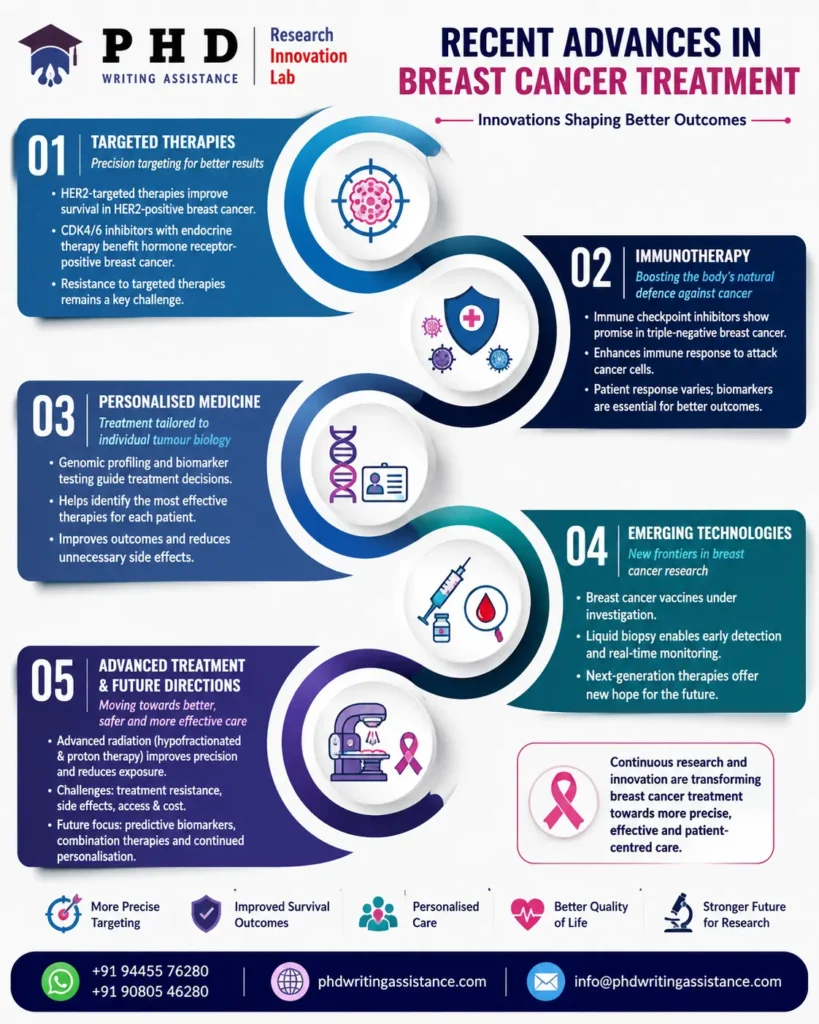
Key Challenges in Breast Cancer Research
Despite substantial progress, several challenges remain within breast cancer research.
Treatment Resistance
Resistance to targeted therapies can limit their long-term effectiveness, particularly in HER2-positive disease.
Variable Immunotherapy Response
Not all patients respond to immunotherapy. Identifying reliable biomarkers for predicting response remains an important research priority.
Treatment-Related Side Effects
Even advanced therapies can produce adverse effects. Balancing treatment effectiveness with patient quality of life remains essential.
Limited Access to Advanced Therapies
Technologies such as proton therapy may be restricted by cost and availability, creating challenges for broader clinical implementation.
Need for Further Evidence
Emerging approaches such as the breast cancer vaccine and liquid biopsy require additional clinical evidence before their full potential can be established.
Future Directions in Breast Cancer Treatment
The future of breast cancer treatment is likely to involve increasingly personalised approaches that combine molecular information, targeted therapies, immune-based strategies, and advanced diagnostic technologies.
Research is continuing into next-generation targeted therapies, predictive biomarkers, personalised cancer vaccines, genomic testing, liquid biopsy, and advanced radiation techniques. The original review also identifies future possibilities involving gene therapy and personalised vaccines.
The combination of different treatment approaches may also become increasingly important. Rather than relying on a single therapy, future strategies may use combinations selected according to tumour biology and individual patient characteristics.
However, continued clinical research is essential to establish the safety, effectiveness, cost-effectiveness, and appropriate clinical application of emerging technologies.
Conclusion
Recent developments have significantly expanded the possibilities available for breast cancer treatment. Targeted therapies have improved treatment options for molecularly defined subtypes such as HER2-positive and hormone receptor-positive breast cancer, while breast cancer immunotherapy has created new opportunities for patients with triple-negative disease.
Personalised medicine and genomic testing are supporting more individualised treatment decisions, while liquid biopsy represents a promising approach for monitoring tumour dynamics. Advances in radiation therapy, including hypofractionated schedules and proton therapy, are also contributing to more efficient and precise treatment strategies.
At the same time, emerging approaches such as the breast cancer vaccine remain under investigation. Resistance, variable treatment responses, side effects, cost, and limited access continue to present challenges. Continued breast cancer research is therefore essential for validating emerging therapies and translating scientific advances into effective clinical applications.
For researchers preparing manuscripts, literature reviews, dissertations, or journal submissions in this field, careful academic writing, accurate referencing, technical editing, and appropriate presentation of research findings are essential for maintaining scientific clarity and credibility.
References
Ginsburg, O., Yip, C. H., Brooks, A., Cabanes, A., Caleffi, M., Dunstan Yataco, J. A., … & Anderson, B. O. (2020). Breast cancer early detection: A phased approach to implementation. Cancer, 126, 2379-2393. https://doi.org/10.1002/cncr.32887 (Breast cancer, detection)
Patel, A., Unni, N., & Peng, Y. (2020). The changing paradigm for the treatment of HER2-positive breast cancer. Cancers, 12(8), 2081. https://doi.org/10.3390/cancers12082081 (breast cancer patients).
Watt, A. C., & Goel, S. (2022). Cellular mechanisms underlying response and resistance to CDK4/6 inhibitors in the treatment of hormone receptor-positive breast cancer. Breast Cancer Research, 24(1), 17. https://doi.org/10.1186/s13058-022-01510-6 (receptor-positive breast cancers)
Zagami, P., & Carey, L. A. (2022). Triple negative breast cancer: Pitfalls and progress. NPJ breast cancer, 8(1), 95. https://doi.org/10.1038/s41523-022-00468-0 (immune response, TNBC patients)
Iwamoto, T., Kajiwara, Y., Zhu, Y., & Iha, S. (2020). Biomarkers of neoadjuvant/adjuvant chemotherapy for breast cancer. Chinese clinical oncology, 9(3), 27-27. https://doi.org/10.21037/cco.2020.01.06 (tumor cells, chemotherapy)
Bradley, R., Braybrooke, J., Gray, R., Hills, R., Liu, Z., Peto, R., … & Swain, S. M. (2021). Trastuzumab for early-stage, HER2-positive breast cancer: a meta-analysis of 13 864 women in seven randomized trials. The Lancet Oncology, 22(8), 1139-1150. https://www.thelancet.com/pdfs/journals/lanonc/PIIS1470-2045(21)00288-6.pdf (meta-analysis, early-stage breast cancer)
Frequently Asked Questions
1. Why is breast cancer treatment research important?
Breast cancer treatment research is important because it helps develop more effective therapies, improve survival outcomes, reduce treatment-related effects, and support more personalised care.
2. What is targeted therapy in breast cancer treatment?
Targeted therapy uses medicines designed to act on specific molecules or pathways involved in cancer growth, helping reduce damage to healthy tissue compared with less selective treatments.
3. How does breast cancer immunotherapy work?
Breast cancer immunotherapy strengthens the body’s immune response against cancer cells. In triple-negative breast cancer, checkpoint inhibitors such as pembrolizumab have shown potential, although responses vary between patients.
4. What is the role of a breast cancer vaccine?
A breast cancer vaccine aims to train the immune system to recognise and attack breast cancer cells. Personalised cancer vaccines are being investigated, but this remains an emerging area requiring further clinical research.
5. How is personalised medicine improving breast cancer treatment?
Personalised medicine uses tumour characteristics, genomic testing, and biomarkers to help select treatments for individual patients and may identify patients who can avoid unnecessary chemotherapy.