Introduction
Every research paper, dissertation, thesis, or academic assignment is built upon existing knowledge. Researchers rely on books, journal articles, conference papers, government reports, and other scholarly sources to support their arguments and demonstrate the credibility of their work. However, using someone else’s ideas without proper acknowledgment can lead to plagiarism and reduce the academic integrity of your research. This is why understanding the citation meaning in research is essential for every student and researcher.
Many students ask what is citation in research and why universities place so much emphasis on referencing. Simply put, citations recognize the original authors whose work has contributed to your research. They also allow readers to verify information, explore additional sources, and understand the evidence supporting your findings. Whether you are preparing an undergraduate assignment or writing a doctoral dissertation, using accurate citation in research improves the quality, transparency, and credibility of your academic work.
Learning how to cite a research paper correctly is equally important. Different universities and journals require specific citation styles, such as APA, MLA, Harvard, Chicago, or IEEE, each with its own formatting rules. Following the correct style ensures consistency throughout your document and demonstrates attention to academic standards.
Beyond avoiding plagiarism, there are several reasons for referencing in research. References strengthen arguments, acknowledge intellectual contributions, support factual claims, and enable readers to locate the original sources. Similarly, understanding quoting in thesis writing helps researchers incorporate direct quotations appropriately while maintaining originality through paraphrasing and critical analysis.
This comprehensive guide explains the citation meaning in research, discusses the importance of citations, explores various citation methods, and provides practical guidance on referencing and quoting. By mastering these essential academic skills, researchers can produce credible, ethical, and professionally written research that meets university and publication standards.
Understanding the Citation Meaning in Research
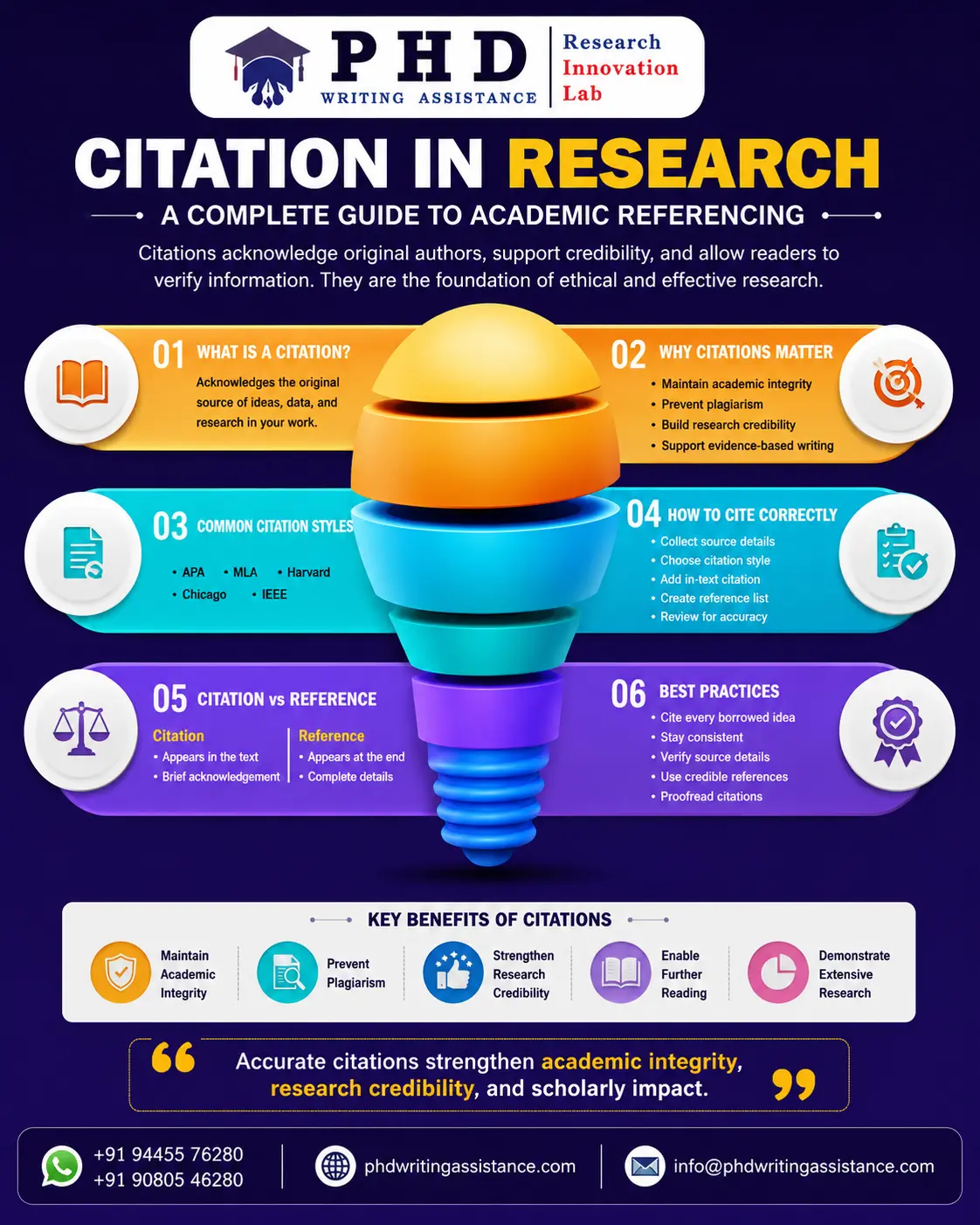
The citation meaning in research refers to the practice of acknowledging the original source of information, ideas, theories, statistics, or findings used in academic writing. A citation provides readers with enough information to identify and locate the original publication.
Citations serve as evidence that your research is supported by credible academic sources rather than personal opinions. They demonstrate that you have reviewed existing literature and built your research upon established knowledge.
Every citation generally includes information such as:
- Author’s name
- Publication year
- Title of the source
- Publisher or journal
- Volume and issue number (if applicable)
- Page numbers
- DOI or URL (when required)
Although citation formats vary across referencing styles, their purpose remains the same: to give proper credit to the original author.
What Is Citation in Research?
Many students wonder what is citation in research and how it differs from referencing.
A citation is a brief acknowledgment placed within the text whenever you use someone else’s work. It directs readers to the complete publication details listed in the reference list or bibliography at the end of the document.
For example, if you summarize findings from a journal article, you include an in-text citation that identifies the original author.
This simple practice demonstrates academic honesty while allowing readers to verify the source independently.
In academic writing, citations may appear when:
- Quoting directly from a source
- Paraphrasing an author’s ideas
- Summarizing previous research
- Referring to statistical data
- Presenting theories or models
- Using figures or tables created by others
Without proper citations, research loses credibility and may violate academic integrity policies.
Why Is Citation in Research Important?
Proper citation in research is one of the foundations of scholarly communication. It benefits both researchers and readers in several important ways.
Maintains Academic Integrity
Citations acknowledge the intellectual contributions of other researchers.
Giving proper credit demonstrates ethical research practices and helps maintain trust within the academic community.
Prevents Plagiarism
Plagiarism occurs when someone presents another person’s work as their own.
Accurate citations clearly distinguish original ideas from borrowed information, reducing the risk of accidental plagiarism.
Strengthens Research Credibility
Supporting your arguments with reliable academic sources increases the credibility of your research.
Readers are more likely to trust conclusions supported by peer-reviewed evidence.
Allows Readers to Verify Information
Citations enable readers to locate the original studies used in your research.
This promotes transparency and encourages further academic exploration.
Demonstrates Extensive Research
A well-cited research paper shows that you have consulted relevant scholarly literature before developing your conclusions.
This reflects academic maturity and strengthens the overall quality of your work.
Common Reasons for Referencing
There are several important reasons for referencing throughout academic writing.
Acknowledge Original Authors
Every researcher deserves recognition for their intellectual contributions.
Referencing ensures that original authors receive appropriate academic credit.
Support Academic Arguments
Evidence from credible sources strengthens your discussion and supports your interpretations.
Arguments backed by published research are generally considered more reliable than unsupported opinions.
Enable Further Reading
Readers often wish to explore topics in greater depth.
References provide a pathway to additional scholarly resources related to your research.
Maintain Academic Ethics
Universities and journals expect researchers to follow ethical writing practices.
Proper referencing demonstrates honesty, transparency, and respect for intellectual property.
Improve Research Quality
Well-referenced papers reflect thorough literature reviews and careful academic investigation.
This enhances both the credibility and professionalism of your research.
How to Cite a Research Paper Correctly
Knowing how to cite a research paper is an essential academic skill. A citation acknowledges the original author’s contribution while allowing readers to locate the source for further study.
Although citation formats vary depending on the required style guide, the process generally follows the same steps.
1. Identify the Required Citation Style
Before citing any source, confirm which referencing style your university or journal requires. The most commonly used citation styles include:
- APA (American Psychological Association)
- MLA (Modern Language Association)
- Harvard Referencing
- Chicago Style
- IEEE Style
Each style has its own rules for in-text citations and reference lists.
2. Collect Complete Source Information
Before writing your citation, record all necessary publication details, including:
- Author name(s)
- Publication year
- Title of the article or book
- Journal or publisher
- Volume and issue number
- Page numbers
- DOI or URL (if applicable)
Having complete information makes it easier to create accurate citations.
3. Use In-Text Citations Appropriately
Every time you refer to another author’s ideas, include an in-text citation. This applies whether you are:
- Quoting directly
- Paraphrasing
- Summarizing
- Discussing previous research
Consistent in-text citations improve transparency and reduce the risk of plagiarism.
4. Include a Complete Reference List
Every in-text citation should correspond to a full reference at the end of your research paper.
Before submission, verify that all cited sources appear in the reference list and that no uncited references have been included.
Understanding Quoting in Thesis Writing
Quoting in thesis writing means using the exact words of another author within your dissertation or thesis while providing proper citation.
Direct quotations are useful when:
- The original wording is especially important.
- A definition must remain unchanged.
- A well-known statement supports your discussion.
- You are analysing a specific passage.
However, excessive quoting should be avoided.
Universities generally encourage researchers to demonstrate critical thinking by paraphrasing, analysing, and synthesising information rather than relying heavily on direct quotations.
A balanced approach strengthens academic writing while maintaining originality.
Common Citation Mistakes to Avoid
Even experienced researchers occasionally make citation errors. Being aware of these common mistakes can improve the quality of your academic writing.
Missing Citations
Using another author’s ideas without citation even unintentionally can be considered plagiarism.
Always cite the source whenever you use external information.
Inconsistent Citation Style
Switching between APA, Harvard, MLA, or other referencing styles creates inconsistency.
Use the same citation style throughout your document unless your institution instructs otherwise.
Incorrect Reference Details
Incomplete author names, incorrect publication years, or missing page numbers reduce the accuracy of your references.
Always verify your citations before submission.
Overusing Direct Quotations
While quoting in thesis writing has its place, relying too heavily on direct quotes may weaken your own academic voice.
Instead, paraphrase and critically discuss existing research wherever appropriate.
Forgetting the Reference List
Every in-text citation should have a corresponding entry in the reference list or bibliography.
Cross-check your document to ensure consistency.
Best Practices for Academic Referencing
Following good referencing practices improves both the quality and credibility of your research.
Some recommended practices include:
- Keep a record of every source you consult.
- Use the citation style required by your institution.
- Cite all borrowed ideas, data, images, and quotations.
- Double-check every reference before submission.
- Use reference management software if appropriate.
- Proofread your citations for formatting consistency.
- Update references if newer editions or publications are used.
Developing these habits will save time and reduce errors during the final stages of your research.
Citation vs Reference: What Is the Difference?
Students often confuse citations with references, but they serve different purposes.
A citation is the brief acknowledgment included within the main text whenever another source is used.
A reference provides the complete publication details at the end of the document, allowing readers to locate the original source.
In simple terms:
- Citation = appears within the text.
- Reference = appears in the reference list or bibliography.
Understanding this distinction helps researchers apply academic referencing correctly.
Benefits of Accurate Referencing in Research
Using accurate citations and references offers several long-term academic benefits.
It:
- Enhances research credibility.
- Demonstrates academic integrity.
- Strengthens evidence-based arguments.
- Helps readers locate supporting sources.
- Prevents plagiarism.
- Improves publication readiness.
- Builds trust among supervisors, reviewers, and journal editors.
Proper referencing is not simply a formatting requirement it is a fundamental component of responsible academic research.
Conclusion
Understanding the citation meaning in research is essential for producing credible, ethical, and academically sound research. Whether you are learning what is citation in research, exploring the importance of citation in research, understanding the reasons for referencing, mastering how to cite a research paper, or applying appropriate quoting in thesis practices, accurate citation plays a vital role in every stage of academic writing.
By acknowledging original authors, supporting your arguments with reliable evidence, and following the correct referencing style, you demonstrate academic integrity and strengthen the overall quality of your work. Consistent and accurate citations not only help prevent plagiarism but also allow readers to verify your sources and explore your research in greater depth.
Developing strong citation and referencing skills is an investment that benefits students, researchers, and scholars throughout their academic and professional careers.
Frequently Asked Questions
1. What is the meaning of citation in research?
A citation is an acknowledgment of the original source of information, ideas, or data used in academic writing. It gives credit to the original author and helps readers locate the source.
2. Why is citation important in research?
Citation is important because it prevents plagiarism, supports academic integrity, strengthens research credibility, and enables readers to verify the sources used in your study.
3. How do I cite a research paper correctly?
Use the citation style required by your university or journal, include accurate in-text citations, and provide complete source details in the reference list.
4. What are the main reasons for referencing?
The main reasons for referencing are to acknowledge original authors, support research arguments, maintain academic ethics, prevent plagiarism, and help readers locate the original sources.
5. When should I use quotations in a thesis?
Use quotations when the original wording is essential for your discussion, such as definitions or key statements. For most academic writing, paraphrasing and critical analysis are recommended over excessive direct quotations.