Introduction
A research abstract is often the first part of a paper that readers encounter, yet it is usually one of the last sections an author writes. In a small space, it must communicate the research problem, explain how the study was conducted and show what the findings contribute. Understanding how to write a research abstract is therefore important for students, doctoral researchers and authors preparing work for academic publication.
An effective abstract does not try to summarise every chapter or reproduce the introduction. It presents a clear, accurate account of the completed research so readers can decide whether the full study is relevant to them. This guide explains the essential format, the writing process and practical examples for different research approaches.
What Is a Research Abstract?
A research abstract is a concise, self-contained summary of a study. It usually identifies the research context and objective, describes the methodology, reports the principal findings and states the main conclusion. Readers should understand the study’s purpose and contribution without needing to consult the full manuscript first.
An academic research abstract also helps databases and journal readers identify relevant work. Its wording must reflect the actual study rather than promising results that the paper does not demonstrate. Although some journals request abstracts of around 150–300 words, the permitted length and headings depend on the journal, university or conference guidelines.
Understanding the Research Abstract Format
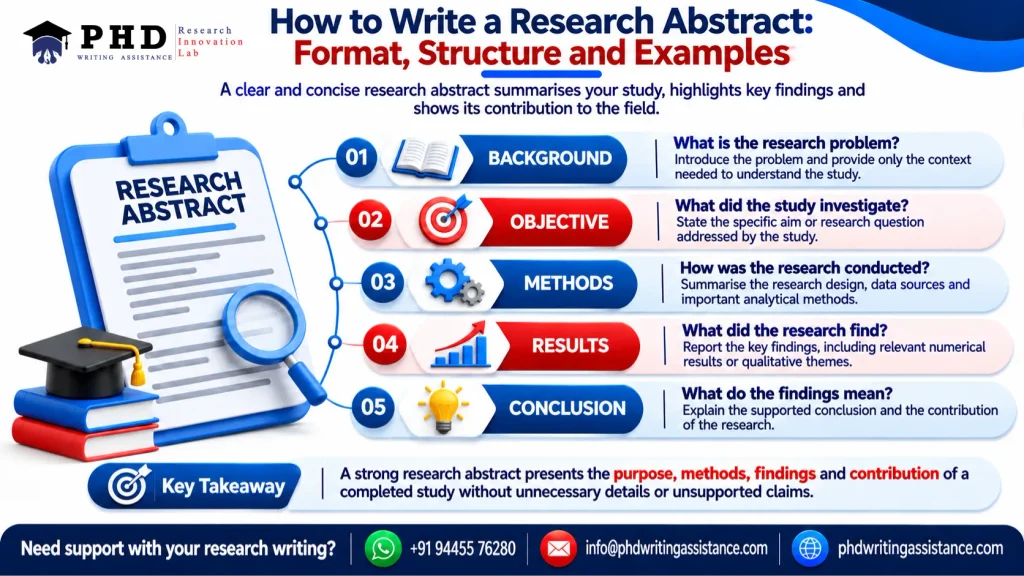
The appropriate research abstract format depends on the discipline and publication requirements. Many scientific and health journals use a structured abstract with labelled sections such as Background, Objective, Methods, Results and Conclusion. Other disciplines prefer a single connected paragraph, often called an unstructured abstract.
Both formats answer broadly similar questions: What problem was investigated? Why was it important? What was done? What was found? What does the finding mean? A structured format makes these elements visible through headings, while an unstructured version links them naturally in prose. Neither is automatically better; the correct choice is the one required by the intended publication or institution.
How to Write a Research Abstract Step by Step
Establish the Research Context
Begin with one or two sentences identifying the issue addressed by the study. Give only the background necessary for a reader to understand the research problem. General statements about the importance of a field can consume space without explaining what your particular investigation contributes.
For example, a study on digital learning might introduce a gap in understanding postgraduate students’ engagement with online feedback rather than begin with a broad history of educational technology.
State the Aim or Research Question
Next, explain precisely what the study set out to examine. A direct statement such as “This study investigated…” is often more useful than a vague declaration of interest. If the project tested a hypothesis or explored a specific experience, make that focus apparent.
The aim should match the question actually examined in the dissertation or article. Avoid introducing objectives that were not part of the completed research.
Summarise the Research Methodology
Describe how the study addressed its aim. The level of detail depends on the design, but readers generally need to know whether the approach was quantitative, qualitative, experimental, observational or review-based. Mention the setting, participants, data sources or analytical methods when they are central to understanding the results.
A concise methods sentence may identify a survey and regression analysis, or interviews analysed thematically. Detailed recruitment procedures, instrument descriptions and every statistical test belong in the main text unless a specific abstract format requires them.
Report the Main Findings
The results are the evidence at the centre of the abstract. Select findings that directly answer the stated research question, rather than listing every outcome. In quantitative research, include important numerical results when they are available and required, especially where a number is necessary to understand the effect. In qualitative work, identify the principal themes and their relationship to the research aim.
Do not replace actual results with statements such as “findings will be discussed”. A completed research abstract should report what the study found. Equally, avoid making stronger claims than the design supports; an observed association does not necessarily establish causation.
Explain the Conclusion and Contribution
End by stating the conclusion supported by the evidence and its significance. This may involve a theoretical insight, a practical implication or an area requiring further research. The conclusion must follow from the results, not introduce a new finding or an unsupported recommendation.
If the study has an important limitation that materially affects interpretation, acknowledge it briefly where the word limit permits. The abstract should leave readers with a realistic understanding of the research, not an exaggerated account of its impact.
Abstract Writing Examples for Different Research Designs
The following abstract writing examples are hypothetical illustrations of structure and wording. They are not accounts of published studies and should not be cited as research evidence.
Example 1: Quantitative Research Abstract
This illustrative study examined the relationship between feedback frequency and academic confidence among postgraduate students. An online questionnaire collected students’ reports of feedback experiences and confidence, and the responses were analysed for associations between the two measures. Students reporting more frequent feedback also tended to report greater academic confidence. However, the observational design could not establish whether feedback caused the difference. The findings suggest that feedback practices warrant further investigation alongside other influences on student confidence.
Notice how the example moves from purpose to method, finding and appropriately cautious conclusion. In a real manuscript, include verified sample details and numerical outcomes where required.
Example 2: Qualitative Research Abstract
This illustrative study explored doctoral researchers’ experiences of using digital tools to locate academic literature. Semi-structured interviews were analysed thematically to identify common experiences. Participants described faster access to publications alongside difficulties judging source relevance and reliability. The themes suggest that digital access and information-evaluation skills are distinct aspects of research practice. The findings highlight questions for future investigation into postgraduate information literacy.
Here, the result is expressed through themes rather than invented percentages. The interpretation remains connected to the participants’ reported experiences.
Dissertation Abstract Structure: What Changes?
A dissertation abstract structure usually follows the same broad sequence as a journal abstract: context, aim, methodology, findings and conclusion. However, a dissertation may involve several research questions, methods or substantial chapters. The challenge is to identify the central contribution without producing a miniature table of contents.
Write the abstract after completing the analysis and conclusion so the wording reflects the final dissertation. Refer to the university’s required length and formatting rules, and prioritise the overarching aim and most important results. A dissertation abstract should stand on its own, even when the reader has not yet seen the introduction or chapter summaries.
Common Abstract Writing Mistakes to Avoid
Many abstracts become unclear because they spend too long describing the background and too little space reporting results. Others use broad statements such as “significant findings were obtained” without explaining what was discovered. The solution is to give each essential element enough space while removing details that do not help the reader understand the study.
Avoid unexplained abbreviations, unnecessary citations, promotional language and conclusions that go beyond the evidence. Check that the objective, methods, results and conclusion tell one consistent story. Finally, read the abstract independently from the full paper: it should make sense without requiring the reader to resolve missing details elsewhere.
Academic Support for Research Abstract Writing
Preparing an abstract requires precision and familiarity with academic conventions. PhD Writing Assistance (PWA) provides research-writing guidance and academic editing support to help students and researchers improve clarity, organisation and consistency in their own manuscripts. Support with dissertation structure, methodology presentation and language refinement can make an abstract easier to follow while keeping responsibility for the research and its claims with the author.
Conclusion
Learning how to write a research abstract means learning to communicate a complete study accurately in limited space. Whether the required format is structured or unstructured, readers should be able to identify the research purpose, approach, principal findings and supported conclusion. Drafting the abstract after the main work is complete, then revising it against the submission guidelines, helps create a focused and credible summary.
Frequently Asked Questions
1. What is the standard research abstract format?
A common format covers background, objective, methods, results and conclusion. Journals and universities may require either labelled headings or one continuous paragraph, so always follow their instructions.
2. How many words should a research abstract contain?
Many academic outlets specify approximately 150–300 words, but limits vary. Use the exact word count required by your university, journal or conference rather than assuming a universal standard.
3. Should a research abstract include references?
Usually, abstracts do not include citations because they need to stand alone. Include references only when the relevant publication guidelines explicitly permit or require them.
4. When should I write my dissertation abstract?
Write it after completing the findings and conclusion. This helps ensure that the dissertation abstract accurately reflects the final aims, methods, results and contribution.
5. What makes a good academic research abstract?
A strong abstract is concise, specific and faithful to the completed study. It reports meaningful findings, uses clear language and avoids unsupported conclusions or unnecessary detail.