Introduction
Methods of data collection in research are systematic techniques used to gather information needed to answer research questions, test hypotheses, and achieve research objectives. The choice of method depends on the research design, type of data required, target population, available resources, and ethical requirements.
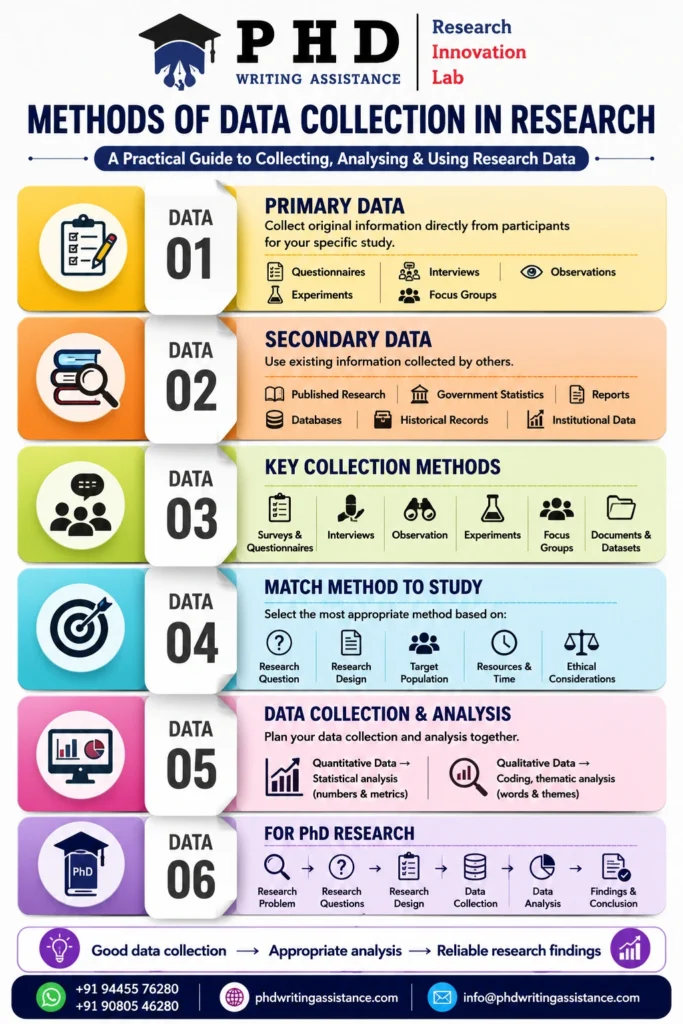
Common methods include surveys, questionnaires, interviews, observations, experiments, focus groups, and the use of existing documents or datasets. Researchers may collect primary data directly from participants or use secondary data that has already been collected by another source.
Selecting the right method is important because the quality and relevance of collected data directly influence the subsequent data analysis in research and the credibility of the final findings.
What Are Methods of Data Collection in Research?
The methods of data collection in research are the procedures researchers use to obtain evidence for a study.
The major methods include:
- Surveys and questionnaires
- Interviews
- Observation
- Experiments
- Focus groups
- Document and record analysis
- Existing datasets and databases
The method should be selected according to the research question rather than convenience alone. A quantitative study may require structured numerical data, whereas qualitative research may require detailed information about participants’ experiences, perceptions, or behaviours.
Primary and Secondary Data Collection
Primary Data
Primary data is collected directly by the researcher for a specific research project.
Examples include:
- Questionnaire responses
- Interview responses
- Experimental measurements
- Field observations
- Focus group discussions
The main advantage is that the researcher can design the collection process around the study objectives. However, primary data collection can require significant time, resources, participant recruitment, and ethical approval.
Secondary Data
Secondary data comes from information that already exists.
Examples include:
- Published research
- Government statistics
- Institutional reports
- Public databases
- Historical records
- Organisational datasets
Secondary data can reduce the time required for a study, but researchers should evaluate its relevance, reliability, completeness, and suitability before using it.
Main Methods of Data Collection
1. Surveys and Questionnaires
Surveys are commonly used to collect information from a relatively large number of participants using a standardised set of questions.
A research survey questionnaire may include:
- Multiple-choice questions
- Yes/no questions
- Rating scales
- Likert-scale questions
- Ranking questions
- Open-ended questions
Surveys are particularly useful for quantitative research because responses can often be coded into numerical data and analysed statistically.
However, poorly designed questions can introduce bias or produce unclear responses. Researchers should therefore ensure that questions are relevant, understandable, and directly connected to the research objectives.
2. Interviews
Interviews involve direct interaction between the researcher and participants.
Three common forms are:
Structured interviews: Use predetermined questions and a consistent sequence.
Semi-structured interviews: Use prepared questions while allowing additional questions based on participants’ responses.
Unstructured interviews: Use broad topics and allow the discussion to develop more freely.
Semi-structured approaches are particularly useful when researchers need consistency while also allowing participants to explain their experiences in greater detail.
3. Observation
Observation involves systematically recording behaviours, activities, events, or conditions.
It may be:
- Participant observation
- Non-participant observation
- Structured observation
- Unstructured observation
Observation can be useful when actual behaviour is more informative than self-reported information. For example, a researcher studying classroom interaction may observe teacher-student behaviour rather than relying entirely on questionnaire responses.
Researchers should consider observer bias, participant awareness, consistency, and ethical requirements when using this method.
4. Experiments
Experiments are used when researchers need to examine relationships between variables under controlled conditions.
Depending on the research design, an experiment may involve:
- Independent variables
- Dependent variables
- Experimental groups
- Control groups
- Controlled conditions
- Defined measurement procedures
Experiments are widely used in scientific, medical, psychological, and engineering research. Their suitability depends on the research question and whether variables can be appropriately controlled.
5. Focus Groups
Focus groups involve a small group of participants discussing a specific topic under the guidance of a moderator.
They can help researchers explore:
- Opinions
- Experiences
- Attitudes
- Perceptions
- Motivations
- Social interactions
The interaction between participants can generate insights that may not emerge from individual questionnaires. However, researchers need effective moderation because dominant participants can influence the discussion.
What Is a Semi-Structured Questionnaire?
A semi structured questionnaire combines structured questions with open-ended opportunities for participants to provide additional information.
For example, a questionnaire may contain a Likert-scale question followed by:
“Please explain your answer.”
This approach provides standardised information while allowing participants to add context in their own words.
A semi-structured questionnaire should not be confused with a semi-structured interview. A semi-structured interview generally involves direct interaction between the researcher and participant, while a questionnaire is normally completed by the participant.
Data Collection and Analysis: How Are They Connected?
Data collection and analysis are connected stages of the research process because the type and quality of collected data determine how that information can subsequently be analysed.
Researchers should therefore consider their planned analysis before finalising the data collection method.
For example, if a researcher plans to perform statistical analysis, the questionnaire should produce appropriately structured and measurable data. In qualitative research, interview or open-ended responses should generate information that can be systematically coded and interpreted.
Good planning can help researchers:
- Collect relevant information
- Reduce unnecessary data
- Minimise missing responses
- Improve consistency
- Select suitable analytical techniques
- Answer the research questions effectively
This connection is sometimes referred to as data collection analysis, where researchers consider the relationship between how information is gathered and how it will be examined.
What Is Data Analysis in Research?
Data analysis in research is the process of organising, processing, examining, and interpreting collected information to identify patterns, relationships, themes, or findings.
The appropriate analysis depends on the research methodology and type of data.
Quantitative Data Analysis
Quantitative data may be analysed using techniques such as:
- Descriptive statistics
- Mean and median
- Standard deviation
- Correlation
- Regression
- Hypothesis testing
- Analysis of variance
The selected technique should match the research question, variables, measurement levels, and assumptions of the statistical method.
Qualitative Data Analysis
Qualitative information such as interview transcripts and open-ended responses can be analysed through:
- Coding
- Categorisation
- Thematic analysis
- Content analysis
- Narrative analysis
The researcher identifies meaningful patterns and themes within the collected information.
How to Choose the Right Data Collection Method
Researchers can use the following process:
1. Define the Research Question
Clearly identify what the study needs to discover or explain.
2. Identify the Type of Data Required
Determine whether the study requires numerical measurements, opinions, experiences, observations, or existing records.
3. Consider the Research Design
The methodology quantitative, qualitative, or mixed methods should guide the selection of data collection techniques.
4. Identify the Target Population
Consider who needs to provide the information and whether the population is accessible.
5. Consider Resources
Time, budget, technology, research skills, and participant availability can affect method selection.
6. Consider Ethics
Researchers should address informed consent, confidentiality, privacy, participant safety, and institutional requirements where applicable.
Common Mistakes in Data Collection
Several problems can reduce the quality of research data:
- Using a method that does not match the research question
- Asking ambiguous or leading questions
- Selecting an unsuitable sample
- Failing to pilot-test research instruments
- Collecting unnecessary information
- Using inconsistent procedures
- Ignoring missing or incomplete responses
- Starting data collection without considering the analysis method
A systematic data collection plan can help researchers avoid these problems and improve the reliability of their findings.
Data Collection in PhD Research
For PhD researchers, data collection is an important component of the methodology chapter. Researchers need to explain what data was collected, from whom, how it was collected, why the method was selected, and how the information will be analysed.
A strong methodology should establish a clear connection between:
Research problem → Research questions → Research design → Data collection → Data analysis → Findings
Researchers should also explain relevant sampling procedures, research instruments, ethical considerations, and approaches used to establish the quality of their data.
For complex PhD projects, academic support can help researchers improve the structure, clarity, methodology presentation, referencing, and overall academic quality of their research documents while preserving the researcher’s original work and findings.
Conclusion
The selection of appropriate methods of data collection in research is essential for producing reliable and meaningful findings. Surveys, questionnaires, interviews, observation, experiments, focus groups, and secondary data each serve different research purposes.
The right method depends on the research question, methodology, population, type of information required, available resources, and ethical considerations. Researchers should also plan data collection and analysis together because the quality and structure of collected information directly affect the analysis process.
A well-designed research survey questionnaire can support structured quantitative research, while interviews and a semi structured questionnaire can provide richer qualitative information. Once the information has been collected, appropriate data analysis in research methods should be used to interpret the findings and answer the research questions.
For PhD research, careful planning and clear methodological justification are particularly important because data collection and analysis contribute directly to the credibility of the thesis.
Frequently Asked Questions
1. What are the main methods of data collection in research?
The main methods include surveys, questionnaires, interviews, observation, experiments, focus groups, and analysis of existing documents or datasets. The appropriate method depends on the research question and methodology.
2. What is the difference between primary and secondary data?
Primary data is collected directly by the researcher for a specific study. Secondary data has already been collected by another researcher, organisation, institution, or government body.
3. What is a research survey questionnaire?
A research survey questionnaire is a structured research instrument containing questions used to collect information from participants. It may contain multiple-choice, rating-scale, ranking, and open-ended questions.
4. What is a semi-structured questionnaire?
A semi-structured questionnaire combines structured questions with open-ended questions that allow participants to provide additional information or explanations.
5. Why are data collection and analysis connected?
Data collection and analysis are connected because the type and quality of collected data determine which analytical techniques can be applied. Researchers should consider their planned analysis when designing their data collection instruments.