Introduction
The healthcare industry is experiencing a major transformation driven by technological innovation and data-driven healthcare solutions. One of the most significant developments is the rise of AI in medical diagnostics, which is reshaping how diseases are detected, monitored, and treated. From advanced imaging systems to portable diagnostic tools, modern healthcare technologies are improving diagnostic accuracy, reducing waiting times, and enabling more personalised patient care.
Today, medical diagnostics technology is becoming more efficient, accessible, and responsive through artificial intelligence, wearable monitoring systems, and molecular testing. These advancements are helping healthcare providers make faster clinical decisions while improving patient outcomes. As the future of medical testing continues to evolve, healthcare systems worldwide are increasingly adopting innovative technologies to support preventive and precision medicine.
Point-of-Care Testing and Portable Diagnostic Devices
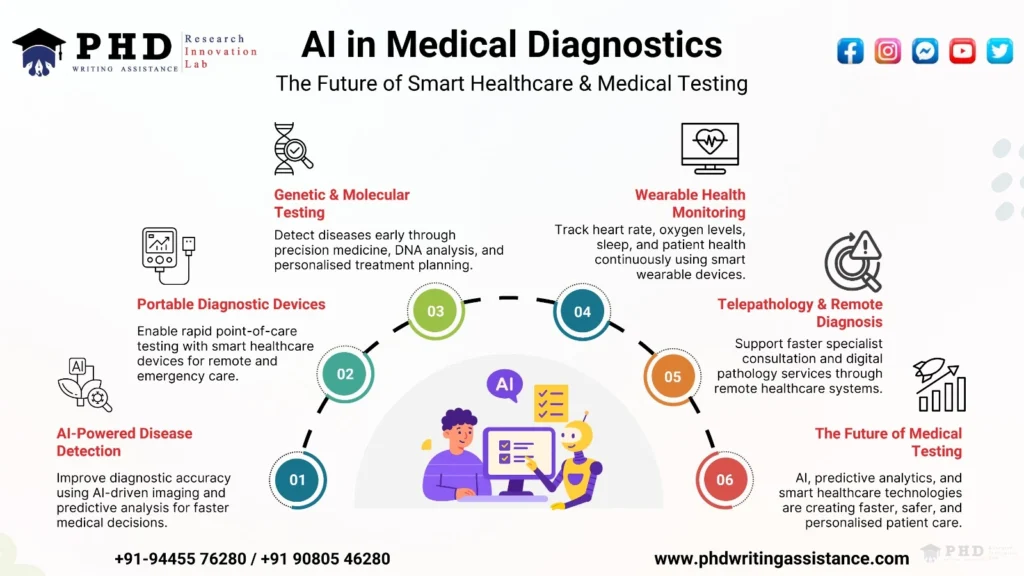
Point-of-care testing (POCT) has transformed traditional diagnostic procedures by allowing healthcare professionals to conduct rapid testing directly at the patient’s location. Unlike conventional laboratory-based testing, portable diagnostic devices provide immediate results, helping clinicians make timely treatment decisions.
Devices such as handheld blood analysers, portable ultrasound scanners, and compact glucose monitors are especially beneficial in remote or underserved areas where laboratory access is limited. These technologies minimise delays in diagnosis and improve healthcare accessibility for vulnerable populations.
In addition, portable healthcare technologies encourage proactive disease management. Patients with chronic illnesses such as diabetes and hypertension can now monitor their conditions from home using smart diagnostic devices. This shift towards patient-centred healthcare improves early intervention and long-term disease management while reducing pressure on hospitals and clinics.
How AI in Medical Diagnostics is Transforming Healthcare
The integration of artificial intelligence into healthcare has revolutionised medical imaging and diagnostic analysis. AI in medical diagnostics uses machine learning algorithms and deep learning systems to interpret complex medical images such as X-rays, CT scans, and MRI scans with remarkable speed and accuracy.
AI-powered diagnostic systems can identify subtle abnormalities that may not always be visible to the human eye. This capability is particularly valuable in detecting conditions such as cancer, neurological disorders, and cardiovascular diseases at earlier stages. Early detection significantly improves treatment success rates and patient survival outcomes.
Furthermore, AI-driven technologies reduce diagnostic errors and support healthcare professionals by streamlining repetitive analytical tasks. Radiologists and clinicians can therefore focus more on patient care and complex clinical decision-making rather than time-consuming image analysis.
As healthcare organisations continue to adopt AI-powered solutions, the role of artificial intelligence in diagnostics is expected to expand rapidly, supporting more accurate, data-driven, and efficient healthcare delivery systems.
Genetic and Molecular Diagnostics
Advancements in genetic and molecular testing have introduced a new era of precision medicine. Through modern medical diagnostics technology, healthcare professionals can now analyse genetic information to identify disease risks, detect inherited conditions, and personalise treatment plans according to individual patient profiles.
Molecular diagnostic tools enable the detection of infections, cancers, and genetic abnormalities at very early stages. One of the most innovative developments is the liquid biopsy, which allows cancer detection through a simple blood sample rather than invasive surgical procedures.
Genetic testing also empowers patients to make informed healthcare and lifestyle decisions based on their hereditary risk factors. This personalised approach to medicine improves treatment effectiveness while reducing unnecessary interventions.
The integration of genomics and artificial intelligence is further strengthening the accuracy and efficiency of predictive healthcare, making precision diagnostics a core component of the future of medical testing.
The Role of Wearable Health Devices in Patient Monitoring
The popularity of wearable health devices has increased significantly in recent years as patients and healthcare providers seek continuous and real-time health monitoring solutions. Smartwatches, fitness trackers, and biosensors now allow users to track important health metrics such as heart rate, oxygen saturation, blood pressure, and sleep patterns.
These devices provide valuable health data that can help detect abnormalities before serious medical complications occur. For patients with chronic illnesses, wearable monitoring technologies support ongoing condition management and improve communication between patients and healthcare professionals.
Continuous monitoring through wearable devices also promotes preventive healthcare by encouraging individuals to become more engaged in their personal health management. Healthcare providers benefit from long-term patient data that supports more accurate treatment planning and faster clinical interventions.
As digital healthcare technologies evolve, wearable monitoring systems are expected to play an even greater role in preventive medicine and personalised healthcare services.
Telepathology and Remote Diagnostic Services
Telepathology is another major innovation transforming diagnostic healthcare services. Through digital imaging technology, pathologists can remotely examine tissue samples and provide specialist diagnoses regardless of geographical location.
This technology is particularly beneficial in regions where access to specialised pathology services is limited. Healthcare providers can transmit high-resolution biopsy images to experts in real time, improving diagnostic accuracy and reducing delays in treatment.
Telepathology also enhances collaboration between medical professionals, ensuring that patients receive expert opinions and accurate diagnoses more efficiently. As digital healthcare infrastructure improves globally, remote diagnostic services will continue to strengthen healthcare accessibility and specialist support systems.
The Future of Medical Testing
The future of medical testing will be increasingly shaped by artificial intelligence, predictive analytics, wearable monitoring systems, and precision medicine technologies. Healthcare systems are moving towards a more proactive and patient-centred model where diseases can be identified earlier and treated more effectively.
The combination of AI-driven diagnostics, molecular testing, and real-time health monitoring will allow healthcare providers to deliver faster, safer, and more personalised care. These innovations will not only improve patient outcomes but also reduce healthcare costs and operational inefficiencies.
As technology continues to evolve, AI in medical diagnostics will remain central to healthcare transformation, driving innovation and improving the quality of care across the global healthcare industry.
Conclusion
Technological advancements in diagnostics are fundamentally changing how healthcare professionals detect, monitor, and manage diseases. Innovations such as AI-powered imaging, wearable monitoring systems, genetic testing, and telepathology are creating a smarter and more connected healthcare environment.
By integrating advanced medical diagnostics technology into healthcare systems, organisations can deliver more accurate, efficient, and patient-focused care. As the future of medical testing continues to evolve, the healthcare industry is expected to become more predictive, accessible, and responsive to patient needs.
Healthcare researchers and students exploring emerging healthcare technologies can also benefit from specialised medical thesis writing support to develop high-quality academic research in this rapidly evolving field.
References
1) Heidt, B., Siqueira, W. F., Eersels, K., Diliën, H., van Grinsven, B., Fujiwara, R. T., & Cleij, T. J. (2020). Point of care diagnostics in resource-limited settings: A review of the present and future of PoC in its most needed environment. Biosensors, 10(10), 133. https://doi.org/10.3390/bios10100133 [Point-of-care testing]
2) Najjar, R. (2023). Redefining radiology: a review of artificial intelligence integration in medical imaging. Diagnostics, 13(17), 2760. https://doi.org/10.3390/diagnostics13172760 [medical imaging]
3) Al-Dewik, N. I., & Qoronfleh, M. W. (2019). Genomics and precision medicine: Molecular diagnostics innovations shaping the future of healthcare in Qatar. Advances in Public Health, 2019(1), 3807032. https://doi.org/10.1155/2019/3807032 [genetic testing and molecular diagnostics]
4) Dias, D., & Paulo Silva Cunha, J. (2018). Wearable health devices—vital sign monitoring, systems and technologies. Sensors, 18(8), 2414. https://doi.org/10.3390/s18082414 [Wearable health devices]5) Razzano, D., Puranam, K., Tomoka, T., & Fedoriw, Y. (2022). The role of telepathology in improving cancer diagnostic and research capacity in sub-Saharan Africa. Frontiers in Medicine, 9, 978245. https://doi.org/10.3389/fmed.2022.978245[Telepathology]
Frequently Asked Questions
1. What is AI in medical diagnostics?
AI in medical diagnostics refers to the use of artificial intelligence technologies to analyse medical data, identify disease patterns, and support healthcare professionals in making faster and more accurate diagnoses.
2. How do wearable health devices improve patient care?
Wearable health devices monitor real-time health data such as heart rate, oxygen levels, and sleep patterns. These devices support early detection, chronic disease management, and preventive healthcare.
3. What is the future of medical testing?
The future of medical testing involves AI-driven diagnostics, genetic testing, predictive analytics, and remote healthcare technologies that improve diagnostic accuracy and patient outcomes.
4. Why is medical diagnostics technology important?
Medical diagnostics technology improves disease detection, reduces diagnostic errors, enables early intervention, and supports personalised healthcare treatment plans.
5. How does AI improve diagnostic accuracy?
AI systems analyse large medical datasets and imaging scans to identify subtle abnormalities quickly and accurately, helping healthcare professionals detect diseases at earlier stages.