Introduction
Trade unions in India have historically played a significant role in protecting workers’ rights, promoting fair wages, and improving workplace conditions across multiple industries. Since the establishment of the All India Trade Union Congress (AITUC) in 1920, trade unions have served as powerful representatives of labor interests in India’s industrial landscape. Through collective action and negotiations, unions have influenced labor policies, strengthened workplace safety, and advocated for social justice among working communities.
However, the modern business environment has transformed significantly due to globalization, rapid technological advancement, privatization, and the expansion of the gig economy. These developments have created new challenges for trade unions in India, forcing them to rethink traditional labor strategies and adapt to evolving workforce expectations. Organizations increasingly prioritize operational flexibility, automation, and cost efficiency, while many workers now operate within informal or contract-based employment systems that offer limited labor protections.
The relationship between employers and workers is therefore undergoing a major transition. In this changing environment, the future relevance of trade unions depends on their ability to modernize their strategies and address emerging workforce concerns effectively. The case of NTPC Unchahar provides an important example of how modern unions are redefining their influence through collaboration, workforce development, and employee welfare initiatives.
This article explores the transformation of industrial relations in India, focusing on how trade unions are adapting to changing economic conditions, technological disruption, and globalization while continuing to protect employee rights in India.
The Evolution of Trade Unions in India
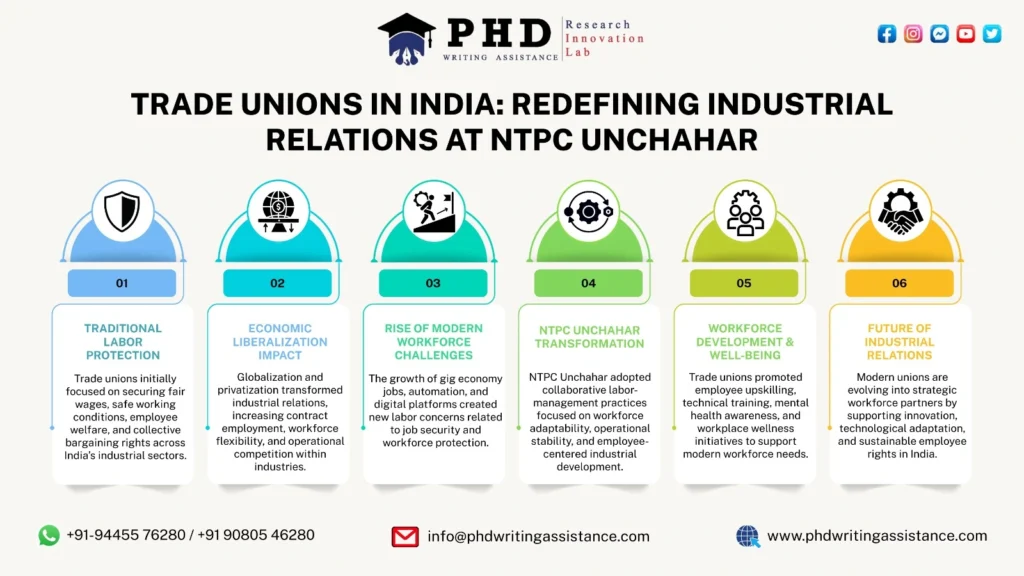
The growth of trade unions in India has historically been linked to industrial expansion and labor reforms. During the early stages of industrialization, unions primarily focused on:
- wage negotiations
- workplace safety
- employee welfare
- job security
- collective bargaining rights
Trade unions became especially influential in industries such as manufacturing, mining, textiles, and public-sector enterprises. Through organized protests and negotiations, unions contributed significantly to labor law reforms and worker protections across India.
However, globalization and economic liberalization introduced new pressures on traditional labor structures. Companies began outsourcing operations, increasing contract-based employment, and adopting flexible workforce models to remain competitive in global markets.
Today, the rise of the informal economy presents one of the biggest challenges for industrial relations in India. According to the International Labour Organization (ILO), a large portion of India’s workforce is employed informally, often without adequate legal protection or social security benefits.
As a result, unions must now address issues beyond traditional factory labor, including:
- gig economy employment
- temporary work contracts
- digital platform workers
- workforce automation
- technological displacement
This shift has transformed the nature of collective bargaining in India, requiring unions to adopt more adaptive and collaborative approaches.
NTPC Unchahar: A Modern Case Study of Trade Union Transformation
NTPC Unchahar represents an important case study for understanding the changing role of unions within India’s energy sector. As one of India’s major thermal power stations, NTPC has traditionally relied on a skilled workforce to maintain operational efficiency and industrial productivity.
However, the energy sector is currently undergoing significant transformation due to:
- renewable energy adoption
- environmental regulations
- digitalization
- automation technologies
- increasing operational competition
These changes have created new pressures on workers and management alike. Instead of relying solely on confrontational labor practices, unions at NTPC Unchahar have gradually shifted toward collaborative labor-management relationships.
This transformation demonstrates how trade unions in India are evolving from traditional protest-oriented organizations into strategic workforce partners.
The unions at NTPC Unchahar now focus on:
- workforce skill development
- employee mental health
- workplace modernization
- collaborative problem-solving
- employee adaptability initiatives
This modern approach strengthens organizational stability while continuing to protect workers’ interests.
Collaboration Over Confrontation in Industrial Relations
One of the most important developments in industrial relations in India is the shift from confrontation to collaboration between unions and management.
Traditionally, labor disputes were often characterized by strikes, protests, and adversarial negotiations. However, modern business challenges require more cooperative strategies that balance organizational efficiency with employee welfare.
At NTPC Unchahar, unions have successfully supported several collaborative initiatives.
Skills Development and Workforce Training
The transition toward renewable energy and digital systems requires workers to develop new technical skills. Recognizing this need, unions have actively advocated for retraining programs that prepare employees for future industry demands.
These initiatives help workers:
- improve employability
- adapt to technological change
- remain competitive in evolving industries
- reduce job insecurity
By supporting workforce development, unions strengthen both employee confidence and organizational resilience.
Employee Well-Being and Mental Health
Workplace stress, uncertainty, and changing job expectations have increased concerns regarding employee mental health. In response, unions at NTPC Unchahar have promoted:
- mental health awareness programs
- counseling support
- work-life balance initiatives
- employee wellness campaigns
This demonstrates how modern trade unions in India are expanding their focus beyond wages and labor disputes toward broader employee well-being.
Trade Unions and Globalization
The relationship between trade unions and globalization remains one of the most significant issues affecting labor markets worldwide.
Globalization has increased competition between businesses, encouraging organizations to reduce labor costs and improve operational flexibility. While globalization has created economic growth opportunities, it has also contributed to:
- workforce fragmentation
- job insecurity
- contract-based employment
- informal labor expansion
These developments challenge the traditional influence of unions.
However, several international examples demonstrate how unions can remain effective within globalized economies.
Germany’s Collaborative Labor Model
In Germany, unions actively participate in cooperative labor-management structures that focus on:
- workforce upskilling
- technological adaptation
- employee participation
- long-term workforce planning
This collaborative system has improved employee satisfaction while maintaining industrial productivity.
Sweden’s Inclusive Labor Policies
Swedish unions have expanded labor protections to include gig workers and non-traditional employees. Their inclusive approach highlights the importance of modernizing labor representation to reflect changing employment models.
These international examples provide valuable lessons for strengthening industrial relations in India.
Employee Rights in India and Modern Labor Challenges
Protecting employee rights in India remains a critical responsibility for trade unions despite changing labor structures.
Workers today face several emerging challenges, including:
- automation-related job displacement
- insecure contract employment
- lack of social protection
- workplace stress
- unequal bargaining power
The rise of platform-based work and gig economy jobs further complicates labor protection efforts because many workers operate outside traditional employment frameworks.
To remain relevant, trade unions in India must advocate for:
- stronger labor regulations
- social security protections
- fair gig economy policies
- workplace equality
- inclusive labor representation
Modern unions must therefore balance traditional labor advocacy with new workforce realities.
The Future of Collective Bargaining in India
The future of collective bargaining in India will depend heavily on adaptability, innovation, and collaboration.
Traditional union models focused mainly on industrial disputes and wage negotiations. However, modern unions must now engage with:
- digital transformation
- workforce reskilling
- technological disruption
- mental health concerns
- sustainability initiatives
Unions that embrace innovation and strategic partnerships are more likely to maintain influence in the future labor market.
At NTPC Unchahar, the shift toward cooperative labor relations demonstrates how unions can continue protecting workers while supporting organizational modernization.
This evolving model may serve as a roadmap for labor organizations across India.
Conclusion
The transformation of trade unions in India reflects broader changes occurring within modern labor markets. Globalization, technological advancement, and the rise of flexible employment structures have significantly reshaped traditional workforce dynamics.
The case of NTPC Unchahar demonstrates that unions can remain relevant by adopting collaborative strategies focused on workforce development, employee well-being, and organizational adaptability.
By strengthening industrial relations in India, promoting inclusive labor policies, and modernizing collective bargaining in India, trade unions can continue protecting workers’ rights while supporting economic progress.
The future success of trade unions will depend on their ability to adapt to modern workforce realities while maintaining their core mission of protecting employee rights in India. Organizations, policymakers, and labor representatives must work together to build a fair, inclusive, and sustainable labor environment that benefits both workers and industries in the evolving global economy.
References
1. Brandl, B. (2022). Everything we do know (and don’t know) about collective bargaining: The Zeitgeist in the academic and political debate on the role and effects of collective bargaining. Economic and Industrial Democracy, 44(3), 0143831X2210860. https://doi.org/10.1177/0143831×221086018 (fair wages and improving working conditions)
2. Hagedorn, J., Paras, C. A., Greenwich, H., & Hagopian, A. (2016). The Role of Labor Unions in Creating Working Conditions That Promote Public Health. American Journal of Public Health, 106(6), 989–995. NCBI. https://doi.org/10.2105/ajph.2016.303138 (safer working conditions)
3. Hammer, A., Keles, J. Y., & Olsen, W. (2022). Working Lives in India: Current Insights and Future Directions. Work, Employment and Society, 36(6), 095001702210835. https://doi.org/10.1177/09500170221083511 (contract labor)
4. Keune, M., & Pedaci, M. (2019). Trade union strategies against precarious work: Common trends and sectoral divergence in the EU. European Journal of Industrial Relations, 26(2), 139–155. https://doi.org/10.1177/0959680119827182 (technological advancements)
5. Sachdeva, T. (2024). The Gig Economy in India: Unpacking the Economic and Social Implications. International Journal for Research Publication and Seminar, 15(3), 166–176. https://doi.org/10.36676/jrps.v15.i3.1465 (workforce)
Frequently Asked Questions
1. How are trade unions in India adapting to globalization?
Trade unions in India are increasingly adopting collaborative approaches focused on workforce training, employee well-being, and technological adaptation to remain relevant in globalized industries.
2. What is the importance of collective bargaining in India?
Collective bargaining in India helps workers negotiate fair wages, workplace safety, employee benefits, and improved working conditions through organized labor representation.
3. How does globalization affect industrial relations in India?
Globalization has increased workforce flexibility, contract labor, and competition, creating new challenges for industrial relations in India and reducing traditional union influence in some industries.
4. Why is NTPC Unchahar an important trade union case study?
NTPC Unchahar demonstrates how modern labor unions can successfully balance employee protection with organizational collaboration, workforce development, and industry modernization.
5. What challenges do trade unions face in modern India?
Modern unions face challenges such as automation, gig economy employment, workforce fragmentation, informal labor growth, and changing employment structures.