Introduction
Academic writing is built on credibility, originality, and evidence-based research. Whether you are preparing a school project, university assignment, dissertation, or research paper, acknowledging the sources you have used is essential. One of the most important ways to give proper credit to authors is by including a well-formatted bibliography. Learning how to write a bibliography not only strengthens the quality of your work but also demonstrates academic integrity and helps readers locate the sources you have referenced.
Many students confuse a bibliography with citations or a reference list. While these elements are related, they serve different purposes in academic writing. Understanding what is meant by bibliography and how it differs from other referencing methods can help you avoid formatting mistakes and plagiarism.
A bibliography is more than a list of books or websites. It is a complete record of all the sources consulted during your research, whether they are directly cited in the text or used for background reading. A properly prepared bibliography enhances the credibility of your research and reflects the depth of your literature review.
This guide explains how to write a bibliography, explores the bibliography format for project, discusses how to write bibliography in assignment, outlines what to write in bibliography, and provides practical tips on how to write references for a research paper.
What Is a Bibliography?
Before learning how to write a bibliography, it is important to understand what is meant by bibliography.
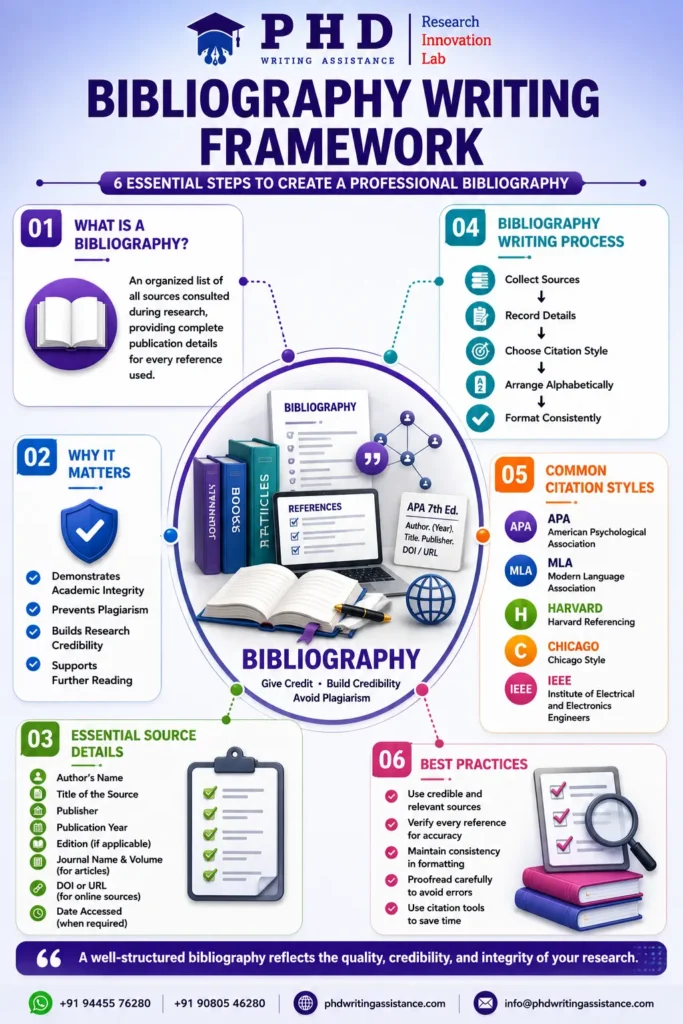
A bibliography is an organized list of all the books, journal articles, websites, reports, conference papers, and other sources consulted during a research project or academic assignment. It appears at the end of the document and provides complete publication details for each source.
Unlike an in-text citation, which briefly acknowledges a source within the content, a bibliography contains full information that enables readers to locate the original material.
A bibliography typically includes:
- Author’s name
- Title of the source
- Publisher
- Year of publication
- Edition (if applicable)
- Journal name and volume (for articles)
- DOI or URL (for online sources)
- Date accessed (when required)
Maintaining an accurate bibliography demonstrates transparency, allows readers to verify information, and supports ethical academic writing.
Why Is a Bibliography Important?
Understanding how to write a bibliography is essential because it plays a significant role in academic and professional research.
Demonstrates Academic Integrity
Every research project builds upon previous knowledge. A bibliography acknowledges the original authors whose work contributed to your understanding of the topic.
Proper attribution reflects honesty and respect for intellectual property.
Prevents Plagiarism
Failing to acknowledge sources may result in plagiarism, one of the most serious academic offences.
Including a complete bibliography shows that ideas, statistics, theories, and quotations have been appropriately credited.
Enhances Research Credibility
Readers are more likely to trust research that is supported by reliable and verifiable sources.
A detailed bibliography allows supervisors, examiners, and readers to evaluate the quality of the references used.
Supports Further Reading
A bibliography also serves as a valuable resource for readers who wish to explore the topic further.
By consulting your references, readers can deepen their understanding of the subject.
How to Write a Bibliography
Learning how to write a bibliography becomes much easier when the process is broken into clear steps.
Step 1: Record Every Source
As you conduct research, maintain a record of every source you consult.
Collect details such as:
- Author(s)
- Title
- Publisher
- Publication year
- Journal name
- Volume and issue number
- DOI or URL
- Date accessed (if required)
Keeping this information from the beginning saves considerable time during the final stages of writing.
Step 2: Select the Appropriate Citation Style
Different universities and journals require different referencing styles.
The most common citation styles include:
- APA (American Psychological Association)
- MLA (Modern Language Association)
- Harvard Referencing
- Chicago Style
- IEEE
Always follow your university or journal guidelines before preparing the bibliography.
Step 3: Organize Sources Alphabetically
A bibliography is usually arranged alphabetically according to the author’s surname.
If the author’s name is unavailable, arrange the entry using the first significant word of the title.
This organization improves readability and helps readers locate references quickly.
Step 4: Use Consistent Formatting
Consistency is essential.
Every bibliography entry should follow the same formatting style throughout the document.
For example, if APA style is used for books, journal articles, and websites, every entry should comply with APA formatting rules.
Bibliography Format for Project
Students frequently ask about the correct bibliography format for project because academic institutions may have different formatting requirements.
Regardless of the citation style, each reference should contain complete publication details.
Book Example (APA Style)
Smith, J. (2023). Research Methodology for Beginners. Oxford University Press.
Journal Article Example
Brown, P., & Lee, M. (2024). Artificial intelligence in higher education. Journal of Educational Technology, 18(2), 45–62.
Website Example
World Health Organization. (2024). Artificial Intelligence in Healthcare. https://www.who.int
Conference Paper Example
Johnson, A. (2023). Machine Learning Applications in Civil Engineering. Proceedings of the International Conference on Smart Infrastructure.
These examples illustrate a standard bibliography format for project that can be adapted based on your required citation style.
How to Write Bibliography in Assignment
Many students wonder whether assignments require a bibliography. In most universities, the answer is yes.
Understanding how to write bibliography in assignment ensures that your work meets academic standards and demonstrates responsible use of information.
When preparing a bibliography for an assignment:
- Include every source you consulted.
- Follow the citation style specified by your instructor.
- Arrange entries alphabetically.
- Maintain consistent formatting.
- Double-check publication details before submission.
Even short assignments benefit from a well-prepared bibliography because it strengthens credibility and shows thorough research.
What to Write in Bibliography
Knowing what to write in bibliography is essential because different types of sources require different publication details. An incomplete bibliography makes it difficult for readers to locate the original source and may reduce the credibility of your work.
Although the exact format depends on the citation style (APA, MLA, Harvard, Chicago, etc.), most bibliography entries include the following information:
For Books
- Author(s)
- Book title
- Edition (if applicable)
- Publisher
- Year of publication
For Journal Articles
- Author(s)
- Article title
- Journal name
- Volume and issue number
- Page numbers
- Year of publication
- DOI (if available)
For Websites
- Author or organization
- Webpage title
- Website name
- URL
- Publication or last updated date
- Access date (if required)
For Conference Papers
- Author(s)
- Paper title
- Conference name
- Location
- Year
- Publisher or proceedings
Including complete publication details ensures that your bibliography meets academic standards and enables readers to verify your sources easily.
How to Write References for a Research Paper
Many students confuse bibliographies with reference lists. Understanding how to write references for a research paper helps ensure that academic writing follows university or journal guidelines.
A reference list contains only the sources that are directly cited within the research paper, whereas a bibliography may include additional materials consulted during the research process.
To prepare accurate references:
Follow the Required Citation Style
Always use the citation style recommended by your university, supervisor, or journal.
Common styles include:
- APA
- MLA
- Harvard
- Chicago
- IEEE
Switching between citation styles within the same paper creates inconsistencies and should be avoided.
Verify Every Reference
Before submitting your paper, check every reference carefully.
Ensure that:
- Author names are spelled correctly.
- Publication years are accurate.
- Titles match the original source.
- URLs and DOIs are valid.
- Journal names and page numbers are complete.
Small errors can reduce the professionalism of your research.
Use Reference Management Software
Citation management tools help organize references and generate bibliographies automatically.
Popular tools include:
- Zotero
- Mendeley
- EndNote
- RefWorks
These applications reduce formatting errors and save significant time during academic writing.
Common Bibliography Mistakes to Avoid
Even experienced researchers occasionally make bibliography mistakes. Being aware of these common errors can improve the quality of your academic work.
Missing Source Information
Incomplete publication details make it difficult for readers to locate original sources.
Always record complete bibliographic information while conducting research.
Mixing Citation Styles
Using APA for one source and Harvard for another creates inconsistencies.
Select one citation style and use it consistently throughout the document.
Incorrect Alphabetical Order
Bibliographies should generally be arranged alphabetically according to the author’s surname.
Incorrect ordering makes references difficult to locate.
Using Unreliable Sources
Avoid relying on blogs, anonymous websites, or non-credible online content unless specifically required.
Instead, prioritize:
- Peer-reviewed journals
- Academic books
- Government publications
- Official organizational websites
- Conference proceedings
Forgetting to Update References
Researchers often revise their content but forget to update the bibliography.
Always review your bibliography before submission to ensure every cited source appears correctly.
Best Practices for Writing a Professional Bibliography
Following best practices helps create an accurate and well-organized bibliography.
Keep Records from the Beginning
Instead of collecting reference details after completing your paper, record publication information while reading each source.
Follow University Guidelines
Different institutions may have slightly different formatting requirements.
Always check your department’s referencing guide before finalizing your bibliography.
Proofread Carefully
Even minor formatting mistakes can affect the overall presentation of your work.
Review every bibliography entry for consistency, punctuation, capitalization, and spacing.
Use Recent and Credible Sources
Whenever possible, include recent peer-reviewed studies to improve the relevance and credibility of your research.
Double-Check Online Sources
If you use websites, ensure the URLs are active and the information comes from reliable organizations.
Conclusion
Learning how to write a bibliography is an essential academic skill that every student and researcher should master. A well-prepared bibliography not only acknowledges the work of other authors but also strengthens the credibility, transparency, and professionalism of your research. Understanding what is meant by bibliography helps distinguish it from citations and reference lists, allowing you to use each correctly in academic writing.
Whether you are preparing a university assignment, dissertation, thesis, or research paper, following the correct bibliography format for project ensures that your work meets institutional and publishing standards. Likewise, knowing how to write bibliography in assignment and what to write in bibliography enables you to present complete and accurate source information, reducing the risk of plagiarism and improving the quality of your work.
Finally, mastering how to write references for a research paper ensures that readers can easily verify your sources while demonstrating your commitment to academic integrity. By following consistent citation styles, using credible references, and proofreading carefully, you can create a professional bibliography that enhances the overall impact of your research.
Frequently Asked Questions
1. What is a bibliography?
A bibliography is a list of all the sources consulted during research, including books, journal articles, websites, and reports. It appears at the end of an academic document and provides complete publication details for each source.
2. How do I write a bibliography correctly?
To write a bibliography, collect complete source information, follow the required citation style, arrange entries alphabetically, and maintain consistent formatting throughout the document.
3. What should be included in a bibliography?
What to write in bibliography depends on the source type, but most entries include the author’s name, title, publisher, publication year, and additional details such as journal information, DOI, or URL.
4. What is the difference between a bibliography and references?
A bibliography lists all sources consulted during research, while references include only the sources that are directly cited within the research paper or assignment.
5. Which citation style should I use for academic writing?
The citation style depends on your university or journal requirements. APA, MLA, Harvard, Chicago, and IEEE are among the most commonly used referencing styles in academic research.