Introduction
A PhD synopsis is an important document that presents the proposed direction of a doctoral research study. It gives supervisors, research committees and academic institutions an overview of the research problem, objectives, methodology, expected contribution and proposed approach. A well-prepared synopsis helps demonstrate that the proposed study is relevant, focused and suitable for doctoral-level investigation.
Learning how to write synopsis for PhD research requires more than summarising a research idea. The synopsis should establish a clear connection between the research problem, existing literature, research gap, questions, objectives and methodology. Although the exact format can vary between universities and disciplines, most PhD synopsis documents contain several core elements.
This guide explains the PhD synopsis structure, important formatting considerations and the key elements researchers should consider when preparing a synopsis.
What Is a PhD Synopsis?
A PhD synopsis is a concise academic document that outlines a proposed doctoral research project. It explains what the researcher intends to investigate, why the research is important and how the study will be conducted.
A synopsis is generally prepared before the full doctoral research is undertaken or at an early stage of the research process. It allows academic reviewers to evaluate the relevance, feasibility and potential contribution of the proposed study.
A dissertation synopsis follows a similar principle, although terminology and requirements may differ between institutions and academic levels. Researchers should therefore always check the specific guidelines provided by their university or research department.
How to Write Synopsis for PhD
The first step in learning how to write synopsis for PhD research is to establish a clearly defined research problem. A broad area of interest should be narrowed into a specific problem that can be investigated systematically.
The researcher should then review relevant academic literature to understand what has already been established and where gaps remain. This literature review provides the foundation for explaining why the proposed research is necessary.
The synopsis should then connect the research problem with clear research questions and objectives. The methodology should explain how those questions will be investigated, while the expected contribution should indicate what the study may add to existing knowledge.
The entire synopsis should follow a logical progression rather than presenting disconnected sections.
PhD Synopsis Structure
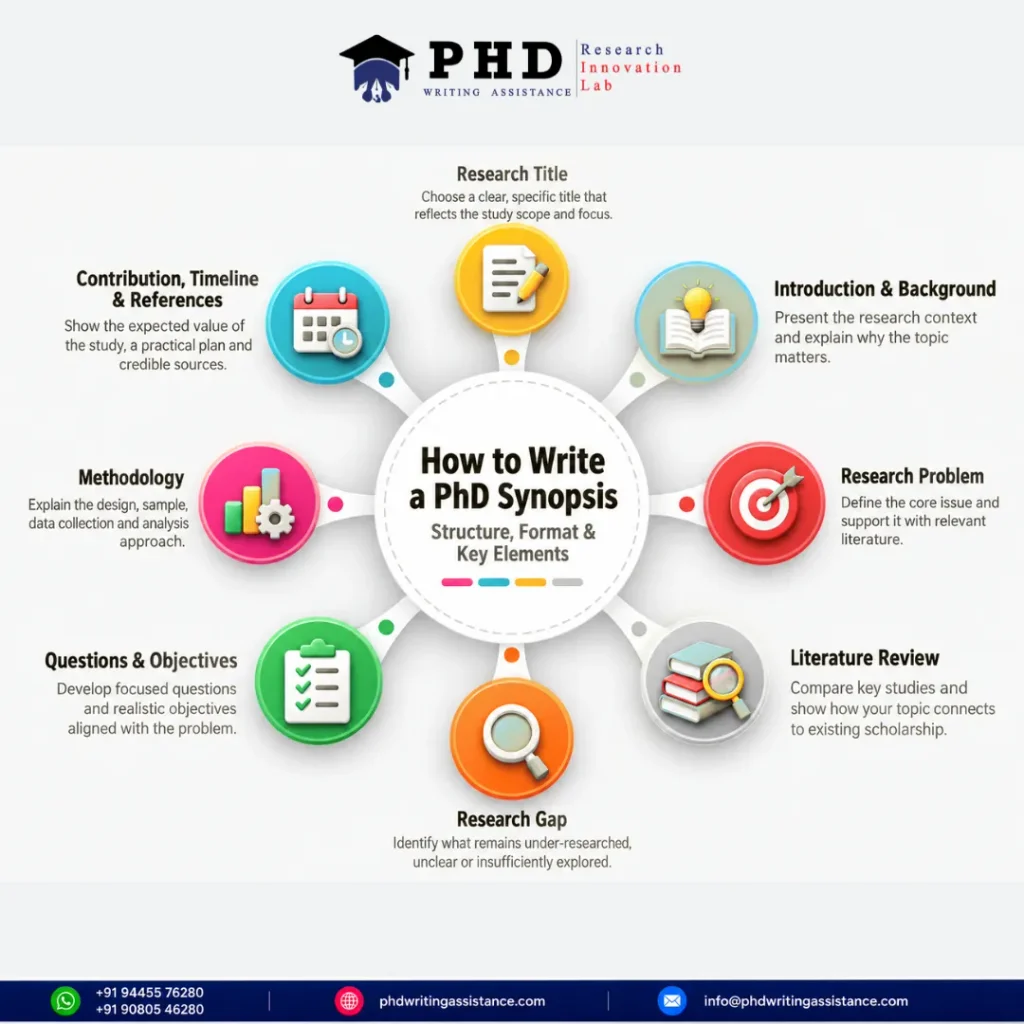
Although universities may use different templates, a typical PhD synopsis structure can include the following elements:
Title of the Research
The title should clearly communicate the subject and scope of the proposed research. It should be specific enough to indicate the central research problem without becoming unnecessarily long.
A strong title should reflect the variables, population, context or research area where relevant. Researchers should avoid titles that are too broad because they can make the proposed research appear difficult to manage.
Introduction and Background
The introduction establishes the broader context of the research. It should explain the subject area and introduce the problem that the proposed study intends to investigate.
A strong background section gradually moves from the broader research area towards the specific research problem. It should explain why the issue is academically or practically significant.
Statement of the Research Problem
The research problem is one of the most important elements of a PhD synopsis. It should clearly identify the issue that requires investigation.
The problem statement should be supported by relevant literature rather than based only on personal observation. It should also demonstrate why existing knowledge is insufficient and why further research is necessary.
Literature Review
The literature review summarises and critically examines relevant academic research. However, a synopsis should not simply list previous studies. The researcher should compare findings, identify limitations and demonstrate how the proposed research relates to existing scholarship.
The literature review should ultimately help establish the research gap. This gap provides the academic justification for the proposed study.
Research Gap
A research gap refers to an area where existing knowledge remains incomplete, inconsistent or insufficiently investigated.
The gap may involve an under-researched population, geographical context, theoretical perspective, methodology, relationship between variables or emerging issue. Clearly identifying the gap helps demonstrate the originality and relevance of the proposed doctoral research.
Research Questions
Research questions establish what the study intends to investigate. They should directly arise from the research problem and identified gap.
Well-defined questions make the scope of the research clearer and help guide the selection of research methods, data sources and analysis techniques.
Research Objectives
Research objectives describe what the study intends to achieve. They should be specific, logically connected to the research questions and realistically achievable within the scope of the doctoral project.
The objectives should also align with the proposed methodology. A mismatch between objectives and methods can weaken the overall research design.
Research Methodology in a PhD Synopsis
The methodology section explains how the proposed research will be conducted. Depending on the discipline and research problem, this may involve qualitative, quantitative or mixed-methods research.
The synopsis should provide sufficient information about the proposed research design, population or sample, data collection methods and data analysis techniques.
For quantitative research, the methodology may discuss variables, sampling, instruments and statistical analysis. Qualitative research may describe interviews, observations, document analysis or thematic analysis. Mixed-methods research should explain how qualitative and quantitative components will be integrated.
The methodology should be appropriate to the research questions rather than selected simply because a particular method is commonly used within the field.
Expected Contribution of the Research
A PhD synopsis should explain the expected contribution of the proposed research. This contribution may be theoretical, methodological, empirical or practical.
For example, a study may extend an existing theoretical framework, provide evidence from an under-researched population or develop a new methodological approach. In applied research, the findings may also have implications for organisations, policymakers or professional practice.
The expected contribution should remain realistic. A synopsis should demonstrate potential value without making unsupported claims about what the research will definitely achieve before the study has been conducted.
Timeline and Proposed Research Plan
A research timeline provides an overview of how the doctoral study is expected to progress. It may include stages such as literature review, research design, data collection, data analysis, thesis writing and final revision.
A realistic timeline helps demonstrate that the proposed research can be completed within the available doctoral period. It should take into account potential delays in participant recruitment, data collection, ethical approval and analysis.
References and Academic Sources
A PhD synopsis should include relevant and credible academic references. The referencing style should follow the requirements of the university or department.
Researchers should prioritise relevant scholarly literature and ensure that references cited in the synopsis are accurately represented. Consistent citation and referencing are important for academic credibility and research integrity.
PhD Synopsis Format and Presentation
The PhD synopsis format should follow the specific guidelines provided by the institution. Requirements may differ in terms of word count, font, spacing, margins, headings, referencing style and required sections.
Researchers should therefore avoid relying on a generic format without checking their university’s official requirements.
The final document should be professionally structured and easy to read. Headings should clearly distinguish each section, while paragraphs should present ideas logically. Grammar, spelling, citations and formatting should also be checked carefully before submission.
PhD Guidance for Developing a Strong Synopsis
Effective PhD guidance can help researchers refine a broad research idea into a focused doctoral proposal. Academic discussion with a supervisor can help identify weaknesses in the research problem, improve the research questions and determine whether the proposed methodology is appropriate.
Researchers should also review previous approved research proposals or institutional guidelines where available. This can help them understand the level of detail and structure expected by their university.
However, examples should be used as structural guidance rather than copied. The synopsis must reflect the researcher’s own research problem, academic argument and proposed contribution.
Approved Synopsis Titles in Ayurveda
For researchers working in Ayurveda, selecting an appropriate title should also be based on the research problem, discipline-specific requirements and institutional guidelines. A list of approved title of synopsis in Ayurveda may be available through individual universities or research institutions, depending on their approval and academic procedures.
Researchers should not assume that a title approved by one institution will automatically be suitable for another. Instead, existing approved titles can be reviewed to understand research areas and naming conventions while developing an original research topic.
PhD Synopsis vs Master Thesis Research
A PhD synopsis and a master thesis proposal may share several elements, including the research problem, literature review, objectives and methodology. However, doctoral research generally requires a stronger demonstration of originality and contribution to knowledge.
A master’s-level study may investigate an established problem within a defined context, whereas a PhD project is normally expected to make a more substantial contribution to academic knowledge. The scope, theoretical development, methodological justification and expected contribution should therefore be appropriate to the level of study.
Common Mistakes When Writing a PhD Synopsis
One common mistake is selecting a topic that is too broad. Another is presenting a literature summary without identifying a clear research gap.
Researchers may also create research questions that do not align with their objectives or propose a methodology that cannot adequately answer the questions.
Ignoring university-specific guidelines is another avoidable problem. Even a well-developed research idea may require revision if the synopsis does not follow the required structure or format.
Finally, researchers should avoid excessive claims about expected findings. A synopsis describes a proposed study, so its claims should remain evidence-based and academically cautious.
Conclusion
A well-developed PhD synopsis provides a clear foundation for doctoral research by connecting the research problem, literature gap, research questions, objectives and methodology. Understanding how to write synopsis for PhD research therefore requires both academic planning and careful attention to institutional requirements.
A strong synopsis should be focused, logically structured, researchable and supported by relevant literature. Whether preparing a dissertation synopsis, developing a research project in Ayurveda or planning doctoral research in another discipline, researchers should adapt the format to their university’s specific requirements.
Careful planning, critical literature analysis and appropriate PhD guidance can help researchers develop a synopsis that clearly communicates the purpose, scope and potential contribution of their proposed doctoral study.
Frequently Asked Questions
1. What is a PhD synopsis?
A PhD synopsis is a concise document outlining a proposed doctoral research project, including the research problem, literature gap, objectives, methodology and expected contribution.
2. How do I write a synopsis for PhD research?
Identify a research problem, review relevant literature, establish a research gap, develop questions and objectives, explain the methodology and present the expected contribution in a logical structure.
3. What should a PhD synopsis include?
A PhD synopsis commonly includes the title, introduction, research problem, literature review, research gap, research questions, objectives, methodology, expected contribution, timeline and references.
4. Is a PhD synopsis different from a master thesis proposal?
Yes. Both may contain similar elements, but a PhD synopsis generally requires stronger emphasis on originality, research contribution and doctoral-level academic significance.
5. Where can I find approved synopsis titles in Ayurveda?
Approved Ayurveda synopsis titles may be available through individual universities or research institutions. Researchers should check the relevant institution’s current guidelines and approval requirements before selecting a title.