Introduction
Presenting interview findings is an important part of qualitative research because it helps researchers explain participants’ experiences, perspectives and opinions in a clear, structured way. Knowing how to present qualitative data analysis effectively allows researchers to demonstrate how interview responses address research questions and contribute to existing knowledge.
In a dissertation, interview transcripts often contain detailed information, different viewpoints and recurring ideas. Simply reproducing these responses is not enough. Researchers must organise the data, identify meaningful patterns and explain what the findings reveal about the research problem.
Effective qualitative data presentation from interviews commonly involves thematic analysis, participant quotations, narrative explanations and structured presentation of themes. The appropriate method depends on the research question, analytical approach and type of information collected.
This guide explains the main methods of presenting qualitative data, demonstrates how to organise interview findings and provides practical guidance for qualitative interview results writing in a dissertation.
What Is Qualitative Data Analysis?
Qualitative data analysis is the systematic process of examining non-numerical information to identify patterns, meanings, experiences and relationships. Researchers commonly use interview transcripts, focus group discussions, observations and open-ended responses to understand how people interpret particular situations.
The process usually involves familiarisation with the data, coding relevant information, grouping related codes, developing themes and interpreting findings in relation to the research questions.
For example, a researcher investigating remote working may interview employees about their experiences. Repeated comments about communication difficulties, isolation and flexible working arrangements could become themes for further analysis.
The purpose is not simply to summarise what participants said. Researchers must interpret the evidence carefully and explain how the findings relate to the research objectives and existing literature.
How to Present Qualitative Data Analysis in a Dissertation
A well-organised results chapter helps readers understand the findings without having to review every interview transcript. The following steps can help researchers present their analysis systematically.
1. Organise Interview Data Before Writing
Begin by reviewing the interview transcripts and ensuring that the data is organised consistently. Remove identifying information where necessary and assign participant codes or pseudonyms to protect confidentiality.
Read the transcripts several times to become familiar with the participants’ responses. Record important observations and identify recurring ideas, differences and unexpected viewpoints.
Before writing, establish a clear structure for presenting the findings. The structure should reflect the analytical method and research objectives rather than simply following the order in which interviews were conducted.
2. Develop Codes and Themes
Coding involves identifying meaningful sections of interview data and assigning labels that represent their content. Related codes can then be grouped into broader themes that capture important patterns across the dataset.
For example, a study examining postgraduate students’ research experiences might identify the following codes:
- Difficulty accessing academic resources
- Limited supervisor availability
- Challenges managing deadlines
- Need for research training
These codes might contribute to broader themes such as academic support, research challenges and time management.
Themes should be developed through systematic analysis rather than selected only because they appear interesting. Researchers should also examine contradictory evidence and differences between participants.
3. Present Each Theme Clearly
Each theme should have a descriptive heading followed by an explanation of its meaning and relevance. Begin by introducing the central finding, then support it with appropriate interview evidence and interpretation.
A useful structure is:
- Introduce the theme and explain what it represents.
- Summarise the main pattern identified in the interviews.
- Include relevant participant quotations.
- Interpret the evidence and identify similarities or differences.
- Connect the finding to the relevant research question.
This approach makes data presentation in qualitative research more coherent and helps readers understand the relationship between raw interview responses and the researcher’s conclusions.
4. Use Participant Quotations as Evidence
Participant quotations help demonstrate how themes are supported by the original data. Select extracts that clearly illustrate the point being discussed rather than including long passages without explanation.
Introduce each quotation, identify the participant using an appropriate code and explain its significance afterwards.
For example, in a hypothetical study of remote working:
Participant P04 stated, “Flexible hours helped me manage my work around my family responsibilities.”
The researcher might interpret this response as evidence that flexibility supported work–life management for this participant. Other responses should be examined before concluding that the finding represents a broader pattern across the dataset.
Quotations should support analysis, not replace it. Researchers must also preserve the intended meaning of participants’ statements and follow their institution’s confidentiality requirements.
Methods of Presenting Qualitative Data
The best approach depends on the research design, analytical framework and purpose of the study. Several methods can be used independently or in combination.
1. Thematic Presentation
Thematic presentation organises findings around themes developed during analysis. Each theme represents a meaningful pattern within the dataset and is supported by evidence from participants.
This method is commonly used when researchers want to understand shared experiences, perceptions or challenges across multiple interviews.
For example, a study on student experiences of online learning might present themes such as digital accessibility, student engagement and interaction with lecturers.
2. Narrative Presentation
Narrative presentation uses descriptive prose to explain participants’ experiences, events or perspectives. It allows researchers to provide context and explore how individuals understand particular situations.
This approach can be useful when the sequence of experiences or the context surrounding participants’ accounts is important to the research question.
3. Case-Based Presentation
Case-based presentation examines individual participants, groups or specific cases in detail. It can help researchers compare experiences and identify differences between people or settings.
For example, a dissertation comparing two organisations might examine each organisation separately before discussing similarities and differences.
4. Framework-Based Presentation
Framework-based presentation organises findings according to predefined categories, research questions or an established analytical framework. Researchers can use this approach to compare responses systematically across participants.
It is particularly useful when a study has clear research objectives and requires structured comparison between different groups or categories.
5. Tables and Thematic Summaries
Tables can summarise themes, subthemes, representative quotations and key interpretations. They provide an overview of complex findings and help readers navigate the results chapter.
For instance, a table might include three columns: theme, supporting evidence and interpretation. The accompanying text should explain the significance of the findings rather than merely repeat the table.
The method chosen should remain consistent with the research design. Researchers should not combine approaches simply to make the chapter appear more comprehensive.
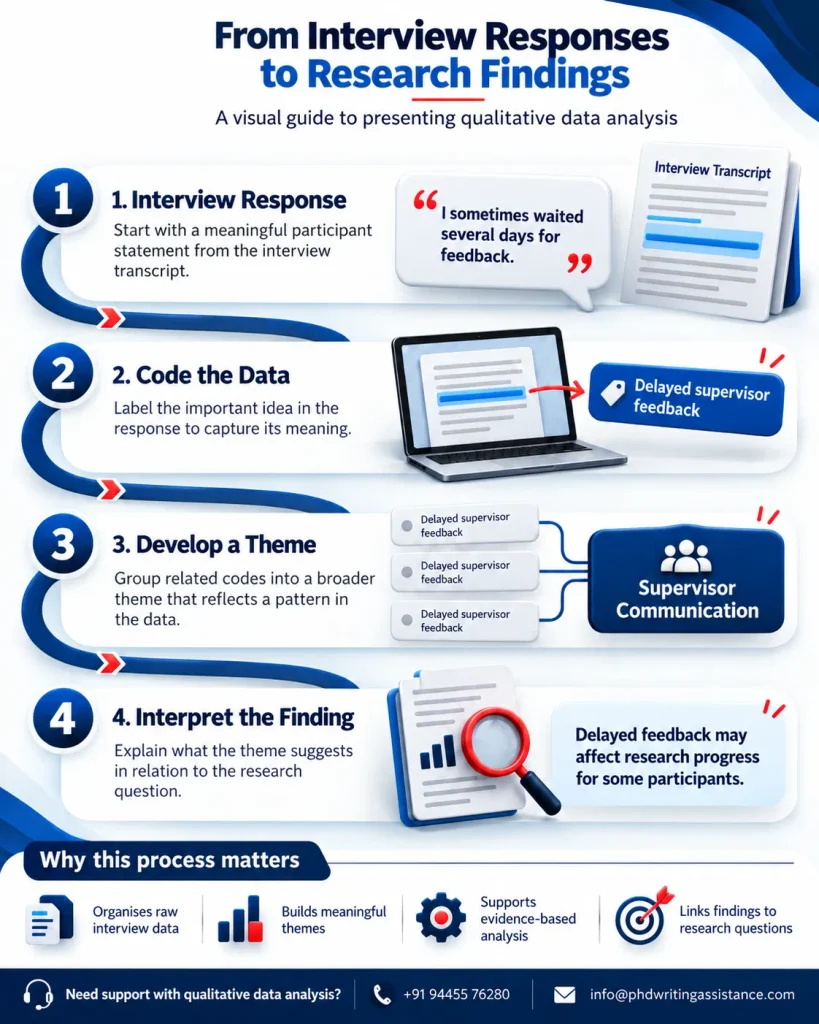
Qualitative Data Presentation from Interviews: An Example
Consider a hypothetical study exploring the challenges experienced by postgraduate students during dissertation research.
After reviewing the interview transcripts, the researcher identifies three themes: supervisor communication, time management and access to research resources.
| Theme | Example interview evidence | Possible interpretation |
| Supervisor communication | “I sometimes waited several days for feedback.” | Delayed feedback may affect research progress for some participants. |
| Time management | “Balancing my job and dissertation was difficult.” | Competing responsibilities may create time-management challenges. |
| Research resources | “I struggled to find suitable journal articles.” | Access to relevant literature may influence the research process. |
These examples are illustrative rather than findings from an actual study.
In the written results chapter, the researcher would introduce each theme, present relevant quotations from the real dataset and explain how the evidence addresses the research questions. The analysis should also consider whether participants expressed different or opposing views.
This example demonstrates how qualitative data presentation from interviews can move beyond listing responses towards a structured interpretation of evidence.
Qualitative Interview Results Writing: Best Practices
Clear qualitative interview results writing requires a balance between evidence, interpretation and academic explanation. The following practices can improve the quality of a dissertation chapter.
Maintain a Logical Structure
Arrange themes in an order that supports the research objectives. Use descriptive headings and introduce each section with a short explanation of the finding being discussed.
Distinguish Findings from Interpretation
Explain what participants reported before discussing what the evidence may mean. Avoid presenting assumptions as established facts or making claims that extend beyond the data.
Use Quotations Selectively
Choose quotations that illustrate important findings, differences or unexpected perspectives. Include sufficient context to preserve their meaning and follow each quotation with analytical commentary.
Protect Participant Confidentiality
Use participant codes or pseudonyms where appropriate. Remove identifying details from quotations and follow the consent arrangements and ethical approval requirements for the study.
Acknowledge Differences and Contradictions
Not every participant will share the same experience. Reporting contrasting perspectives strengthens the analysis and prevents the researcher from presenting a misleadingly uniform account.
Connect Findings to the Research Questions
Each major theme should contribute to answering at least one research question or research objective. This connection makes the results chapter more focused and academically meaningful.
How Much Interview Data Should Be Included in a Results Chapter?
There is no universal number of quotations or fixed proportion of interview data that every dissertation must include. The amount depends on the research design, number of themes, length of the chapter and requirements of the institution.
Include enough evidence to demonstrate how each theme was developed and why the interpretation is credible. Avoid inserting lengthy transcript extracts that do not add analytical value.
A strong results chapter prioritises relevant evidence and explanation rather than the volume of quoted material. Researchers should also follow their supervisor’s guidance and university dissertation requirements.
Common Mistakes in Qualitative Data Presentation
Several mistakes can reduce the clarity and credibility of qualitative findings.
- Listing quotations without analysis: Explain what each quotation demonstrates and how it supports the theme.
- Using too many quotations: Select evidence that contributes directly to the research question.
- Creating vague themes: Use precise headings that represent the central idea.
- Ignoring contradictory evidence: Consider different experiences and interpretations across participants.
- Making unsupported claims: Ensure conclusions are grounded in the collected data.
- Repeating the literature review: Focus the results chapter on the findings, while reserving broader comparisons with existing studies for the discussion chapter where appropriate.
- Overlooking confidentiality: Remove personal identifiers and follow ethical requirements.
Avoiding these mistakes helps produce a results chapter that is transparent, coherent and supported by appropriate evidence.
Qualitative Data Analysis and Dissertation Support
Presenting interview findings requires careful coding, theme development, evidence selection and academic writing. Researchers must ensure that their interpretations remain grounded in the data and that the final chapter addresses the research objectives.
PhD Writing Assistance provides academic support for research projects, including literature review development, research methodology guidance, data analysis support and dissertation editing. Researchers can seek assistance with organising their findings, improving the clarity of their explanations and presenting their methodology and results in an appropriate academic format.
The researcher remains responsible for the accuracy of the analysis, interpretation of findings and originality of the submitted work. Appropriate support should strengthen the presentation of research without misrepresenting evidence or replacing the researcher’s own academic judgement.
Conclusion
Learning how to present qualitative data analysis effectively is essential for communicating interview findings in a dissertation. Researchers should organise transcripts systematically, develop meaningful themes, select relevant participant quotations and explain how the evidence addresses their research questions.
The main methods of presenting qualitative data include thematic, narrative, case-based and framework-based approaches. The most appropriate method depends on the research objectives and analytical framework.
Effective qualitative interview results writing prioritises clear organisation, evidence-based interpretation, confidentiality and concise academic explanation. By following these principles, researchers can present their findings in a way that is transparent, meaningful and academically credible.
Frequently Asked Questions
1. How do I present qualitative interview data in a dissertation?
Organise findings into themes, support them with relevant participant quotations and explain how they answer the research questions.
2. What is the best way to present interview findings clearly?
Use descriptive headings, concise explanations, relevant quotations and a logical structure based on the research objectives.
3. Should I use quotes when presenting qualitative interview data?
Yes. Use relevant participant quotations to support themes and illustrate findings while protecting confidentiality.
4. How much interview data should be included in the results chapter?
Include enough evidence to support each theme without overwhelming the chapter with raw interview transcripts.
5. How do I link interview data with research questions?
Organise themes around the research questions and explain how the interview evidence addresses each question.