Introduction
Computational chemistry is an important branch of modern scientific research that uses computer simulations, mathematical models and theoretical methods to understand chemical structures, molecular behaviour and chemical reactions. It enables researchers to investigate complex chemical systems, predict molecular properties and explore scientific questions that may be difficult, expensive or time-consuming to examine through laboratory experiments alone.
The growing use of artificial intelligence, machine learning, high-performance computing and molecular modelling has expanded the scope of computational chemistry. Researchers can now investigate drug–molecule interactions, develop new materials, analyse catalytic processes and study biological systems at molecular level. These developments have also created opportunities for interdisciplinary research involving chemistry, medicine, biotechnology, microbiology and pharmaceutical sciences.
For postgraduate students and PhD scholars, computational chemistry offers a wide range of potential research directions. However, selecting a suitable topic requires an understanding of current scientific developments, available computational methods, research objectives and the feasibility of the proposed study.
This guide explores the latest research areas in computational chemistry, provides dissertation topic ideas and explains how students can develop a focused research question for an academic project.
What Is Computational Chemistry?
Computational chemistry applies computational techniques and theoretical principles to investigate chemical systems. Instead of relying exclusively on physical experiments, researchers use computer-based methods to model molecular structures, estimate energy levels, simulate chemical reactions and predict interactions between atoms and molecules.
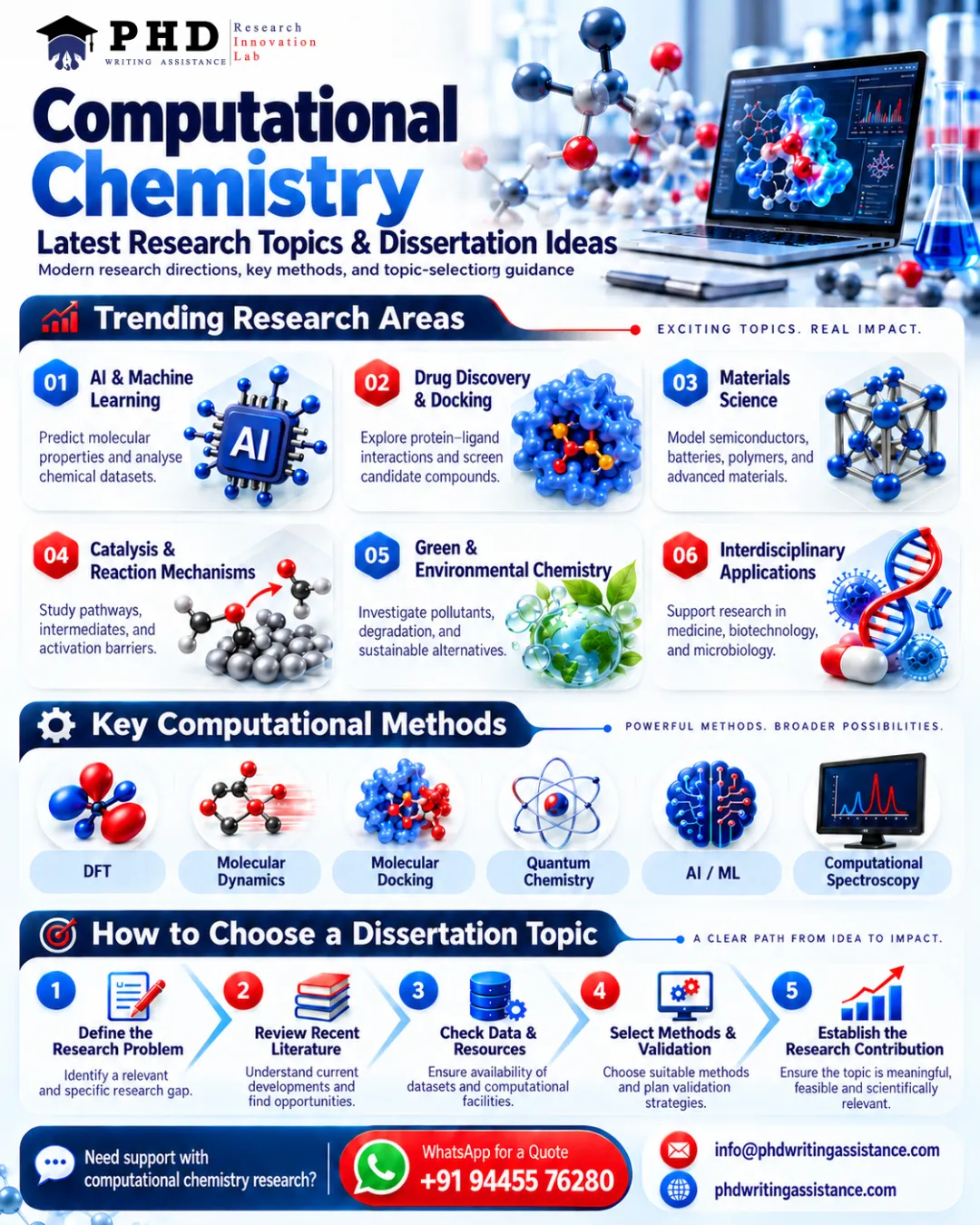
Common computational chemistry methods include:
- Density functional theory (DFT): Used to investigate electronic structures, molecular properties, reaction mechanisms and material characteristics.
- Molecular dynamics simulations: Used to study the movement and interactions of atoms and molecules over time.
- Molecular docking: Used to predict how a molecule may interact with a biological target, particularly in early-stage drug discovery.
- Quantum chemistry calculations: Used to investigate electronic properties, bonding, molecular energies and reaction pathways.
- Machine learning and artificial intelligence: Used to identify patterns in chemical datasets and predict molecular properties.
- Computational spectroscopy: Used to model spectroscopic properties and support the interpretation of experimental observations.
The most appropriate method depends on the research question, the size of the system, computational resources and the level of accuracy required. A well-designed study should explain why a particular method is suitable and how its limitations will be addressed.
Why Is Computational Chemistry Important in Modern Research?
Computational chemistry helps researchers develop explanations and predictions that can guide experimental investigation. It is particularly valuable when studying systems involving numerous possible molecular structures, complicated reaction pathways or interactions that are difficult to observe directly.
In pharmaceutical research, computational approaches can help screen candidate molecules and investigate potential drug–target interactions. In materials science, they can support the development of catalysts, battery materials, polymers and semiconductors. Environmental researchers can use computational methods to investigate pollutants, chemical degradation and interactions between contaminants and natural systems.
Computational chemistry also supports interdisciplinary research. For example, a project combining molecular modelling and microbiology could investigate the predicted interactions between a candidate compound and a microbial protein. Similarly, a project connecting computational chemistry with medicine could examine molecular properties relevant to drug development.
Nevertheless, computational predictions should not automatically be treated as experimental evidence. Reliable research requires appropriate validation, transparent reporting, consideration of uncertainty and, where feasible, comparison with experimental data or established reference results.
Latest Research Topics in Computational Chemistry
The following areas offer potential directions for contemporary computational chemistry research. The suitability of each topic depends on the current literature, available datasets, computational facilities and the specific research gap identified by the student.
1. Artificial Intelligence and Machine Learning in Computational Chemistry
Artificial intelligence and machine learning are increasingly used to analyse chemical datasets, predict molecular properties and accelerate the identification of promising compounds. These methods can learn relationships between molecular structures and properties such as stability, solubility, reactivity and biological activity.
Potential research directions include developing predictive models, comparing machine-learning algorithms and evaluating how different molecular representations influence prediction accuracy.
Possible dissertation topics:
- Machine-learning models for predicting molecular properties of organic compounds.
- Comparative evaluation of artificial intelligence techniques in chemical property prediction.
- Using molecular representations to improve the accuracy of chemical activity prediction.
- Evaluating the reliability and interpretability of machine-learning models in computational chemistry.
- Integrating quantum-chemical descriptors with machine-learning approaches for molecular prediction.
A strong study should establish a clear benchmark, use appropriate training and test data, and examine model limitations rather than focusing solely on prediction accuracy.
2. Computational Drug Discovery and Molecular Docking
Computational drug discovery applies molecular modelling and related techniques to investigate potential interactions between candidate compounds and biological targets. Molecular docking can help generate hypotheses about binding poses, while molecular dynamics simulations may provide additional insight into how molecular complexes behave over time.
These techniques are useful for prioritising compounds for further investigation, but docking scores alone cannot establish that a compound is an effective or safe drug.
Possible dissertation topics:
- Molecular docking analysis of selected compounds against a disease-associated protein.
- Comparative computational screening of natural products for potential biological activity.
- Molecular dynamics analysis of selected protein–ligand complexes.
- Evaluating the relationship between molecular descriptors and predicted binding affinity.
- Integrating docking, molecular dynamics and computational toxicity prediction in early-stage drug discovery.
Students should select a well-defined biological target, justify the choice of compounds and use suitable validation procedures.
3. Computational Chemistry in Materials Science
Computational chemistry plays an important role in understanding how atomic arrangements, chemical composition and electronic structure influence material properties. Researchers use computational models to investigate materials for energy storage, catalysis, electronics and other technological applications.
Possible dissertation topics:
- Density functional theory investigation of electronic properties in selected semiconductor materials.
- Computational screening of materials for potential battery applications.
- Modelling defect structures and their influence on material stability.
- Computational investigation of adsorption properties in porous materials.
- Predicting the relationship between molecular structure and polymer properties using computational methods.
The feasibility of these topics depends on the complexity of the material, the chosen computational approach and access to appropriate software and computing facilities.
4. Computational Catalysis and Reaction Mechanisms
Catalysts influence the rate and pathway of chemical reactions. Computational methods can help researchers investigate reaction intermediates, estimate activation barriers and understand how changes in catalyst structure affect reactivity.
This research area has applications in industrial chemistry, sustainable manufacturing, energy conversion and environmental technologies.
Possible dissertation topics:
- Density functional theory analysis of a selected catalytic reaction mechanism.
- Computational comparison of transition-metal catalysts for a defined chemical transformation.
- Investigating the influence of catalyst structure on predicted activation energy.
- Modelling adsorption and reaction pathways on selected catalyst surfaces.
- Computational evaluation of catalyst properties relevant to sustainable chemical processes.
A focused project should define the reaction, explain the model system and establish how calculated results will be interpreted or compared with published evidence.
5. Green Chemistry and Environmental Applications
Computational chemistry can contribute to environmental research by helping scientists investigate chemical degradation, pollutant interactions and potential alternatives to hazardous substances. It can also support the early evaluation of materials and reactions intended to improve resource efficiency.
Possible dissertation topics:
- Computational investigation of the degradation pathways of a selected environmental pollutant.
- Molecular modelling of interactions between contaminants and adsorbent materials.
- Predicting the chemical properties of potential alternatives to selected hazardous compounds.
- Computational comparison of reaction pathways relevant to sustainable chemical synthesis.
- Modelling molecular interactions involved in the removal of contaminants from water.
These projects should connect the computational findings to a clearly defined environmental question and avoid making unsupported claims about real-world performance.
6. Computational Spectroscopy and Molecular Structure
Computational spectroscopy helps researchers interpret experimental spectra and investigate molecular structure. By calculating vibrational frequencies, electronic transitions or other spectroscopic properties, researchers can compare theoretical predictions with laboratory observations.
Possible dissertation topics:
- Computational prediction and interpretation of infrared spectra for selected organic molecules.
- Comparing theoretical and experimental vibrational frequencies of a defined compound.
- Computational analysis of electronic transitions in selected molecular systems.
- Investigating how molecular conformation influences predicted spectroscopic properties.
- Evaluating computational methods for interpreting molecular structure using spectroscopy.
This area is particularly suitable for projects where reliable reference spectra or experimental measurements are available.
Research Topics for Medicine and Biotechnology
Computational chemistry can contribute to medical and biotechnology research by connecting molecular-level analysis with biological processes. However, these interdisciplinary studies require careful selection of biological targets, suitable chemical systems and appropriate evidence.
Computational Chemistry Research Topics for Medicine
Potential topics include:
- Computational screening of candidate molecules for a defined therapeutic target.
- Molecular modelling of interactions between selected compounds and disease-associated proteins.
- Computational investigation of molecular properties relevant to drug absorption and distribution.
- Comparing predicted binding modes of selected compounds against a validated biological target.
- Combining molecular docking and machine learning to prioritise candidate compounds for further testing.
A medical research project should distinguish between computational predictions and demonstrated therapeutic effects. Claims about efficacy, safety or clinical relevance require evidence beyond modelling results alone.
Biotechnology and Critical Reviews
A critical review in biotechnology examines and evaluates published research rather than simply summarising individual studies. Computational chemistry can provide a useful focus for reviews exploring molecular modelling, computational drug discovery, protein–ligand interactions or machine learning in biotechnology.
Possible review topics include:
- Critical review of computational approaches in biotechnology-driven drug discovery.
- Advances and limitations of molecular docking in predicting protein–ligand interactions.
- A critical review of machine learning for molecular property prediction.
- Computational chemistry applications in enzyme engineering and biotechnology.
- Challenges in validating computational predictions in biomedical research.
A strong critical review compares methods, identifies inconsistencies, evaluates the quality of evidence and explains gaps that could guide future investigations. The review should use a transparent literature-search strategy and clearly defined inclusion criteria appropriate to its scope.
Dissertation Topics in Microbiology Using Computational Chemistry
Microbiology provides opportunities to investigate the molecular interactions associated with microbial proteins, enzymes and biologically relevant compounds. Computational chemistry can support these studies by generating hypotheses about molecular structure and interactions.
Potential dissertation topics include:
- Molecular docking analysis of selected compounds against a defined bacterial protein target.
- Computational investigation of enzyme–inhibitor interactions relevant to microbial systems.
- Molecular dynamics analysis of selected ligand interactions with a microbial protein.
- Comparative molecular modelling of related proteins from selected microbial species.
- Machine-learning prediction of chemical properties associated with a defined antimicrobial compound dataset.
- Computational investigation of the binding interactions of selected natural products with a validated microbial target.
- Structure-based analysis of candidate molecules for further investigation in a defined microbiological context.
- Computational comparison of inhibitor-binding sites in selected microbial enzymes.
These topics should be narrowed to a specific organism, molecular target, compound set and research objective. Computational results do not demonstrate antimicrobial activity by themselves; appropriate laboratory evidence is needed to confirm biological effects.
How to Choose a Suitable Computational Chemistry Dissertation Topic
Selecting a topic is an important stage of postgraduate and doctoral research. A topic that is too broad may produce a descriptive project without a clear contribution, while an overly complex topic may be difficult to complete with the available time and resources.
Consider the following steps when refining a research idea.
1. Identify a Specific Research Problem
Begin with a broad area such as computational drug discovery or materials modelling. Then identify a question that can be investigated using defined methods and measurable outcomes.
For example, instead of choosing “Artificial intelligence in chemistry”, consider “Comparing machine-learning models for predicting the aqueous solubility of a defined set of organic compounds”.
2. Conduct a Structured Literature Review
Review recent peer-reviewed research, established methods and relevant review articles. Identify what researchers have already demonstrated, where findings disagree and which limitations remain unresolved.
The purpose is not merely to find a topic that has received little attention. A viable research gap should be meaningful, supported by evidence and suitable for investigation within the project’s scope.
3. Evaluate Data and Computational Resources
Check whether the required molecular structures, experimental reference data, software and computing resources are available. Consider licensing, reproducibility and the learning curve associated with specialised computational tools.
A project based on publicly available datasets may be more practical than one requiring expensive simulations or extensive experimental validation.
4. Define the Methodology and Validation Strategy
Specify the computational methods, input data, evaluation criteria and validation procedures before starting the main analysis. Explain why the chosen methods are appropriate and what limitations they may introduce.
Depending on the project, validation could include comparison with published experimental measurements, benchmark datasets, alternative computational methods or established reference calculations.
5. Establish the Research Contribution
A dissertation should do more than repeat an existing workflow. Its contribution may involve comparing methods, testing a hypothesis, investigating a new system, analysing uncertainty or producing a reproducible dataset.
The final topic should align with the researcher’s academic level, supervisor’s expertise, project timeline and institutional requirements.
Common Challenges in Computational Chemistry Research
Although computational methods offer considerable opportunities, they also present methodological challenges.
Computational cost: Large molecular systems and advanced simulations may require substantial processing power and time.
Model limitations: Results depend on assumptions, parameter choices and the accuracy of the selected computational method.
Data quality: Incomplete, inconsistent or biased datasets can reduce the reliability of predictions.
Validation difficulties: A promising computational result may not translate directly into an experimentally observable outcome.
Reproducibility: Inadequate reporting of software versions, parameters, datasets and workflows can make results difficult to reproduce.
Interdisciplinary knowledge: Research involving chemistry, medicine, biotechnology or microbiology may require an understanding of both computational methods and the relevant biological or material system.
Addressing these challenges through transparent methodology, suitable controls and critical interpretation strengthens the credibility of the research.
Publication Support for Computational Chemistry Research
Preparing computational chemistry research for publication involves more than obtaining promising simulation results. Researchers must communicate the research question, computational workflow, validation strategy and scientific contribution clearly.
A well-prepared manuscript generally includes a focused abstract, a critical review of relevant literature, a reproducible methodology, clearly presented results, a discussion of limitations and conclusions supported by the evidence.
Before submission, researchers should verify journal scope, author guidelines, reporting requirements, data-sharing policies and publication ethics. Computational studies should report relevant model settings and validation details so that readers can assess the reliability of the findings.
PhD Writing Assistance can support researchers with academic writing, literature review development, research methodology presentation, data interpretation and manuscript editing. Such support can help improve clarity and structure while preserving the researcher’s ownership of the work, scientific judgement and responsibility for the findings.
Conclusion
Computational chemistry offers diverse research opportunities across molecular modelling, artificial intelligence, drug discovery, materials science, catalysis, spectroscopy and environmental chemistry. Its interdisciplinary applications also create potential research directions in medicine, biotechnology and microbiology.
Choosing an appropriate dissertation topic requires more than following a popular research trend. Students should identify a meaningful research gap, select methods suited to the question, evaluate data and computational resources, and establish a suitable validation strategy.
By developing a focused research question and reporting methods and limitations transparently, postgraduate students and PhD scholars can build computational chemistry projects that are scientifically meaningful, reproducible and suitable for further academic investigation.
Frequently Asked Questions
1. What are the latest research topics in computational chemistry?
Current research directions include artificial intelligence for molecular property prediction, computational drug discovery, molecular dynamics, density functional theory, computational catalysis, materials modelling and environmental chemistry. The best topic depends on the research gap and available resources.
2. Which computational chemistry topics are suitable for a PhD dissertation?
Potential topics include machine-learning models for molecular property prediction, computational studies of catalytic mechanisms, molecular dynamics of protein–ligand complexes and modelling electronic properties of advanced materials. A suitable PhD topic should have a clear research question, feasible methodology and a defensible contribution to existing knowledge.
3. How is computational chemistry used in medicine?
Computational chemistry can support early-stage drug discovery by modelling molecular structures, screening candidate compounds and investigating predicted interactions with biological targets. These results help generate research hypotheses but do not independently establish clinical efficacy or safety.
4. Can computational chemistry be combined with microbiology?
Yes. Computational approaches can be used to investigate interactions between compounds and microbial proteins, study enzyme–inhibitor complexes and compare molecular structures. Computational predictions should be interpreted carefully and, where relevant, validated using suitable experimental evidence.
5. How can researchers prepare computational chemistry research for publication?
Researchers should establish a clear research question, use appropriate computational methods, document the workflow, validate findings where feasible and discuss limitations transparently. A manuscript should also follow the target journal’s scope, formatting, data-sharing and publication-ethics requirements.