Introduction
The construction industry is undergoing a significant transformation driven by technological innovation, and one of the most influential advancements is artificial intelligence in construction. Traditionally, construction and civil engineering projects relied heavily on manual planning, human expertise, and historical practices. However, increasing project complexity, rising costs, safety concerns, and sustainability requirements have created a need for smarter and more efficient solutions.
Today, AI-powered technologies are reshaping how infrastructure is designed, constructed, monitored, and maintained. From predictive analytics and automated project management to intelligent monitoring systems, artificial intelligence in construction is enabling organizations to improve accuracy, reduce risks, and optimize resources. Simultaneously, the adoption of artificial intelligence in civil engineering is helping professionals make data-driven decisions that improve infrastructure performance and resilience.
Despite these advantages, the rapid integration of AI raises important concerns regarding data reliability, ethical considerations, workforce transformation, and long-term system sustainability. Understanding both the opportunities and challenges associated with AI adoption is essential for industry stakeholders seeking to maximize its benefits while minimizing potential risks.
This article critically examines the growing role of AI in construction and civil engineering, exploring its applications, benefits, challenges, and future implications for the built environment.
The Growing Importance of Artificial Intelligence in Civil Engineering
The emergence of artificial intelligence in civil engineering represents a major shift in how engineers approach infrastructure planning and management. AI systems can process vast amounts of information from sensors, historical records, satellite imagery, and construction databases to generate actionable insights that support engineering decisions.
Modern infrastructure projects generate enormous volumes of data. Bridges, highways, tunnels, and buildings continuously produce information through embedded monitoring systems. AI technologies can analyze these datasets faster and more accurately than traditional methods, allowing engineers to identify patterns, predict failures, and optimize maintenance schedules.
As governments and private organizations invest in smart cities and sustainable infrastructure, AI is becoming a critical tool for improving efficiency and ensuring long-term asset performance.
Key Benefits of Artificial Intelligence in Construction
Improved Accuracy and Predictive Decision-Making
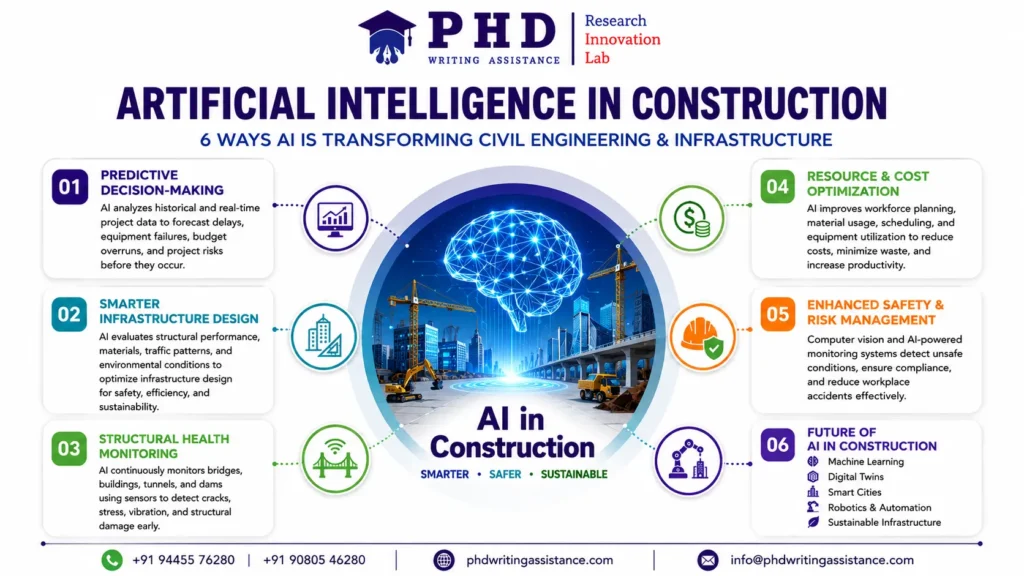
One of the most significant benefits of artificial intelligence in construction is its ability to analyze large datasets and generate highly accurate predictions. AI algorithms identify patterns that may be difficult for humans to detect, helping project teams anticipate potential challenges before they become major problems.
Predictive analytics can forecast equipment failures, construction delays, budget overruns, and maintenance requirements. By identifying risks early, organizations can implement preventive measures that reduce disruptions and improve project outcomes.
For example, AI-powered systems can evaluate historical project data alongside real-time site conditions to predict scheduling conflicts and resource shortages. This proactive approach helps construction managers make informed decisions and improve operational efficiency.
Cost Reduction and Resource Optimization
Construction projects frequently face budget constraints and resource management challenges. AI-driven solutions help organizations optimize material usage, workforce allocation, and equipment utilization.
By analyzing project requirements and performance metrics, AI systems can recommend the most efficient construction methods and identify opportunities to reduce waste. This leads to lower project costs, improved productivity, and enhanced sustainability.
Enhanced Safety and Risk Management
Safety remains a top priority within the construction sector. AI technologies can monitor construction sites in real time, detecting hazardous conditions and alerting managers before accidents occur.
Computer vision systems powered by AI can identify workers who are not wearing protective equipment, monitor unsafe behaviors, and assess site risks. These capabilities contribute to safer working environments and reduced workplace incidents.
How AI in Infrastructure Design is Reshaping Modern Construction
The integration of AI in infrastructure design is changing how engineers develop and evaluate construction projects. Traditional design processes often require extensive manual calculations and multiple iterations to identify optimal solutions.
AI-powered design tools can simulate thousands of design scenarios within minutes, helping engineers evaluate structural performance, environmental impact, and cost efficiency.
Data-Driven Design Optimization
Through advanced modeling and simulation capabilities, AI in infrastructure design enables engineers to create more efficient and sustainable structures. AI systems can analyze multiple variables simultaneously, including material properties, environmental conditions, and traffic patterns.
This data-driven approach helps engineers select designs that maximize durability while minimizing costs and environmental impact.
Sustainable Infrastructure Planning
Sustainability has become a key objective in modern construction. AI assists planners in developing infrastructure projects that reduce carbon emissions, conserve resources, and improve energy efficiency.
By incorporating environmental data into design processes, AI supports the creation of resilient infrastructure capable of adapting to future challenges such as climate change and population growth.
The Role of Structural Health Monitoring Using AI
Infrastructure assets require continuous monitoring to ensure safety and performance throughout their lifecycle. Structural health monitoring using AI has emerged as one of the most valuable applications within civil engineering.
Traditional inspection methods often rely on periodic manual assessments that can be time-consuming and expensive. AI-powered monitoring systems offer a more efficient alternative by continuously analyzing data collected from sensors embedded within structures.
Real-Time Infrastructure Monitoring
Through structural health monitoring using AI, engineers can receive real-time information about the condition of bridges, buildings, dams, and transportation networks.
AI algorithms process sensor data to identify signs of deterioration, stress, vibration anomalies, and structural damage. Early detection allows maintenance teams to address issues before they escalate into costly failures.
Predictive Maintenance and Failure Prevention
Predictive maintenance is a major advantage of AI-based monitoring systems. Rather than waiting for infrastructure components to fail, organizations can schedule repairs based on predicted deterioration patterns.
This proactive maintenance strategy reduces downtime, lowers repair costs, and extends the lifespan of critical infrastructure assets.
However, challenges remain. AI systems may occasionally generate false positives or overlook subtle indicators of structural problems. Therefore, human expertise remains essential in validating AI-generated recommendations.
Applications of Machine Learning in Civil Engineering
The adoption of machine learning in civil engineering continues to expand as organizations seek innovative solutions for complex engineering challenges.
Machine learning algorithms improve over time by learning from historical and real-time data. This capability makes them particularly valuable for applications involving prediction, classification, and optimization.
Construction Delay Prediction
Project delays remain one of the most common challenges in construction management. Using historical project data, machine learning in civil engineering can identify factors that contribute to delays and predict future scheduling risks.
These insights enable project managers to implement corrective actions before delays affect project timelines.
Project Risk Assessment
Machine learning models can analyze multiple risk factors simultaneously, including weather conditions, resource availability, labor productivity, and financial constraints.
By evaluating these variables, AI systems help organizations make more informed decisions regarding project planning and risk mitigation.
Smart Construction Management
AI-powered project management platforms support real-time monitoring, automated reporting, and resource optimization. These tools improve collaboration among project teams and enhance overall project performance.
Ethical Implications of AI in Engineering
While AI offers significant benefits, organizations must carefully address the ethical implications of AI in engineering.
Data Privacy and Security Concerns
AI systems rely on extensive data collection and processing. In construction and civil engineering projects, this may involve sensitive operational information, infrastructure data, and public records.
Organizations must implement robust cybersecurity measures and data governance frameworks to protect privacy and ensure compliance with regulations.
Bias in AI Models
AI algorithms learn from historical data, which may contain biases or inaccuracies. If these biases are not addressed, AI systems can produce flawed recommendations that affect project outcomes.
Developing transparent and accountable AI models is essential for maintaining trust and ensuring fair decision-making.
Workforce Transformation and Job Displacement
Automation has raised concerns regarding potential job displacement within engineering and construction sectors. While AI can automate repetitive tasks, it is unlikely to replace human expertise entirely.
Instead, AI is expected to transform workforce requirements by increasing demand for professionals with digital, analytical, and AI-related skills.
Challenges and Limitations of Artificial Intelligence in Construction
Despite its potential, artificial intelligence in construction faces several limitations.
Dependence on High-Quality Data
AI systems require accurate, comprehensive, and standardized datasets. Poor data quality can significantly reduce prediction accuracy and system reliability.
Reliability During Unpredictable Events
AI models primarily rely on historical patterns. As a result, they may struggle to respond effectively to rare or unprecedented events such as natural disasters, extreme weather conditions, or unexpected structural failures.
Technology Adoption Costs
Implementing AI technologies often requires significant investments in software, hardware, training, and infrastructure upgrades. Smaller organizations may face financial barriers that limit adoption.
Future Trends in Artificial Intelligence in Construction
The future of artificial intelligence in construction is expected to be driven by advancements in machine learning, robotics, digital twins, and smart infrastructure systems.
Emerging technologies will enable greater automation, improved project visibility, and more sophisticated predictive capabilities. AI-powered digital twins will allow engineers to create virtual representations of infrastructure assets, supporting real-time monitoring and scenario analysis.
Additionally, increased collaboration between AI systems and human experts will likely result in more resilient, sustainable, and efficient infrastructure projects.
As AI technologies continue to evolve, organizations that embrace innovation while maintaining ethical and responsible practices will be better positioned to achieve long-term success.
Conclusion
The rise of artificial intelligence in construction is transforming the construction and engineering industries by enhancing efficiency, improving decision-making, and strengthening infrastructure resilience. The integration of artificial intelligence in civil engineering, AI in infrastructure design, structural health monitoring using AI, and machine learning in civil engineering demonstrates the technology’s vast potential to reshape how projects are planned, executed, and maintained.
However, the successful implementation of AI requires careful consideration of data quality, ethical concerns, workforce adaptation, and technological limitations. Addressing the ethical implications of AI in engineering is essential to ensuring that innovation benefits society while maintaining public trust.
As the construction industry moves toward a more digital future, the combination of AI technologies and human expertise will play a critical role in building safer, smarter, and more sustainable infrastructure for generations to come.
References
1. Kapoor, N. R., Kumar, A., Kumar, A., Kumar, A., & Arora, H. C. (2024). Artificial intelligence in civil engineering: An immersive view. In Artificial Intelligence Applications for Sustainable Construction (pp. 1-74). Woodhead Publishing. https://doi.org/10.1016/B978-0-443-13191-2.00009-2 [data-driven predictions]
2. Gondia, A., Siam, A., El-Dakhakhni, W., & Nassar, A. H. (2020). Machine learning algorithms for construction projects delay risk prediction. Journal of Construction Engineering and Management, 146(1), 04019085. https://doi.org/10.1061/(ASCE)CO.1943-7862.0001736 [constraints and biases]
3. Habib, M., Habib, A., Albzaie, M., & Farghal, A. (2024). Sustainability benefits of AI-based engineering solutions for infrastructure resilience in arid regions against extreme rainfall events. Discover Sustainability, 5(1), 278. https://doi.org/10.1007/s43621-024-00500-2 [infrastructure design]
4. Zinno, R., Haghshenas, S. S., Guido, G., & VItale, A. (2022). Artificial intelligence and structural health monitoring of bridges: A review of the state-of-the-art. IEEE Access, 10, 88058-88078. https://doi.org/10.1109/ACCESS.2022.3199443 [Structural Health Monitoring]
5. Liang, C. J., Le, T. H., Ham, Y., Mantha, B. R., Cheng, M. H., & Lin, J. J. (2024). Ethics of artificial intelligence and robotics in the architecture, engineering, and construction industry. Automation in Construction, 162, 105369. https://doi.org/10.1016/j.autcon.2024.105369 [data privacy]
Frequently Asked Questions
1. What is artificial intelligence in construction?
Artificial intelligence in construction uses machine learning, predictive analytics, and automation to improve construction planning, project management, safety, and maintenance. It helps organizations reduce costs, improve efficiency, and make faster data-driven decisions.
2. How is artificial intelligence used in civil engineering?
Artificial intelligence in civil engineering is used for infrastructure design, structural analysis, risk assessment, predictive maintenance, and project monitoring. It helps engineers analyze large datasets, optimize designs, and improve infrastructure performance.
3. What are the benefits of AI in infrastructure design?
AI in infrastructure design improves design accuracy, reduces material waste, lowers project costs, and supports sustainable construction. It enables engineers to evaluate multiple design options and select the most efficient solution.
4. How does structural health monitoring using AI improve infrastructure safety?
Structural health monitoring using AI improves safety by continuously analyzing sensor data to detect structural damage, deterioration, and stress. Early detection allows engineers to perform maintenance before failures occur.
5. What are the ethical implications of AI in engineering?
The ethical implications of AI in engineering include data privacy concerns, algorithm bias, cybersecurity risks, and workforce changes. Responsible AI implementation requires transparency, secure data management, and human oversight.