Introduction
Writing a research paper for PhD requires a clear research question, strong evidence, appropriate methodology, critical analysis, and a well-structured academic argument. A PhD research paper should do more than summarise existing studies; it should communicate a meaningful contribution to the research field.
For PhD students, learning research paper how to write effectively can also support thesis development and journal publication. A well-planned paper helps researchers organise their findings, explain their contribution, and communicate their research to an academic audience.
The exact structure varies by discipline and journal, but the fundamental writing process remains similar across many research areas.
What Is a Research Paper for PhD?
A research paper for PhD is an academic document that presents original research, analysis, findings, or a critical contribution to a specific research area.
A strong PhD research paper generally:
- Addresses a clearly defined research problem
- Reviews relevant academic literature
- Explains an appropriate research methodology
- Presents and analyses evidence
- Discusses the significance of the findings
- Identifies the research contribution
- Uses appropriate academic references
The paper should have a clear connection between the research problem, objectives, methodology, findings, and conclusion.
Steps to Write a Research Paper for PhD
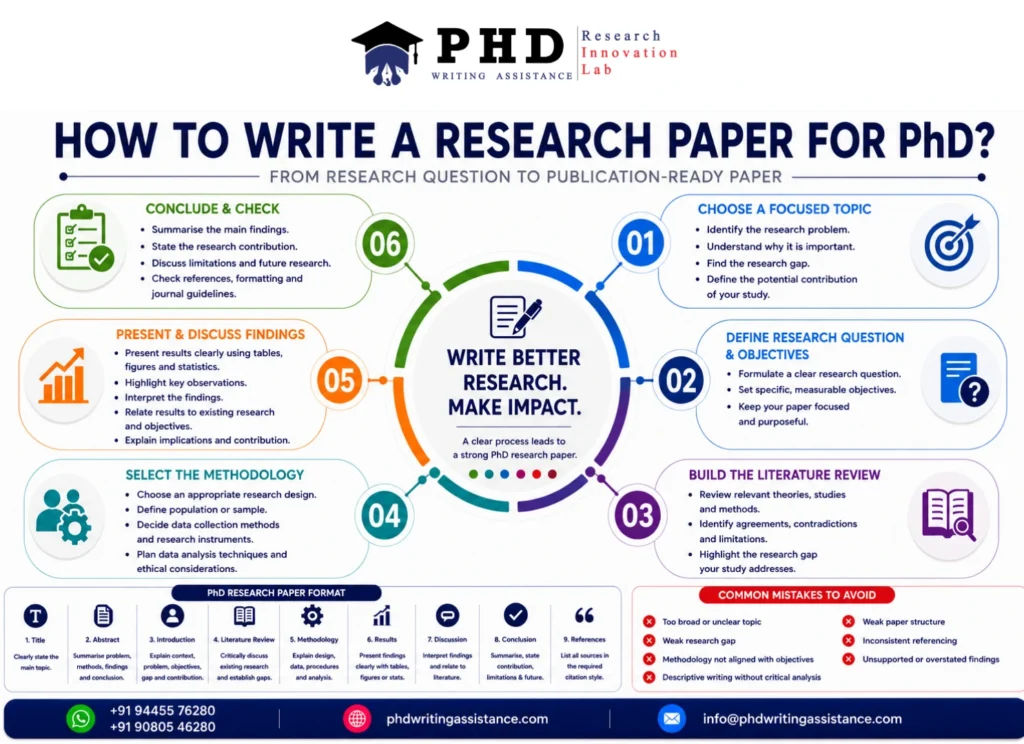
Following clear steps to write a research paper for PhD can make the writing process more manageable.
1. Choose a Focused Research Topic
Start with a specific research problem rather than a broad subject.
Ask:
- What problem does the study address?
- Why is the problem important?
- What gap exists in current research?
- What new contribution could the study make?
A focused topic makes it easier to develop research questions and determine what evidence is relevant.
2. Define the Research Question and Objectives
The research question should clearly establish what the paper is investigating.
Your objectives should explain what the research intends to achieve.
For example:
Research question:
How does a particular intervention affect a defined research outcome?
Research objectives:
- To examine the existing evidence
- To evaluate the selected intervention
- To analyse the resulting data
- To identify implications for future research
A clear research question keeps the paper focused and prevents unnecessary information from being included.
3. Conduct a Literature Review
A literature review establishes the academic context for the research.
Instead of simply listing previous studies, critically examine:
- Existing theories
- Previous findings
- Research methods
- Areas of agreement
- Contradictory findings
- Limitations
- Research gaps
The literature review should lead logically to the research problem and explain why the current study is necessary.
4. Select an Appropriate Methodology
The methodology explains how the research was conducted.
Depending on the study, this may include:
- Research design
- Population and sample
- Data collection methods
- Research instruments
- Variables
- Data analysis techniques
- Ethical considerations
The methodology should be appropriate for the research question and sufficiently clear for readers to understand how the findings were produced.
PhD Research Paper Format
The PhD research paper format can vary depending on the discipline, institution, and target journal. However, many research papers follow a structure similar to:
1. Title
Clearly communicate the main topic or research problem.
2. Abstract
Summarise the research problem, methodology, key findings, and conclusion.
3. Introduction
Explain the research context, problem, objectives, research gap, and contribution.
4. Literature Review
Critically discuss relevant existing research and establish the research gap.
5. Methodology
Explain the research design, participants or data sources, procedures, and analysis methods.
6. Results
Present the findings clearly using appropriate text, tables, figures, or statistical results.
7. Discussion
Interpret the findings and relate them to existing literature and the research objectives.
8. Conclusion
Summarise the main findings, contribution, limitations, and possible future research.
9. References
List the sources cited in the paper according to the required referencing style.
Always check the target journal’s author guidelines because the required structure can differ.
How to Write the Results and Discussion
The results section should present what the research found without unnecessarily repeating the methodology.
Use:
- Tables
- Figures
- Statistical results
- Key observations
- Relevant qualitative themes
The discussion should then explain what those findings mean.
A strong discussion can address:
- How the findings relate to previous research
- Whether the results support existing theories
- Why unexpected findings may have occurred
- The implications of the results
- The contribution of the study
Avoid simply repeating the results. The discussion should provide interpretation and critical analysis.
How to Write a Strong Conclusion
A conclusion should provide a clear answer to the research problem.
It can include:
- Main findings
- Research contribution
- Practical or theoretical implications
- Study limitations
- Recommendations
- Future research directions
Avoid introducing completely new evidence or arguments that were not discussed earlier in the paper.
Common Mistakes in PhD Research Papers
Understanding the common mistakes in PhD research paper writing can help researchers improve their manuscripts.
1. Choosing an Overly Broad Topic
A broad topic can make the research question and argument unclear.
2. Weak Research Gap
The paper should clearly explain what is missing from existing research.
3. Poor Methodology Alignment
The research design and methods should directly support the research question.
4. Descriptive Rather Than Critical Writing
PhD-level research requires analysis and evaluation rather than simply describing previous studies.
5. Weak Structure
Each section should contribute to the overall argument and connect logically with the next.
6. Inconsistent Referencing
Missing or incorrectly formatted references can reduce academic credibility.
7. Overstating the Findings
Researchers should ensure that conclusions are supported by the evidence rather than making claims beyond the study’s scope.
How to Improve Your PhD Research Paper
Before submitting a paper, complete a structured review.
Check the Research
- Is the research question clear?
- Is the research gap well established?
- Is the methodology appropriate?
- Are the findings supported by the evidence?
Check the Writing
- Is the argument easy to follow?
- Are paragraphs logically connected?
- Is academic terminology used consistently?
- Have unnecessary repetitions been removed?
Check the Presentation
- Are tables and figures clearly labelled?
- Are references complete?
- Does the manuscript follow the required format?
- Have the journal’s submission requirements been followed?
A final editing and proofreading stage can help identify clarity, grammar, structure, and formatting issues before submission.
Can a PhD Research Paper Support Thesis Writing?
Yes. A research paper can contribute to PhD thesis development when its research question, literature review, methodology, findings, and analysis align with the broader doctoral research project.
However, a journal paper and thesis chapter are not necessarily interchangeable. A thesis usually provides a more comprehensive explanation of the research, while a journal article is typically more focused and constrained by the target journal’s requirements.
Writing papers during a PhD can therefore help researchers practise academic communication and refine how they present their research contribution.
PhD Research Paper Writing Support
Preparing a research paper can involve several stages, including literature organisation, methodology presentation, academic writing, referencing, editing, and proofreading.
PhD students who need academic support can seek assistance with areas such as research paper structure, academic editing, proofreading, literature organisation, and manuscript preparation.
Professional PhD writing assistance should support the presentation and clarity of the research while preserving the student’s original ideas, research data, analysis, and academic contribution.
Conclusion
Learning how to write a research paper for PhD involves more than following a standard template. Researchers need to develop a clear research question, establish a research gap, select an appropriate methodology, analyse evidence critically, and communicate the contribution of the study effectively.
The PhD research paper format provides a useful framework, but the exact requirements depend on the research discipline and target journal. By following clear writing steps, avoiding common mistakes, and carefully reviewing the manuscript before submission, PhD students can produce clearer and more academically rigorous research papers.
Frequently Asked Questions
1. How do I write a research paper during my PhD?
Define a focused research question, review relevant literature, select an appropriate methodology, analyse the findings, and present the research using a clear academic structure.
2. What structure should a PhD research paper follow?
A typical structure includes the title, abstract, introduction, literature review, methodology, results, discussion, conclusion, and references.
3. How many papers should a PhD student publish?
There is no universal number. Publication requirements vary by university, discipline, programme, supervisor expectations, and research field.
4. What are common mistakes in PhD research papers?
Common mistakes include a weak research gap, unclear research questions, poor methodology alignment, descriptive writing, weak structure, inconsistent referencing, and unsupported conclusions.
5. Can PhD students publish papers before thesis submission?
Yes. PhD students can often publish research papers before submitting their thesis, provided the research and manuscript meet the requirements of the target journal and their institution’s policies.