Introduction
Selecting the right research design is one of the most important decisions in any research project. Whether you are writing a university assignment, master’s dissertation, PhD thesis, or journal article, a well-planned research design ensures that your study is systematic, reliable, and capable of answering the research questions effectively. Understanding research design methods helps researchers choose appropriate strategies for data collection, analysis, and interpretation, ultimately improving the quality and credibility of their work.
Many students confuse research design with research methodology. While research methodology explains the overall approach to conducting research, research design provides the detailed blueprint that outlines how the study will be carried out. It includes selecting participants, deciding on data collection techniques, determining analysis methods, and ensuring that the research objectives are achieved efficiently.
A structured research design process helps researchers organise every stage of the study before data collection begins. By following the correct steps in research design, researchers can minimise bias, improve accuracy, and produce findings that are both valid and reliable. Choosing the right research approach types, such as quantitative, qualitative, or mixed methods, is equally important because each approach is designed to answer different types of research questions.
Researchers may also adopt specialised designs depending on the objectives of their study. For example, understanding the characteristics of action research is valuable for studies focused on solving practical problems through continuous improvement and collaboration. Similarly, narrative research enables researchers to explore personal experiences and life stories, making it particularly useful in education, healthcare, psychology, and social sciences.
This comprehensive guide explains research design methods, explores the research design process, outlines the essential steps in research design, discusses different research approach types, examines the characteristics of action research, and explains how narrative research contributes to academic and professional studies.
What Are Research Design Methods?
Research design methods refer to the structured plans or strategies researchers use to conduct a study. They define how data will be collected, measured, analysed, and interpreted to answer specific research questions.
A research design acts as the foundation of a study by ensuring that every stage of the research follows a logical and organised process. It helps researchers:
- Define clear research objectives.
- Select suitable data collection methods.
- Choose appropriate sampling techniques.
- Reduce bias and errors.
- Improve the reliability and validity of findings.
- Ensure ethical research practices.
Selecting the right research design depends on the nature of the research problem, available resources, and the objectives of the study.
Why Are Research Design Methods Important?
Choosing appropriate research design methods plays a significant role in the success of any research project.
A well-designed study offers several advantages.
Improves Research Quality
A structured design helps researchers collect accurate and relevant data, resulting in more reliable conclusions.
Reduces Research Bias
Carefully planned research procedures minimise errors and reduce the influence of personal bias throughout the study.
Supports Valid Conclusions
An appropriate research design ensures that the findings accurately address the research questions and objectives.
Enhances Research Efficiency
Planning the study before collecting data saves time, reduces unnecessary revisions, and improves project management.
Increases Academic Credibility
Well-designed research demonstrates professionalism and strengthens the credibility of academic work during thesis evaluation or journal publication.
Understanding the Research Design Process
The research design process is the systematic sequence of activities researchers follow to prepare and conduct a research study.
Although individual projects may vary, the overall process generally includes:
- Identifying the research problem.
- Reviewing existing literature.
- Defining research objectives.
- Selecting the research approach.
- Choosing data collection methods.
- Planning data analysis.
- Interpreting and presenting findings.
Following a structured process helps ensure consistency, transparency, and research integrity throughout the study.
Essential Steps in Research Design
Every successful research project follows organised steps in research design.
Step 1: Identify the Research Problem
Clearly define the issue or question your research intends to investigate.
A focused research problem provides direction for the entire study.
Step 2: Conduct a Literature Review
Review previous studies to understand existing knowledge, identify research gaps, and establish a theoretical foundation.
A strong literature review also helps refine your research objectives.
Step 3: Develop Research Objectives
Clearly state what your study aims to achieve.
Specific objectives make it easier to select appropriate research methods and evaluate findings.
Step 4: Select the Research Design
Choose the most suitable research design methods based on your research questions, available data, and study objectives.
Step 5: Choose Data Collection Methods
Determine how information will be gathered.
Common methods include:
- Surveys
- Interviews
- Observations
- Experiments
- Questionnaires
- Secondary data analysis
Step 6: Plan Data Analysis
Select appropriate statistical or qualitative analysis techniques before collecting data.
Proper planning ensures meaningful interpretation of research findings.
Step 7: Report Findings
Present results clearly, discuss their significance, acknowledge limitations, and provide recommendations for future research.
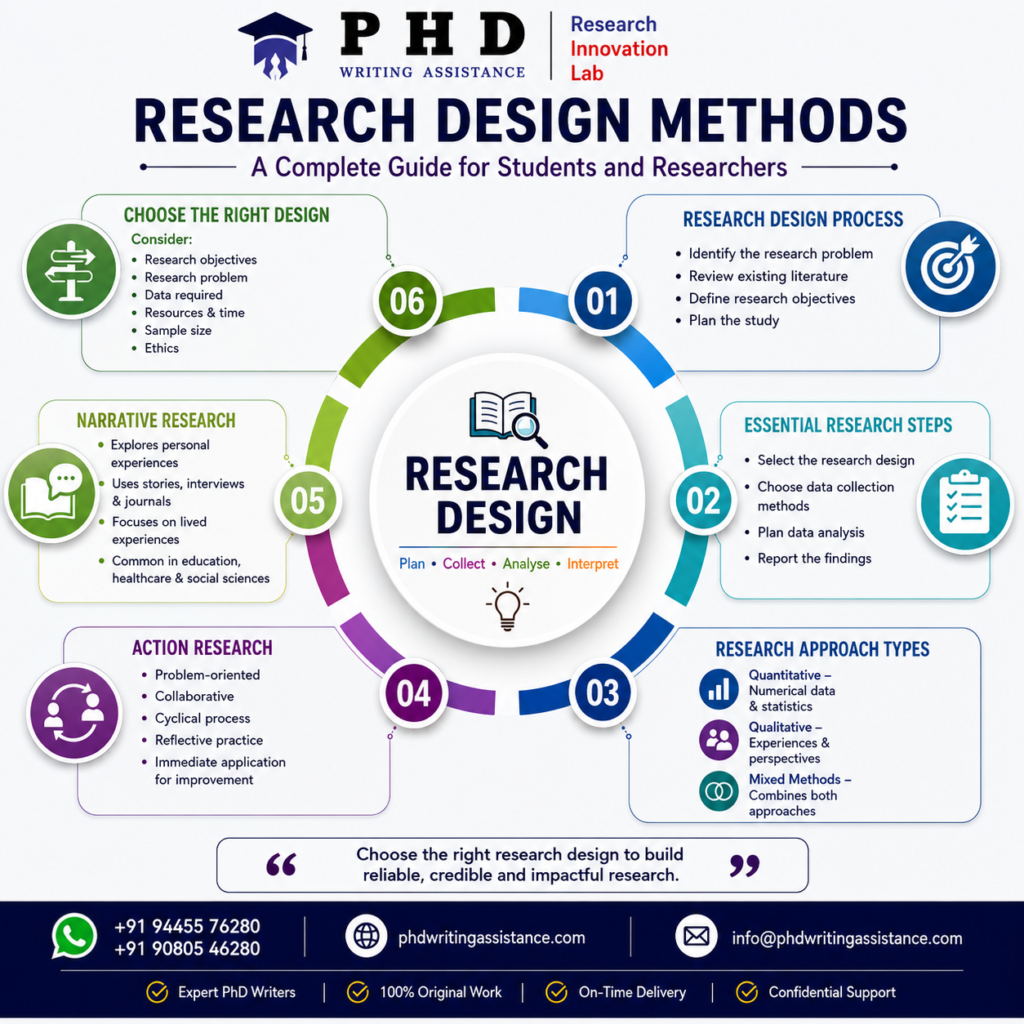
Understanding Research Approach Types
Selecting the appropriate research approach types is an important part of designing a successful research study. The research approach determines how data is collected, analysed, and interpreted to answer the research questions.
The three most commonly used research approaches are quantitative, qualitative, and mixed methods.
Quantitative Research
Quantitative research focuses on numerical data and statistical analysis. It is commonly used when researchers want to measure variables, test hypotheses, or identify relationships between different factors.
Examples of quantitative data collection include:
- Surveys
- Structured questionnaires
- Experiments
- Statistical databases
Advantages
- Produces measurable and objective results.
- Suitable for large sample sizes.
- Supports statistical analysis.
- Easy to compare findings across studies.
Qualitative Research
Qualitative research explores people’s experiences, opinions, beliefs, and behaviours. Instead of numerical data, it focuses on understanding meanings and perspectives.
Common qualitative methods include:
- Interviews
- Focus groups
- Observations
- Case studies
Advantages
- Provides detailed insights.
- Explores complex social phenomena.
- Captures participant experiences.
- Offers flexibility during data collection.
Mixed Methods Research
Mixed methods research combines both quantitative and qualitative approaches within the same study.
Researchers often use this approach when numerical findings alone cannot fully explain the research problem.
For example, a researcher may analyse survey data and then conduct interviews to gain a deeper understanding of participant responses.
Advantages
- Provides comprehensive findings.
- Improves research validity.
- Combines statistical evidence with real-world experiences.
- Strengthens overall research conclusions.
Understanding the Characteristics of Action Research
One of the most practical research design methods is action research. It is widely used in education, healthcare, business, and organisational development to solve real-world problems through continuous improvement.
The characteristics of action research distinguish it from traditional research designs.
Problem-Oriented
Action research focuses on identifying and solving practical problems rather than only developing theoretical knowledge.
Cyclical Process
Action research follows a continuous cycle of:
- Planning
- Acting
- Observing
- Reflecting
- Improving
This process allows researchers to refine solutions based on ongoing observations.
Collaborative Approach
Researchers often work closely with participants, stakeholders, teachers, healthcare professionals, or organisations throughout the study.
Collaboration improves both the relevance and effectiveness of the research outcomes.
Reflective Practice
Researchers continuously evaluate their actions and findings to improve future practices and decision-making.
Immediate Application
Unlike many traditional research designs, action research aims to implement practical solutions that can be applied immediately within real-world settings.
What Is Narrative Research?
Narrative research is a qualitative research design that explores people’s personal experiences by collecting and analysing their stories.
Instead of focusing on numbers, narrative research seeks to understand how individuals interpret significant events in their lives.
Researchers typically gather information through:
- In-depth interviews
- Personal journals
- Diaries
- Autobiographies
- Life histories
- Personal documents
When Is Narrative Research Used?
Narrative research is particularly valuable in disciplines such as:
- Education
- Psychology
- Healthcare
- Social Work
- Sociology
- Counselling
For example, researchers may study the experiences of first-generation university students, patients living with chronic illnesses, or teachers adapting to new educational policies.
By analysing personal stories, researchers gain rich insights that may not emerge through surveys or statistical analysis.
How to Choose the Right Research Design Method
Selecting the most suitable research design methods depends on several important factors.
Consider the following before making your decision:
- Your research objectives.
- The nature of the research problem.
- The type of data required.
- Available time and resources.
- Sample size.
- Ethical considerations.
- Preferred data analysis techniques.
A carefully selected research design improves the reliability, validity, and overall quality of your research findings.
Common Mistakes When Choosing Research Design
Many researchers make avoidable mistakes during the planning stage.
Some of the most common include:
- Selecting a research design that does not align with the research objectives.
- Ignoring the importance of the research design process.
- Skipping essential steps in research design.
- Choosing inappropriate research approach types for the available data.
- Overlooking ethical considerations.
- Collecting insufficient or unreliable data.
- Failing to justify the chosen research design.
Avoiding these mistakes strengthens the overall quality of your research project.
Best Practices for Effective Research Design
To develop a strong research design:
- Clearly define your research objectives.
- Follow every stage of the research design process systematically.
- Complete all essential steps in research design before collecting data.
- Select the most appropriate research approach types based on your research questions.
- Understand the characteristics of action research if your study focuses on practical problem-solving.
- Use narrative research when exploring personal experiences and lived realities.
- Maintain ethical research standards.
- Review your research design before beginning data collection.
Following these best practices improves research quality and increases the credibility of your findings.
Conclusion
Understanding research design methods is essential for conducting high-quality academic research. A well-planned research design provides a clear framework for collecting, analysing, and interpreting data while ensuring that the study remains organised, reliable, and aligned with its objectives. By following a structured research design process and completing the essential steps in research design, researchers can minimise bias, improve data quality, and produce meaningful results.
Choosing the appropriate research approach types whether quantitative, qualitative, or mixed methods depends on the research questions and the type of evidence required. Researchers should also understand specialised approaches such as the characteristics of action research for solving practical problems and narrative research for exploring personal experiences and lived stories. Selecting the right research design not only strengthens the credibility of a study but also contributes to producing ethical, impactful, and academically valuable research.
Frequently Asked Questions
1. What are research design methods?
Research design methods are structured plans that guide how researchers collect, analyse, and interpret data to answer specific research questions effectively.
2. What are the main steps in research design?
The main steps in research design include identifying the research problem, reviewing the literature, defining objectives, selecting the research design, collecting data, analysing results, and presenting findings.
3. What are the common research approach types?
The most common research approach types are quantitative research, qualitative research, and mixed methods research. Each approach is selected based on the study’s objectives and data requirements.
4. What are the characteristics of action research?
The key characteristics of action research include a problem-solving focus, collaboration, continuous improvement, reflective practice, and the immediate application of research findings.
5. What is narrative research?
Narrative research is a qualitative research design that explores and analyses individuals’ personal stories and lived experiences to gain deeper insights into a particular phenomenon.