Introduction
Publishing research is an important milestone for PhD scholars, postgraduate students and academic researchers. It allows researchers to communicate their findings, contribute to existing knowledge and receive feedback from the wider academic community. However, preparing a manuscript for publication requires more than conducting a study. Researchers must select an appropriate publication venue, follow submission guidelines, demonstrate originality and respond effectively to peer-review feedback.
IEEE paper publication is particularly relevant to researchers working in electrical and electronic engineering, computer science, telecommunications, robotics, artificial intelligence and related technical disciplines. IEEE publishes scholarly journals, magazines and conference proceedings covering a wide range of engineering and technology topics.
Understanding the publication process can help researchers prepare stronger manuscripts and avoid common submission errors. From selecting the right journal or conference to revising a manuscript after peer review, each stage requires careful planning.
What Is IEEE Paper Publication?
IEEE paper publication refers to publishing scholarly research through the Institute of Electrical and Electronics Engineers (IEEE), a professional organisation supporting engineering, computing and technology research.
IEEE provides several publication routes, including peer-reviewed journals and conference proceedings. Journals generally publish research articles within defined subject areas, while conferences provide opportunities to present and disseminate research through proceedings and academic discussion. The requirements, review procedures and publication timelines vary by venue.
Researchers should therefore identify whether their work is better suited to a journal or a conference before preparing a submission. For example, a detailed study presenting extensive experimental validation may suit a journal, whereas a focused technical contribution intended for presentation at a specialist conference may be appropriate for conference proceedings. The best choice depends on the research contribution, the venue’s scope and its submission criteria.
How to Publish an IEEE Research Paper Successfully
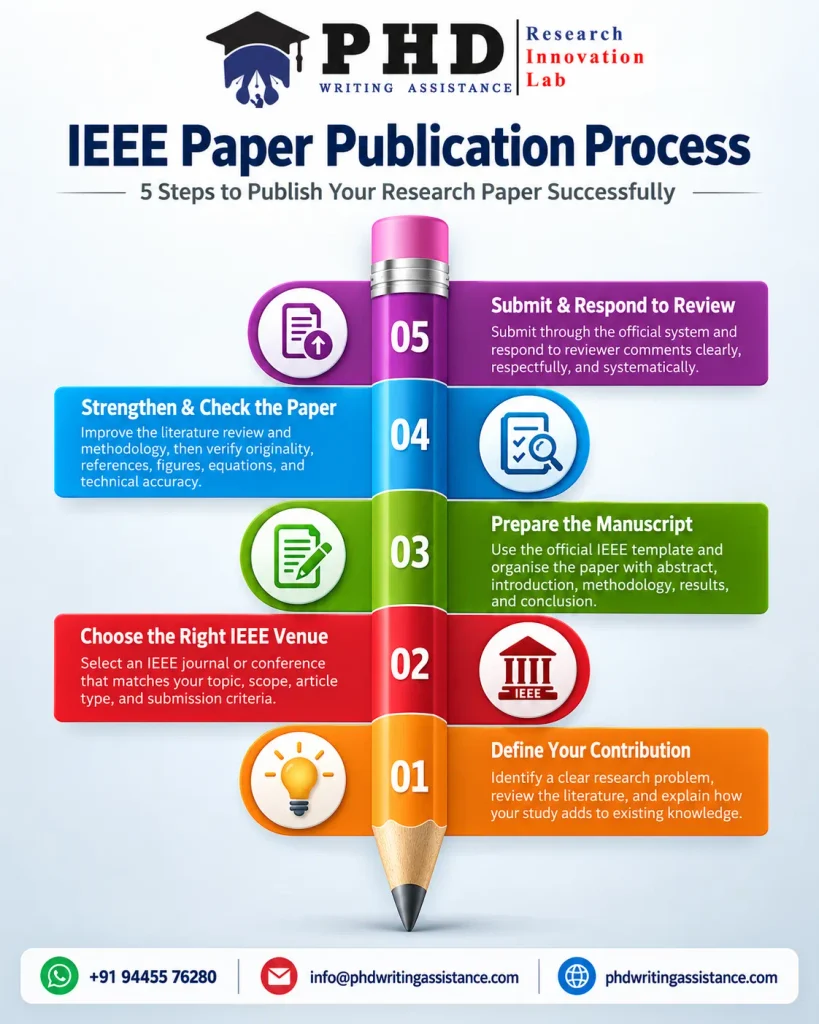
The IEEE paper publication process involves several connected stages. Following a structured approach can help researchers prepare their manuscripts and identify potential problems before submission.
Step 1: Identify a Clear and Original Research Contribution
A publishable research paper should address a meaningful research problem and explain how the study contributes to existing knowledge. Researchers should begin by reviewing relevant literature, identifying unresolved questions and defining the specific contribution of their work.
In technical disciplines, originality may involve a new algorithm, an improved engineering design, a novel application of an established technique or experimental evidence that advances current understanding. The contribution must be explained clearly and supported by appropriate evidence.
Before drafting the manuscript, researchers should formulate a focused research question and determine how their results will address it.
Step 2: Select the Right IEEE Journal or Conference
Choosing an appropriate publication venue is one of the most important decisions in the submission process. Researchers should review the scope, recent publications, accepted article types and author instructions of potential IEEE journals or conferences.
The subject area must align with the venue’s interests. A technically strong manuscript may still be rejected if it falls outside the publication’s scope or does not meet its expectations for originality and significance.
Researchers should also examine the expected manuscript length, review process, submission deadlines and publication policies. Conference submissions may have fixed deadlines, while journal submissions may follow a different schedule.
Step 3: Prepare the Manuscript According to IEEE Guidelines
IEEE publications provide specific requirements for manuscript structure, formatting, references, figures and tables. Authors should obtain the current template and instructions for their selected journal or conference rather than relying on a generic format.
A research paper commonly includes a title, abstract, keywords, introduction, related work, methodology, results, discussion and conclusion. The precise structure depends on the research area and publication requirements.
The abstract should summarise the research problem, approach, principal findings and contribution. The introduction should establish the research context and explain the gap being addressed. The methodology must provide sufficient detail for readers to understand how the study was conducted, while the results and discussion should connect the findings to the research objectives.
Careful formatting improves readability, but it does not compensate for weak research or insufficient evidence.
Step 4: Strengthen the Literature Review and Methodology
A strong literature review does more than list previous studies. It compares relevant findings, evaluates existing approaches and identifies the limitations that motivate the current research.
Researchers should use credible, relevant sources and ensure that all borrowed ideas, data and quotations are properly acknowledged. The review should establish how the paper relates to existing scholarship and what new contribution it offers.
The methodology must also be appropriate to the research question. Depending on the discipline, this may involve simulations, experiments, mathematical modelling, statistical analysis, software development or systematic evaluation. Researchers should explain their procedures, assumptions and evaluation criteria clearly enough for reviewers to assess the reliability of the findings.
Step 5: Check Originality, References and Technical Accuracy
Before submission, researchers should review the manuscript for citation accuracy, originality and technical consistency. Similarity-checking tools may help identify passages requiring closer examination, but a similarity score alone does not determine whether a paper contains plagiarism. The context of each match, appropriate citation and the publication’s policies must be considered.
Authors should verify equations, units, figures, references and reported results. They should also ensure that the manuscript complies with applicable research ethics requirements and that authorship accurately reflects contributions.
Submitting the same manuscript to multiple journals simultaneously may violate publication policies. Researchers should check the target venue’s rules before submitting.
Step 6: Submit the Paper and Respond to Peer Review
After completing the final checks, authors can submit the manuscript through the designated journal or conference submission system. They should provide the required metadata, author information, declarations and supplementary files.
The editorial team may conduct an initial screening to assess relevance, completeness and compliance with submission requirements. Manuscripts that pass this stage may proceed to peer review, where reviewers evaluate the research contribution, methodology, evidence and presentation.
A paper may be accepted, rejected or returned for revision. When revisions are requested, authors should respond to each reviewer comment systematically, explain the changes made and provide evidence or reasoning where they disagree with a recommendation. A clear, respectful response can help editors evaluate the revised manuscript.
Research Paper Publication Sites: Where Should You Submit Your Paper?
Researchers searching for research paper publication sites should prioritise official journal and conference websites, established publisher platforms and recognised scholarly databases. These sources help researchers verify publication scope, submission instructions and editorial policies.
For IEEE research, the official IEEE publication catalogue and IEEE conference information are useful starting points for identifying potential venues. Researchers can also consult scholarly databases to discover relevant papers and understand where similar research has been published.
When evaluating a publication venue, check whether it provides transparent peer-review information, clear editorial responsibilities, publication policies and verifiable indexing claims. Avoid choosing a journal solely because it promises rapid acceptance or guarantees publication.
The phrase where to publish research paper should lead to a subject-based decision, not simply a search for the fastest or easiest route. The best venue is one that matches the research contribution and maintains appropriate scholarly standards.
How to Identify the Best Journals to Publish Research Papers
The best journals to publish research papers are not necessarily those with the highest impact metrics. A suitable journal should publish research relevant to the manuscript, reach the intended academic audience and apply credible editorial and review practices.
Researchers should examine the journal’s aims and scope, recent articles, article types, author guidelines and peer-review procedures. They should verify indexing claims directly through the relevant database and review any publication charges before submitting.
It is also important to distinguish between journal publication and conference publication. Both can provide legitimate routes for disseminating research, but their purposes, review procedures and publication formats may differ. Researchers should follow the expectations of their university, research funder or academic discipline when deciding which route is appropriate.
Common Reasons IEEE Research Papers Are Rejected
Research papers may be rejected for several reasons, including limited originality, weak methodology, insufficient experimental validation, unclear writing or a mismatch with the publication’s scope.
Other problems include incomplete comparisons with existing approaches, unsupported conclusions, inconsistent references and failure to follow submission guidelines. In technical research, reviewers may also question whether the proposed method has been evaluated adequately or whether the reported results support the authors’ claims.
Researchers can reduce avoidable problems by reviewing comparable publications, validating their methods, checking the strength of their evidence and obtaining constructive feedback before submission. However, no preparation method can guarantee acceptance.
How Publication Support Can Help Researchers
Researchers preparing a technical manuscript may benefit from publication support when they need help improving academic structure, clarity, formatting or presentation. Appropriate support can include language editing, proofreading, reference checking, manuscript organisation and guidance on responding to reviewer comments.
For PhD scholars, research and writing assistance may also help clarify research questions, strengthen literature reviews and improve the explanation of research methodology. These services should complement the researcher’s own contribution rather than replace it.
At PhD Writing Assistance, relevant academic support may include research methodology assistance, literature review assistance and academic editing and proofreading. Researchers should select support according to their specific needs and ensure that all work complies with the target publication’s authorship, originality and research-integrity requirements.
Conclusion
Successful IEEE paper publication requires a well-defined research contribution, an appropriate journal or conference, a carefully prepared manuscript and a thorough understanding of submission and peer-review requirements.
Researchers should select publication venues based on subject relevance and editorial credibility rather than relying solely on publication speed or impact metrics. Following IEEE guidelines, checking originality, presenting reliable evidence and responding constructively to reviewers can improve the quality of a submission.
With careful preparation and suitable publication support, researchers can communicate their findings more effectively and make informed decisions about where to publish their research.
Frequently Asked Questions
1. How can I publish an IEEE research paper?
Identify an original research contribution, select a suitable IEEE journal or conference, prepare the manuscript using its guidelines, check originality and submit it through the official submission system. If peer review requires revisions, respond carefully to the reviewers’ comments.
2. How do I choose the best IEEE journal for my research paper?
Compare the journal’s scope, recently published research, author guidelines, peer-review process and publication policies. Choose a venue that matches your research contribution and intended academic audience.
3. Where can I find research paper publication sites?
Start with official publisher websites, journal catalogues, conference websites and established scholarly databases. Verify the publication’s scope, editorial process and indexing claims before submitting your manuscript.
4. Why are IEEE research papers rejected?
Common reasons include insufficient originality, weak methodology, inadequate validation, unclear presentation, unsuitable scope and failure to follow submission guidelines. Reviewers may also identify unsupported conclusions or incomplete comparisons with existing research.
5. Can publication support improve my chances of acceptance?
Publication support can help improve manuscript clarity, formatting, structure and compliance with submission requirements. However, acceptance depends on the research contribution, methodological quality, evidence, relevance and editorial decision; no service can guarantee publication.