Introduction
Images can play an important role in academic research by presenting information that may be difficult to explain through text alone. Photographs, diagrams, charts, graphs, maps, screenshots and other visual materials can help readers understand research findings, methods and supporting evidence. However, images should be added to a dissertation carefully and formatted according to the requirements of the university, department or academic style guide.
Knowing how to format images in a dissertation involves more than inserting a picture into a document. Researchers need to consider image quality, size, placement, numbering, captions, references, permissions and consistency throughout the dissertation. Poorly formatted images can make a dissertation difficult to read and may reduce the clarity of otherwise strong research.
This guide explains how to add and format images correctly in a dissertation, including dissertation image formatting guidelines, image placement, resolution, numbering, citations and common formatting mistakes.
Why Are Images Important in a Dissertation?
Images can make complex research information easier to understand. A well-designed figure can present relationships, processes, patterns or results more clearly than several paragraphs of explanation.
For example, a researcher may use a graph to present statistical findings, a diagram to explain a conceptual framework, a map to show a research location, or a photograph to document an experimental or fieldwork context.
However, images should have a clear academic purpose. Researchers should avoid adding images simply to make pages visually attractive. Every image should contribute to the research argument, explain evidence or help the reader understand an important aspect of the study.
How to Add and Format Images in a Dissertation
The process of adding an image should begin with checking the dissertation formatting requirements provided by the university. Different institutions may specify requirements for figure placement, captions, numbering, margins, resolution and referencing.
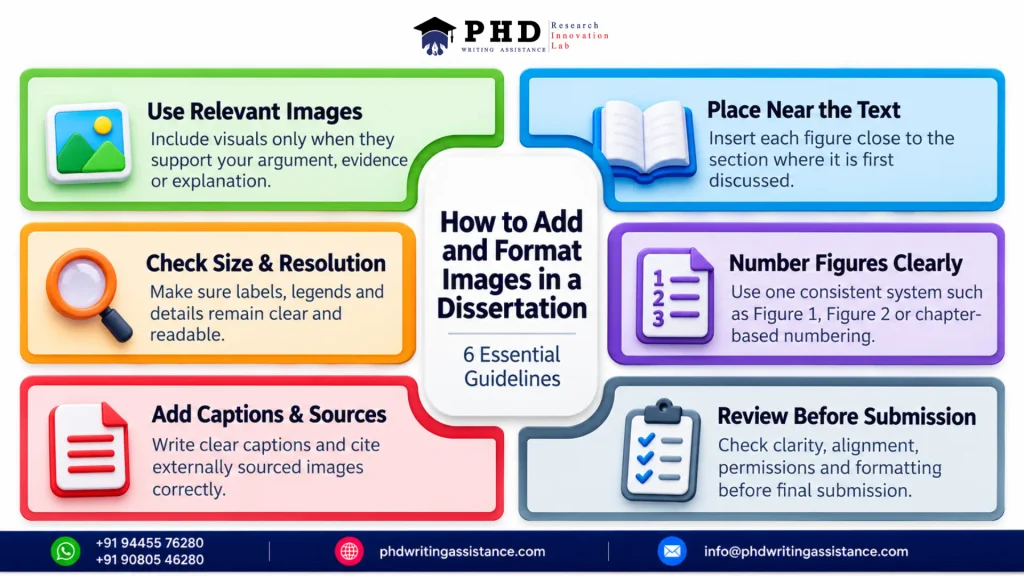
Once the requirements are established, insert the image close to the section where it is discussed. The image should be clearly visible and appropriately sized without affecting the readability of surrounding text.
A useful approach is to introduce the image in the text before presenting it. For example, a researcher might explain what the figure demonstrates and then direct the reader to the relevant figure. This creates a clear connection between the written discussion and the visual evidence.
Images should also be aligned consistently throughout the dissertation. Researchers should avoid using different formatting styles for different figures unless there is a specific academic reason to do so.
Dissertation Image Formatting Guidelines
Following consistent dissertation image formatting guidelines helps create a professional and readable document. Although exact requirements vary between universities and referencing styles, several principles are commonly important.
First, images should be clear enough for the reader to understand the information presented. Second, figures should be appropriately sized so that labels, legends and other details remain readable. Third, every image should have an appropriate figure number and caption where required.
The formatting of captions should also remain consistent. If the dissertation uses a particular font, alignment or spacing for figure captions, the same approach should normally be followed throughout the document.
Researchers should also check whether their university requires figures to appear within the main chapters or in a separate list of figures or appendix.
What Image Size and Resolution Should Be Used?
Image size and resolution should be selected according to the purpose of the image and the dissertation’s submission requirements.
An image should be large enough for important details, labels and text to remain readable. At the same time, unnecessarily large images can increase the size of the dissertation file and make the document difficult to manage.
For photographs and other raster images, resolution is particularly important because low-resolution images may appear blurred when enlarged or printed. Charts, diagrams and line drawings should also remain clear when viewed or printed at the required dissertation size.
There is no single image resolution that applies to every dissertation. Researchers should therefore check their university’s submission guidelines before finalising images, particularly when the dissertation will be printed.
Where Should Images and Figures Be Placed?
Images should generally be placed close to the relevant discussion so that readers can easily connect the figure with the accompanying explanation.
For example, if a researcher discusses the results presented in a particular graph, the graph should normally appear near that discussion rather than several pages away.
However, placement requirements can differ between institutions. Some universities may allow figures to appear immediately after their first mention, while others may require specific placement or allow large figures to be moved to an appendix.
Large images, detailed diagrams or supplementary visual materials may be more appropriate for an appendix when placing them within the main text would interrupt the flow of the discussion.
Regardless of placement, the text should refer clearly to each figure. Statements such as “Figure 2 shows…” or “As illustrated in Figure 2…” help readers navigate the dissertation.
How to Number Images in a Dissertation
Images should be numbered consistently so that readers can identify and locate them easily.
A dissertation may use sequential numbering such as Figure 1, Figure 2 and Figure 3. Some institutions may instead use chapter-based numbering, such as Figure 2.1 for the first figure in Chapter 2.
The appropriate system depends on the university’s formatting requirements.
The same numbering system should be applied throughout the dissertation. Researchers should also make sure that figure numbers in the main text match the actual numbers shown with the corresponding images.
If a dissertation contains many figures, using automatic caption and cross-reference functions in word-processing software can reduce numbering errors when figures are added or moved.
Captions and References for Dissertation Images
A caption provides important information about what an image represents. A good caption should be sufficiently clear for the reader to understand the purpose of the figure without creating unnecessary repetition of the main text.
For example:
Figure 3.1: Conceptual framework showing the relationship between the study variables
The exact caption format depends on institutional and referencing requirements.
Researchers should also distinguish between images they have created themselves and images obtained from other sources. A researcher-created graph based on their own analysis may require a different source statement from an image reproduced from another publication.
When an image comes from another source, the researcher should follow the relevant citation and referencing requirements. The source should not be omitted simply because the image has been edited, cropped or incorporated into a new figure.
Do Images Need Permission or Citations?
Whether permission is required depends on the source of the image, copyright status, licence and intended use.
An image taken from a book, journal article, website or another copyrighted source may require appropriate attribution and, in some circumstances, permission from the copyright holder. A citation alone does not automatically replace a permission requirement.
Researchers should therefore check the copyright or licensing conditions associated with an image before using it. University guidance and the relevant referencing style should also be consulted.
For images created by the researcher, the situation is generally different because the researcher may hold the relevant rights. Nevertheless, images containing identifiable people, private information or material belonging to another organisation may raise additional ethical or legal considerations.
Research Paper With Images: What Should You Consider?
A research paper with images follows many of the same principles as a dissertation. Images should support the research rather than function as decoration.
Researchers should consider whether each figure directly contributes to the research question, methodology, analysis or findings. The figure should then be introduced and discussed within the surrounding text.
Images should also be readable when the research paper is viewed in its final format. This is particularly important for graphs and diagrams containing small labels or large amounts of information.
The formatting requirements of the target journal should always be checked before submission because journals may have specific requirements for image dimensions, file formats, resolution, captions and supplementary materials.
Format of a Research Paper and Image Presentation
The format of a research paper usually requires a logical relationship between written sections, figures, tables and references. Images should therefore be integrated into the overall structure rather than treated as separate visual elements.
In a typical academic paper, figures may appear within the results or discussion sections when they provide evidence for the research findings. A figure should normally be mentioned in the text and explained sufficiently for readers to understand why it is relevant.
Researchers should also avoid presenting the same information repeatedly in both a figure and a long paragraph. Instead, the written discussion should focus on interpreting the important findings shown in the image.
Common Mistakes When Formatting Dissertation Images
Several common mistakes can reduce the quality of images in academic documents.
One mistake is using low-quality or stretched images. Enlarging a small image can make text and visual details difficult to read.
Another problem is inconsistent numbering. Missing figure numbers, duplicate numbers or incorrect references within the text can confuse readers.
Researchers may also forget to provide appropriate captions or source information. Images copied from external sources without appropriate attribution can create academic and copyright concerns.
Finally, excessive use of images can make a dissertation unnecessarily long. Images should be included because they contribute to the research, not simply because space is available.
How to Check Images Before Dissertation Submission
Before submitting a dissertation, researchers should conduct a final image-formatting check.
Confirm that every figure is numbered correctly and that every figure mentioned in the text exists in the document. Check that captions are consistent and that source information has been provided where necessary.
Images should also be checked for clarity, resolution, alignment and readability. Researchers should review the dissertation both on screen and, where relevant, in its expected printed format.
Finally, compare the completed dissertation against the university’s official submission and formatting requirements. This final step can identify issues that may otherwise be overlooked during writing.
Help With My Research Paper and Dissertation Formatting
Students working on a dissertation or research paper with images may need support with more than image insertion. Academic formatting also involves organising chapters, figures, references, citations and supporting evidence consistently.
Help with my research paper may include assistance with academic structure, research methodology, figure organisation, formatting, editing and proofreading. Researchers should ensure that any support maintains the originality and academic integrity of their work.
Professional academic editing can also help identify inconsistent figure numbering, unclear captions, formatting problems and issues with the relationship between figures and the surrounding discussion.
Conclusion
Learning how to format images in a dissertation is an important part of preparing a clear and professional academic document. Images should be relevant to the research, appropriately sized, clearly labelled and positioned close to the discussion where they are needed.
Researchers should follow their university’s dissertation image formatting guidelines for figure numbering, captions, resolution, placement and referencing. When images come from external sources, citation, attribution and copyright requirements should also be considered.
A final review of every figure before submission can help ensure that images support the research rather than creating avoidable formatting or referencing problems. When used appropriately, well-formatted images can strengthen the presentation of research findings and make complex information easier for readers to understand.
Frequently Asked Questions
1. How do I add and format images correctly in a dissertation?
Insert each relevant image near the discussion where it is introduced, use consistent sizing and alignment, provide an appropriate figure number and caption, and follow your university’s formatting requirements.
2. What image size and resolution should be used in a dissertation?
Images should be large enough for all important details and labels to remain readable. The exact resolution and size should follow your university’s submission guidelines.
3. Where should images and figures be placed in a dissertation?
Figures should generally be placed close to the relevant discussion. Large or supplementary figures may be placed in an appendix if permitted by the university.
4. Do I need permission or citations for images used in a dissertation?
Images obtained from external sources generally require appropriate citation or attribution, and some copyrighted images may also require permission. Always check the source licence and university guidance.
5. How should images be numbered and referenced in a dissertation?
Use a consistent numbering system such as Figure 1, Figure 2 or chapter-based numbering such as Figure 2.1. Refer to each figure by its number in the main text and follow your university’s required format.