Introduction
A Doctor of Philosophy (PhD) is an advanced research degree designed for candidates who want to make an original contribution to knowledge within a specific field. Understanding the PhD qualification requirements is an important first step for anyone considering doctoral study.
The exact requirements vary between universities, countries and academic disciplines. However, most PhD programmes assess a candidate’s academic background, research potential, proposed research area and ability to complete independent research.
This article explains the common PhD requirements, including academic qualifications, admission criteria, coursework, research proposals and the role of a PhD research scholar.
What Are the PhD Qualification Requirements?
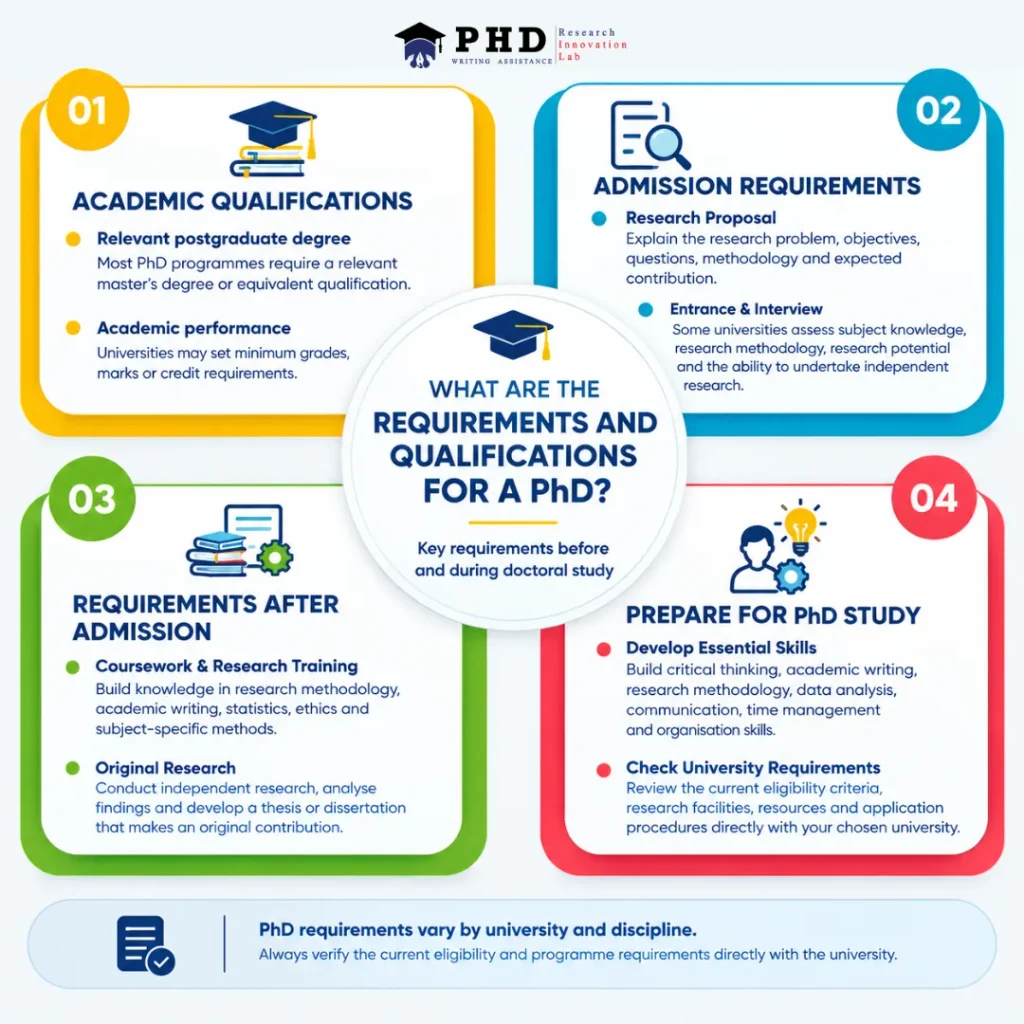
The PhD qualification requirements generally include a relevant postgraduate degree, the required academic performance, a suitable research area and, depending on the institution, an entrance examination or interview.
Some universities may accept candidates with an integrated master’s degree or another recognised qualification that demonstrates appropriate preparation for doctoral research.
Because admission rules differ between institutions, prospective candidates should always check the specific eligibility criteria of the university and PhD programme they intend to apply for.
What Qualifications Do You Need to Pursue a PhD?
A master’s degree in a relevant subject is a common entry requirement for a PhD. The previous qualification should normally provide sufficient academic knowledge and research preparation for the proposed doctoral field.
Some programmes may accept candidates from closely related disciplines, while others require a specific subject background.
Academic performance may also be considered during admission. Universities can set minimum marks, grades, credit requirements or equivalent qualifications.
In addition to academic qualifications, universities may assess research experience, publications, professional experience or other evidence of research potential where relevant to the programme.
What Are the Main PhD Requirements for Admission?
Although requirements vary, prospective doctoral candidates may need to meet several criteria before admission.
Relevant Academic Qualification
Candidates normally need an appropriate postgraduate or equivalent qualification. The required academic background depends on the subject and university.
Minimum Academic Performance
Universities may establish a minimum grade or percentage for entry. Meeting the minimum requirement does not necessarily guarantee admission because some programmes use competitive selection processes.
Research Proposal
Some PhD programmes require applicants to submit a research proposal explaining the proposed research problem, objectives, research questions, methodology and expected contribution.
A strong proposal demonstrates that the applicant understands the research area and has identified a research problem that can be investigated systematically.
Entrance Examination
Certain universities require candidates to complete a doctoral entrance examination. The examination may assess subject knowledge, research methodology or related academic skills.
Interview or Research Discussion
An interview may be used to assess the candidate’s understanding of the proposed research, motivation, academic background and ability to undertake independent research.
The exact combination of these requirements depends on the institution and programme.
What Are the PhD Degree Requirements After Admission?
Admission requirements and PhD degree requirements are not the same. Admission determines whether a candidate can enter the programme, while degree requirements determine what the candidate must complete to receive the doctorate.
A doctoral programme may require coursework, research training, a research proposal or confirmation process, original research, progress reviews, a thesis or dissertation and a final examination.
Candidates must normally satisfy the requirements established by their university before their degree can be awarded.
What Is Coursework in a PhD?
Coursework in PhD programmes provides researchers with the academic and methodological knowledge needed to conduct doctoral research.
Depending on the programme, coursework may cover research methodology, advanced subject knowledge, academic writing, research ethics, statistics, data analysis or discipline-specific research methods.
Coursework requirements can differ substantially. Some programmes have structured taught modules during the early stage of the doctorate, while others place greater emphasis on independent research from the beginning.
The purpose of coursework is not simply to complete academic assignments. It helps researchers develop the theoretical and methodological foundation required for their doctoral project.
What Does a PhD Research Scholar Do?
A PhD research scholar is responsible for conducting independent research under the academic requirements of their doctoral programme.
The researcher normally begins by identifying and refining a research problem, reviewing existing literature and establishing research questions or objectives. The next stages may involve developing the methodology, collecting or obtaining data, analysing findings and interpreting the results.
A research scholar must also monitor progress, communicate with supervisors and meet institutional requirements throughout the programme.
The central expectation is that the research should make an original and academically defensible contribution to the chosen field.
Is a Research Proposal Required for a PhD?
A research proposal is commonly required by many PhD programmes, although its format and timing vary.
The proposal normally explains what the researcher intends to investigate and why the research is important. It may include the research background, problem statement, research gap, objectives, research questions, methodology, expected contribution and preliminary references.
A proposal should demonstrate that the research is sufficiently focused and feasible. It may also be revised after admission as the researcher develops a deeper understanding of the literature and research problem.
How Important Is Research Methodology in a PhD?
Research methodology is fundamental to doctoral research because it determines how the research problem will be investigated.
The methodology should be appropriate to the research questions and objectives. Depending on the discipline, a study may use quantitative, qualitative or mixed-methods approaches.
Researchers may use statistical analysis, interviews, surveys, experiments, case studies, computational methods, textual analysis or other techniques depending on their research design.
A well-developed methodology also explains how data will be collected, analysed and evaluated. This allows readers and examiners to understand how the research findings were produced.
What Skills Should a PhD Research Scholar Develop?
A doctoral researcher needs more than subject knowledge. PhD study requires the ability to evaluate academic literature, identify research gaps, formulate research questions and work independently.
Researchers should also develop academic writing, critical thinking, research methodology, data analysis and research communication skills.
Time management and organisation are equally important because doctoral research often involves several interconnected activities, including literature review, data collection, analysis, writing and revision.
The specific skills required will depend on the discipline and research methodology.
How Can You Prepare for PhD Admission?
Preparation should begin by identifying a suitable research area and understanding the admission requirements of the universities being considered.
Candidates should review relevant academic literature and develop a preliminary understanding of potential research problems. If a research proposal is required, sufficient time should be allocated to developing the research background, research gap, objectives and methodology.
It is also useful to check whether the proposed research requires specialist datasets, laboratory facilities, software, equipment or other resources.
Most importantly, candidates should verify the current requirements directly with the university because eligibility criteria and application procedures can change.
Common Mistakes When Preparing for a PhD
One common mistake is choosing a research topic that is too broad. A doctoral project needs a sufficiently focused research problem that can realistically be investigated within the available time and resources.
Another mistake is selecting a topic without first examining the existing literature. Understanding previous research is essential for identifying a genuine research gap.
Candidates may also underestimate the importance of research methodology. A promising topic can become difficult to investigate if the proposed methodology does not adequately address the research questions.
Finally, applicants should avoid assuming that the same PhD requirements apply to every university. Admission criteria, coursework, proposal requirements and assessment procedures can vary considerably.
PhD Guidance and Research Support
Understanding PhD guidance can be valuable when moving from an initial research idea to a structured doctoral project. Researchers may require support with topic refinement, literature review, research methodology, data analysis, thesis structure and academic writing.
PhD Research Assistance can help researchers understand different stages of the research process, while PhD Writing Assistance can support the organisation and refinement of academic documents.
Editing and proofreading may also be useful when researchers need to improve clarity, academic language and consistency before submitting research documents.
Any research support should complement the researcher’s own academic work and follow the relevant university, authorship and research-integrity requirements.
Conclusion
Understanding the PhD qualification requirements is essential before applying for doctoral study. Although requirements vary between universities and disciplines, common areas include relevant academic qualifications, minimum academic performance, research potential, a research proposal, entrance assessments and interviews.
Once admitted, candidates may need to complete coursework in PhD programmes, develop a research project, conduct original research and produce a thesis or dissertation that meets the university’s PhD degree requirements.
For anyone planning to become a PhD research scholar, careful preparation, appropriate research methodology and a clear understanding of institutional requirements can provide a strong foundation for doctoral research. Always verify the current eligibility and programme requirements directly with the university before applying.
Frequently Asked Questions
1. What are the basic PhD qualification requirements?
The basic requirements commonly include a relevant postgraduate qualification, minimum academic performance and evidence of research potential. Exact criteria vary by university and programme.
2. What qualifications do you need to pursue a PhD?
Most PhD programmes require a relevant master’s degree or equivalent qualification. Some programmes may accept other recognised qualifications depending on their admission rules.
3. Is coursework required in a PhD?
Many PhD programmes include coursework in research methodology, advanced subject knowledge or related areas. The specific coursework requirements depend on the university and discipline.
4. What does a PhD research scholar do?
A PhD research scholar conducts independent research, reviews existing literature, develops a research methodology, analyses findings and produces a thesis demonstrating an original contribution.
5. Do PhD students need a research proposal?
Many universities require a research proposal either during admission or at an early stage of the programme. It normally outlines the research problem, objectives, questions, methodology and expected contribution.