Introduction
A research proposal for PhD admission is a structured document that explains what you want to research, why the topic matters, what research gap you intend to address, and how you plan to conduct the study. Universities may use the proposal to assess the originality, feasibility, academic relevance, and potential contribution of a proposed PhD project.
A strong proposal should demonstrate that you understand your research area and have a realistic plan for investigating the proposed problem. However, requirements can vary between universities, departments, and supervisors, so applicants should always check the specific admission guidelines before preparing their proposal.
What Is a Research Proposal for PhD Admission?
A PhD admission research proposal is a preliminary plan for a proposed doctoral research project.
It normally explains:
- The research topic
- Background and research context
- Research problem or gap
- Research aim and objectives
- Research questions
- Relevant literature
- Proposed methodology
- Expected contribution
- References
The proposal does not need to predict every detail of the final thesis. Instead, it should demonstrate that the proposed research is clear, relevant, feasible, and academically worthwhile.
Why Is a Research Proposal Important for PhD Admission?
A research proposal can help an admissions committee or potential supervisor understand the applicant’s proposed research direction.
It can demonstrate:
- Knowledge of the research area
- Understanding of existing literature
- Ability to identify a research problem
- Critical thinking
- Research planning skills
- Awareness of suitable methodology
- Potential academic contribution
The importance of the proposal varies between institutions. Some programmes require a detailed proposal during application, while others may request only a brief research outline.
How to Write a Research Proposal for PhD Admission
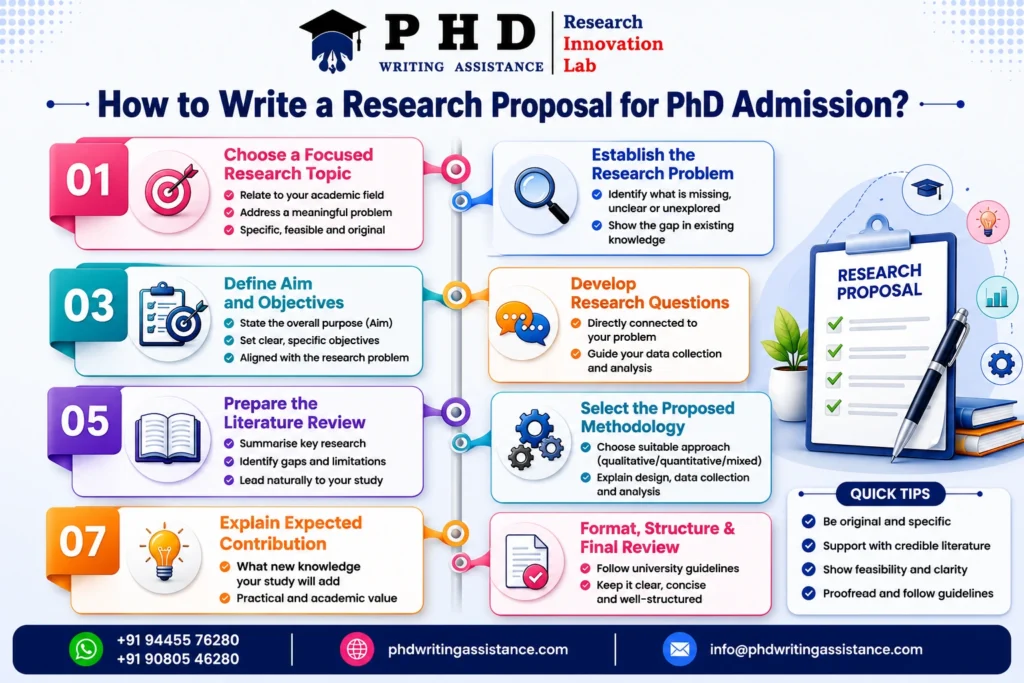
1. Choose a Focused Research Topic
Start with a topic that is specific enough to investigate within the available time and resources.
A good PhD topic should:
- Relate to your academic field
- Address a meaningful problem
- Have sufficient literature available
- Offer scope for original investigation
- Be feasible with available resources and data
Avoid topics that are extremely broad. A focused research problem is easier to develop into research questions, objectives, and a suitable methodology.
2. Establish the Research Problem
Clearly explain what problem your proposed research will investigate.
Start by providing relevant background and then identify what is currently missing, unclear, or insufficiently explored.
For example:
Existing knowledge → limitation or gap → research problem → proposed investigation
This logical connection helps demonstrate why the proposed study is necessary.
3. Define the Research Aim and Objectives
The research aim provides the overall purpose of the study, while objectives describe the specific steps needed to achieve that aim.
A strong aim should be:
- Clear
- Focused
- Relevant to the research problem
- Realistic
Objectives should be specific enough to guide the proposed research rather than simply repeating the research topic.
4. Develop Research Questions
Research questions should directly connect to the research problem and objectives.
For example:
Research problem: Limited understanding of a particular phenomenon.
Research question: How does the phenomenon affect the selected population?
Additional questions may investigate causes, relationships, experiences, outcomes, or possible solutions depending on the research approach.
Good research questions help determine what data needs to be collected and how it may later be analysed.
5. Prepare the Literature Review
The literature review demonstrates your understanding of existing research.
Instead of simply listing previous studies, explain:
- What researchers already know
- Where researchers disagree
- What limitations exist
- What gaps remain
- How your proposed study addresses the gap
A strong literature review should lead naturally towards the research problem and proposed contribution.
6. Select the Proposed Methodology
Explain how you intend to conduct the research.
Depending on your research question, the methodology may be:
- Quantitative
- Qualitative
- Mixed methods
- Experimental
- Case study
- Survey-based
- Other discipline-specific approaches
Briefly explain the proposed research design, participants or data sources, data collection methods, and approach to analysis.
At the admission stage, the methodology may be preliminary because the research design can be refined after discussions with supervisors.
7. Explain the Expected Contribution
Explain what the research could contribute to the field.
The contribution might involve:
- Addressing an identified research gap
- Developing new knowledge
- Testing an existing theory
- Providing new empirical evidence
- Developing a framework or model
- Offering practical implications
Avoid making unrealistic claims. The proposed contribution should be consistent with the research problem and methodology.
Research Proposal Format for PhD
There is no single research proposal format for PhD applications because universities and departments can have different requirements.
A commonly used structure is:
- Title
- Introduction/Background
- Research Problem
- Research Aim and Objectives
- Research Questions
- Literature Review
- Proposed Methodology
- Expected Contribution
- Proposed Timeline
- References
Some universities may additionally request sections such as ethical considerations, preliminary findings, theoretical framework, resources, or a detailed research plan.
Always follow the specific university’s application guidelines over a generic proposal template.
What Should a PhD Research Proposal Sample Include?
A research proposal sample for PhD can help applicants understand how a proposal is organised, but it should be used as a structural reference rather than copied.
When reviewing a sample, look at:
- How the research problem is introduced
- How the research gap is established
- How objectives are presented
- How research questions connect with objectives
- How the methodology is justified
- How the expected contribution is explained
- How references are incorporated
Your proposal should reflect your own research idea, academic field, and target university requirements.
Common Mistakes to Avoid
When applicants write a research proposal, several problems can weaken the application.
Overly Broad Topic
A topic covering too many variables, populations, or locations may be difficult to complete within a PhD.
Unclear Research Gap
Simply stating that “few studies exist” is not enough. Explain what is missing and why that gap matters.
Weak Connection Between Sections
The research questions, objectives, methodology, and expected contribution should support one another.
Too Much Background
The proposal should provide enough context to establish the research problem without becoming a general textbook chapter.
Unrealistic Methodology
The proposed research should be achievable with the likely time, data, participants, resources, and ethical requirements.
Ignoring University Requirements
A well-written proposal can still be unsuitable if it does not follow the requested format, length, or submission requirements.
Final Checklist Before PhD Proposal Submission
Before submitting your proposal, check that:
- The research topic is focused.
- The research problem is clearly explained.
- The research gap is supported by relevant literature.
- The aim and objectives are aligned.
- Research questions are clear.
- The proposed methodology is appropriate.
- The expected contribution is realistic.
- The proposal follows the university’s requirements.
- References are accurate and consistent.
- The document has been carefully proofread.
PhD Research Proposal Writing Support
Preparing a doctoral proposal can involve extensive literature research, research-gap identification, methodology planning, academic structuring, and editing.
Professional PhD writing assistance can support applicants with areas such as proposal structure, academic editing, proofreading, literature organisation, and presentation of research ideas.
Any academic support should complement the applicant’s own research ideas and maintain the originality and academic integrity of the proposed work.
Conclusion
A strong research proposal for PhD admission should clearly explain the proposed research problem, establish a meaningful research gap, define the research objectives and questions, and present a realistic methodology.
Applicants should not rely on a single generic template because the required research proposal format for PhD admission can vary between universities and disciplines. Instead, use examples and samples to understand structure while following the specific requirements of the intended programme.
Most importantly, the proposal should demonstrate a clear research direction, academic relevance, feasibility, and potential contribution to knowledge.
Frequently Asked Questions
1. How do I write a research proposal for PhD admission?
Choose a focused topic, identify a research gap, define your objectives and questions, review relevant literature, propose a suitable methodology, and explain the expected contribution.
2. What format is required for a PhD admission research proposal?
A common format includes the title, background, research problem, objectives, research questions, literature review, methodology, expected contribution, timeline, and references, but university requirements vary.
3. How is a PhD admission proposal different from a regular proposal?
A PhD admission proposal primarily demonstrates the feasibility, originality, relevance, and potential contribution of your proposed doctoral research to an admissions committee or supervisor.
4. What topics are best for PhD research proposals?
The best topics are focused, researchable, relevant to the field, supported by existing literature, and capable of addressing a meaningful research gap.
5. How important is the research proposal for PhD selection?
Its importance varies by university, but where a proposal is required, it can help assess your research understanding, academic potential, originality, and suitability for doctoral study.