Introduction
Plagiarism is a serious academic concern that can affect the credibility, originality and publication prospects of a research paper. Researchers may unintentionally create similarity through copied wording, inadequate paraphrasing, missing citations or incorrect use of previously published material.
Conducting a plagiarism check for research paper before submission allows researchers to identify potentially problematic sections and review them before the manuscript reaches a journal. However, a similarity report should not be treated as a simple pass-or-fail result. Similarity can arise from legitimate citations, technical terminology, references and commonly used academic phrases.
This article explains how to check plagiarism in research paper, how plagiarism detection works, what similarity reports mean and what researchers should consider before submitting a manuscript to a journal.
How Can You Check Plagiarism in Research Paper?
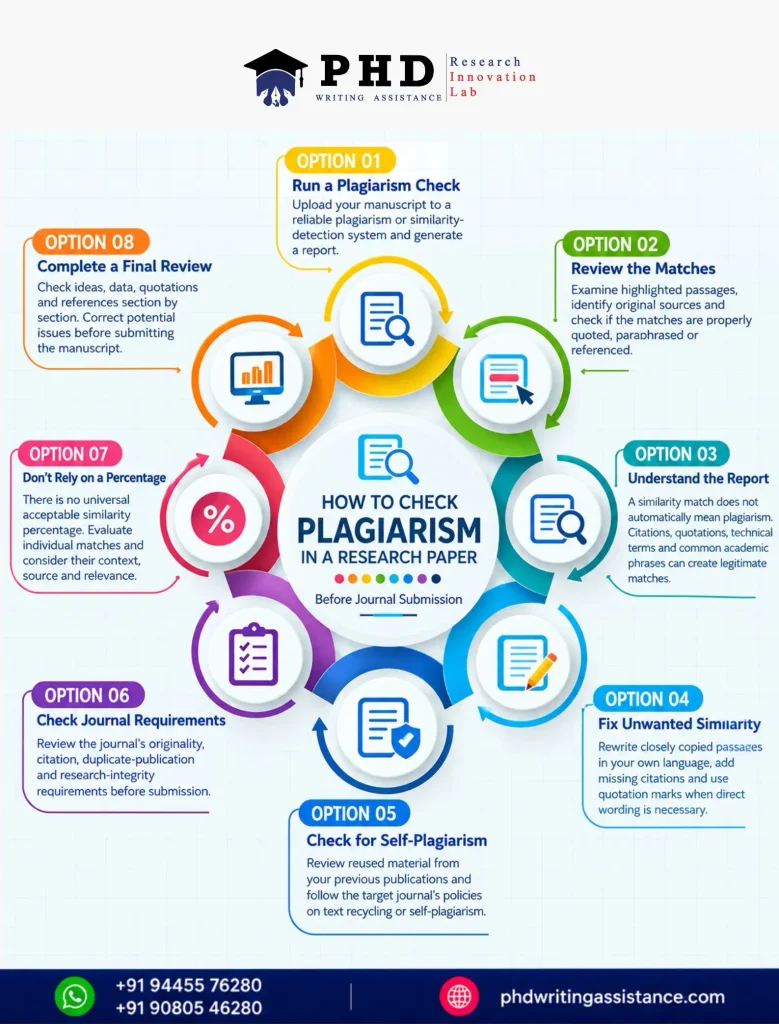
To check plagiarism in research paper, upload the manuscript to a reliable plagiarism or similarity-detection system and review the resulting report carefully. The report normally identifies text that matches content found in published articles, websites, academic documents or other sources indexed by the system.
The process should involve more than checking the overall similarity percentage. Researchers should examine individual matches, identify the original sources and determine whether each match is appropriately quoted, paraphrased or referenced.
After reviewing the report, problematic sections can be rewritten or properly cited before the final manuscript is submitted.
What Is a Plagiarism Check for a Research Paper?
A plagiarism check for research paper is a process used to identify textual similarities between a manuscript and existing sources.
Similarity-detection systems compare submitted text against their available databases and generate a report showing matching or similar passages. Depending on the system, these sources may include academic publications, websites, institutional documents and previously submitted manuscripts.
A similarity report indicates where text overlaps with other sources. It does not automatically establish that plagiarism has occurred. The researcher, supervisor or editor must interpret the context of each match.
Why Should You Check Plagiarism Before Journal Submission?
Researchers should check plagiarism before journal submission because identifying potential problems early provides an opportunity to correct them.
A manuscript may contain unintended similarity because a researcher has closely followed the wording of a source, failed to cite a reference correctly or reused material from an earlier publication. These issues can often be addressed during the final review stage.
Checking the paper before submission can therefore support better academic writing and help researchers ensure that sources are properly acknowledged.
It is also important to remember that journals may use their own similarity-detection systems during editorial screening. A report generated before submission does not guarantee that the journal will produce the same result.
How Does Plagiarism Detection Work for Research Papers?
Plagiarism detection for research papers generally works by comparing sections of a manuscript with content contained within the system’s available sources.
When matching text is identified, the system may highlight the relevant passage and provide information about the corresponding source. The report can help researchers locate areas requiring closer examination.
However, automated detection has limitations. It may identify legitimate similarities, such as standard terminology, commonly used expressions, article titles, references or properly quoted material.
For this reason, researchers should treat plagiarism-detection software as a screening and review tool rather than a substitute for academic judgement.
What Does a Research Paper Plagiarism Check Report Show?
A research paper plagiarism check report can provide several types of information, depending on the software being used.
It may show an overall similarity percentage, highlighted sections of matching text and links or references to potential sources. Some systems also categorise matches according to different sources or types of overlap.
The most important part of the report is not necessarily the overall percentage. Researchers should examine where the similarities occur and why they exist.
For example, a correctly cited quotation may appear as a match even though it is not plagiarism. Similarly, technical terms may naturally be shared across papers within the same field.
What Plagiarism Percentage Is Acceptable for Research Papers?
There is no universal plagiarism percentage that is acceptable for every research paper. Acceptable similarity levels depend on the journal, discipline, type of manuscript and the nature of the detected matches.
A low similarity percentage does not automatically mean that a paper is free from plagiarism, while a higher percentage does not necessarily mean that plagiarism has occurred.
For example, a manuscript containing properly cited quotations and unavoidable technical terminology may generate legitimate matches. Conversely, a smaller amount of unattributed copied text can still represent an academic-integrity problem.
Researchers should therefore review the individual matches and follow the specific similarity or originality requirements of their target journal.
How Can You Reduce Unwanted Similarity in a Research Paper?
Reducing unwanted similarity begins with writing in your own words while maintaining accurate references to the sources used.
When discussing another researcher’s ideas, researchers should understand the source before paraphrasing it rather than simply replacing individual words with synonyms. The resulting text should communicate the idea independently while providing the appropriate citation.
Direct quotations should be used only when necessary and should follow the relevant citation style and journal requirements.
Researchers should also maintain accurate reference records throughout the writing process. This reduces the risk of including information without the necessary attribution.
Can Plagiarism Be Removed After Checking a Research Paper?
Plagiarism itself should not simply be “removed” by changing a few words. If a similarity report identifies improperly used source material, the underlying issue should be corrected.
Researchers can rewrite closely copied passages in their own academic language, add missing citations, use quotation marks where direct wording is necessary and remove unnecessary duplicated material.
If the text originated from the researcher’s own previously published work, the researcher should also consider the journal’s policies on text recycling or self-plagiarism.
The goal should be to produce an accurate and original presentation of the research while properly acknowledging previous work.
Do Journals Check Plagiarism Before Accepting Research Papers?
Yes, many academic journals use plagiarism or similarity-detection systems as part of their editorial screening or publication process. The timing and method vary between journals.
A manuscript may be screened before peer review, during editorial assessment or at another stage of the publication process. Journals can also apply their own thresholds and policies for handling substantial similarity.
Researchers should therefore review the originality and ethical requirements of the target journal before submitting their manuscript.
Running a plagiarism check for a research paper before submission can help identify potential issues, but it cannot guarantee that the journal’s own screening process will produce the same result.
Common Plagiarism Problems in Research Papers
Plagiarism can occur in several ways. Directly copying text without appropriate attribution is one obvious example, but researchers should also be aware of less obvious forms.
Poor paraphrasing can create substantial textual similarity even when a citation has been included. Missing references can also make it difficult to distinguish the researcher’s ideas from information obtained from other sources.
Self-plagiarism or text recycling can arise when researchers reuse substantial portions of their previous publications without following the relevant journal requirements.
Another problem occurs when researchers rely heavily on a source’s sentence structure while making only minor word changes. Effective academic paraphrasing requires genuine restructuring and clear attribution.
Best Practices Before Journal Submission
Before submitting a research paper, researchers should conduct a final originality review alongside their academic and language checks.
Read the manuscript section by section and verify that ideas, data, quotations and evidence obtained from other sources have been appropriately acknowledged. Review highlighted matches in the similarity report and determine whether each one is legitimate or requires revision.
Researchers should also check the target journal’s submission and research-integrity policies. Requirements relating to originality, duplicate publication, text recycling and citations may differ between journals.
This approach is more reliable than attempting to achieve a particular similarity percentage without considering the context of the matches.
Plagiarism Checking and Research Paper Support
Preparing a manuscript for journal submission involves more than running a similarity report. Researchers may need support with academic writing, literature review, citation practices, manuscript editing and final submission preparation.
PhD Writing Assistance can support researchers with structuring and refining academic documents, while PhD Research Assistance may help with research development, literature-based work and methodology.
Academic editing and proofreading can also help improve clarity, consistency and presentation before submission. Where similarity is identified, the focus should remain on responsible rewriting, accurate attribution and maintaining the integrity of the research.
Conclusion
Checking plagiarism in research paper before submission is an important part of preparing an academic manuscript. A plagiarism or similarity-detection report can help researchers identify potentially problematic passages, review source use and make appropriate corrections.
However, a similarity percentage should never be interpreted in isolation. Legitimate citations, quotations, technical terminology and commonly used academic language can all produce matches.
Researchers should examine individual similarities, ensure that sources are properly acknowledged, follow the target journal’s policies and review the manuscript carefully before submission. A thorough research paper plagiarism check can therefore become part of a broader quality-control process that supports responsible academic writing and journal publication.
Frequently Asked Questions
1. How can I check plagiarism in my research paper before submission?
Upload your research paper to a reliable plagiarism checker, review the highlighted similarities and correct any improperly cited or closely copied content before submission.
2. Which plagiarism checker is best for research papers and journals?
The appropriate plagiarism checker depends on your field and target journal. Researchers should choose a reputable tool with suitable academic databases and follow the journal’s own requirements.
3. What plagiarism percentage is acceptable for research papers?
There is no universal acceptable percentage. Journals set their own requirements, and researchers should evaluate the individual matches rather than relying only on the overall similarity score.
4. Can plagiarism be removed after checking a research paper?
Potential plagiarism can be corrected by properly citing sources, rewriting closely copied passages in original language and following the relevant academic-integrity guidelines.
5. Do journals check plagiarism before accepting research papers?
Yes, many journals use similarity or plagiarism-detection systems during editorial screening or the publication process. The exact procedure varies by journal.