Introduction
Writing a PhD thesis is a significant academic achievement that requires originality, critical thinking, and ethical research practices. Throughout the research process, doctoral students rely on books, journal articles, conference papers, and other scholarly sources to support their arguments and develop new knowledge. While using existing literature is essential, failing to acknowledge these sources properly can result in plagiarism, one of the most serious forms of academic misconduct. Therefore, learning how to Avoid Plagiarism in Thesis Writing is a fundamental responsibility for every PhD researcher.
Many students unintentionally commit plagiarism due to incorrect citation practices, poor paraphrasing, or a lack of understanding of academic referencing standards. Universities worldwide have established strict PhD thesis plagiarism guidelines to ensure research integrity and protect intellectual property. Violating these guidelines can lead to rejected theses, delayed graduation, disciplinary action, or even the withdrawal of academic qualifications.
Before submitting a dissertation, many universities require students to Check plagiarism in PhD thesis using plagiarism detection software. One of the most widely accepted tools is Turnitin to check plagiarism, which compares submitted documents against billions of academic publications, web pages, and student papers. Although plagiarism detection software helps identify similarities, it is ultimately the researcher’s responsibility to ensure the originality of their work.
Understanding the Common plagiarism mistakes in PhD research is equally important. Issues such as copying text without citation, improper paraphrasing, self-plagiarism, and inaccurate referencing are among the most frequent reasons for high similarity scores. By recognising these mistakes early, students can take proactive steps to improve the quality and originality of their thesis.
This guide explains practical strategies to Avoid Plagiarism in Thesis Writing, outlines key PhD thesis plagiarism guidelines, discusses how to Check plagiarism in PhD thesis, explores the role of Turnitin to check plagiarism, and highlights the most Common plagiarism mistakes in PhD research. Following these best practices will help you produce an ethical, credible, and submission-ready doctoral thesis.
What Is Plagiarism in a PhD Thesis?
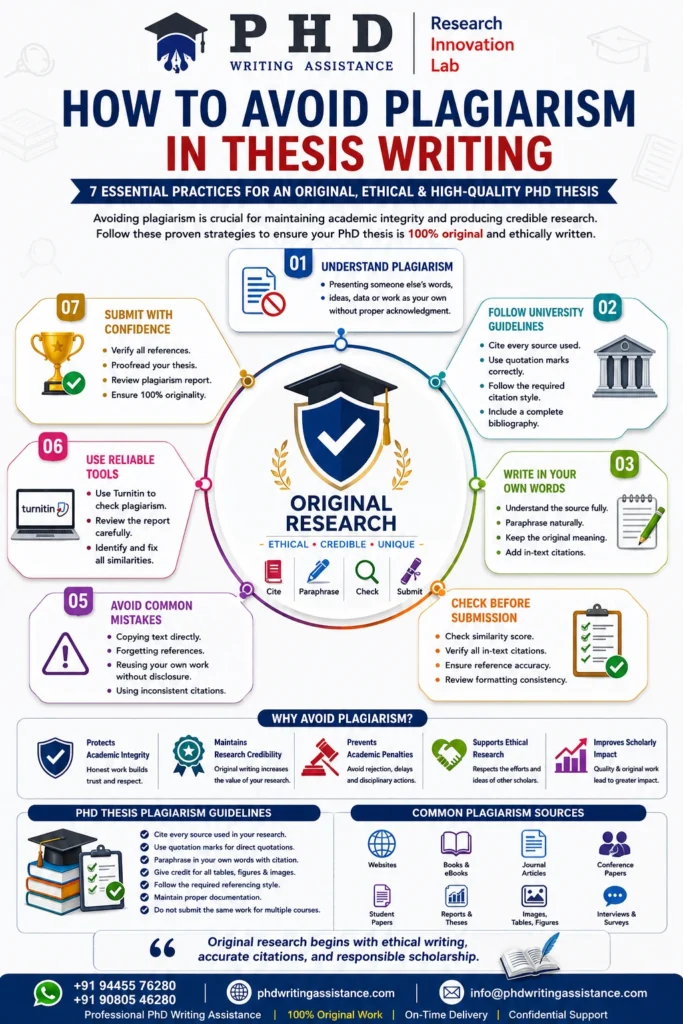
Plagiarism is the act of presenting another person’s words, ideas, data, images, or research findings as your own without proper acknowledgment. In doctoral research, originality is one of the core requirements, making plagiarism a serious academic offence.
Plagiarism is not limited to copying entire paragraphs. It can also occur when researchers:
- Copy sentences without quotation marks or citations.
- Paraphrase too closely to the original source.
- Reuse previously published work without disclosure.
- Present another researcher’s ideas without referencing.
- Copy tables, figures, or graphs without permission or citation.
Even accidental plagiarism can negatively affect the credibility of your research. Therefore, every PhD student should understand the importance of ethical writing and proper referencing.
Why Is It Important to Avoid Plagiarism in Thesis Writing?
Learning to Avoid Plagiarism in Thesis Writing is essential for maintaining academic integrity and demonstrating independent research skills.
Here are the key reasons why plagiarism must be avoided.
Protects Academic Integrity
Academic integrity is built on honesty, transparency, and respect for intellectual property. Original research reflects your ability to contribute meaningful knowledge to your field of study.
Proper citation acknowledges the work of previous researchers while demonstrating ethical academic practice.
Maintains Research Credibility
A thesis supported by correctly cited academic sources is more credible and trustworthy. Supervisors, examiners, and journal reviewers expect researchers to provide accurate references for all borrowed ideas and evidence.
Original writing strengthens the quality of your research and increases confidence in your findings.
Prevents Academic Penalties
Universities enforce strict PhD thesis plagiarism guidelines to maintain research standards.
Failure to comply may result in:
- Thesis rejection
- Mandatory revisions
- Delayed graduation
- Academic disciplinary action
- Loss of research credibility
Understanding plagiarism policies helps researchers avoid unnecessary academic consequences.
Supports Ethical Research
Ethical research requires researchers to acknowledge all sources honestly and accurately.
By following proper referencing practices, you respect the intellectual contributions of other scholars while demonstrating professional research ethics.
Understanding PhD Thesis Plagiarism Guidelines
Every university has specific PhD thesis plagiarism guidelines, but most institutions follow similar principles to ensure originality and ethical research.
Common guidelines include:
- Cite every source used in your research.
- Use quotation marks for direct quotations.
- Paraphrase information in your own words while providing proper citations.
- Include complete references in the bibliography.
- Obtain permission when required for copyrighted material.
- Avoid submitting previously published work without disclosure.
Many universities also specify acceptable similarity thresholds and require plagiarism reports before thesis submission.
Students should always review their institution’s plagiarism policy before preparing the final dissertation.
Practical Ways to Avoid Plagiarism in Thesis Writing
Avoiding plagiarism requires careful planning throughout the research and writing process. The following strategies help maintain originality while producing high-quality academic work.
Keep Accurate Records of Your Sources
Maintain detailed notes of every book, journal article, conference paper, website, and report you consult during your research.
Recording publication details from the beginning makes referencing easier and reduces the risk of missing citations later.
Learn Proper Paraphrasing
Paraphrasing means expressing another author’s ideas in your own words while preserving the original meaning.
Effective paraphrasing requires more than changing a few words. Read the original source carefully, understand the concept, and then rewrite it using your own academic language before adding an appropriate citation.
Good paraphrasing demonstrates critical thinking while reducing similarity scores.
Cite Every Borrowed Idea
Not all borrowed information involves direct quotations.
Whenever you use:
- Research findings
- Theories
- Definitions
- Statistical data
- Concepts
- Models
you should provide an appropriate citation.
Proper referencing strengthens your arguments while maintaining academic integrity.
Use Direct Quotations Sparingly
Direct quotations should only be used when the original wording is essential.
Whenever a direct quotation is included:
- Place the text within quotation marks (or block quotes where required).
- Provide an accurate in-text citation.
- Include the source in the reference list.
Most universities encourage researchers to rely primarily on paraphrasing and critical analysis rather than excessive quoting.
Plan Your Writing Carefully
Writing your thesis gradually rather than rushing close to the submission deadline reduces the likelihood of accidental plagiarism.
Sufficient time allows you to:
- Verify citations.
- Review references.
- Improve paraphrasing.
- Check originality before submission.
A well-organised writing schedule contributes to higher-quality academic work.
Use Reference Management Tools
Reference management software can help organise and format citations efficiently.
These tools assist researchers in maintaining consistent referencing styles and reducing citation errors throughout the thesis.
However, always review automatically generated references for accuracy before submission.
How to Check Plagiarism in PhD Thesis
Before submitting your dissertation, it is essential to Check plagiarism in PhD thesis to identify unintentional similarities and ensure your work meets your university’s originality requirements.
A plagiarism check allows you to:
- Detect duplicated or closely matched text.
- Verify that all borrowed ideas are properly cited.
- Identify missing references.
- Improve paraphrasing where necessary.
- Reduce the overall similarity score before submission.
Checking your thesis early gives you enough time to revise your work and correct any issues before the final review.
Using Turnitin to Check Plagiarism
One of the most widely used plagiarism detection tools in higher education is Turnitin to check plagiarism. Universities, research institutions, and academic publishers use Turnitin to compare submitted documents against an extensive database of scholarly journals, books, websites, and previously submitted student papers.
Turnitin generates a similarity report that highlights matching text and provides a similarity percentage.
It is important to remember that a similarity score does not automatically indicate plagiarism. Some matches may result from:
- Correctly cited quotations.
- Common academic phrases.
- Reference lists.
- Technical terminology.
Researchers should review the report carefully and revise only the sections that represent inappropriate similarities.
Understanding Similarity Score vs Plagiarism
Many PhD students assume that a high similarity percentage always means plagiarism. In reality, a similarity score simply indicates how much text matches existing sources.
Plagiarism occurs when matched content is presented without proper acknowledgment.
For example:
- Correctly quoted and cited text may appear in the similarity report but is generally acceptable.
- Uncited copied content is considered plagiarism and must be corrected.
Rather than focusing only on the percentage, researchers should ensure that every borrowed idea, quotation, and piece of evidence is referenced appropriately.
Common Plagiarism Mistakes in PhD Research
Understanding the Common plagiarism mistakes in PhD research helps researchers avoid academic misconduct and improve the originality of their work.
Copying Text Without Citation
One of the most serious mistakes is copying sentences or paragraphs directly from published sources without providing proper citations.
Every borrowed statement should be acknowledged using the required referencing style.
Poor Paraphrasing
Changing only a few words from the original text is not effective paraphrasing.
Researchers should fully understand the source material and rewrite it using their own academic language while still providing appropriate citations.
Missing References
Sometimes students include in-text citations but forget to add the corresponding source to the reference list.
Every citation within the thesis should have a complete reference entry.
Self-Plagiarism
Reusing parts of your previously published papers, conference articles, or earlier assignments without disclosure is known as self-plagiarism.
If previous work must be reused, consult your university’s policy and cite the original publication where required.
Incorrect Citation Formatting
Using an incorrect referencing style or incomplete citation details can create confusion and reduce the credibility of your thesis.
Always follow your university’s preferred citation style consistently throughout the document.
Best Practices Before Thesis Submission
Before submitting your dissertation, take the following steps to ensure originality and compliance with academic standards:
- Review your university’s PhD thesis plagiarism guidelines.
- Verify that every source has been cited correctly.
- Check plagiarism in PhD thesis using approved plagiarism detection software.
- Carefully review the similarity report instead of relying only on the similarity percentage.
- Improve paraphrasing where excessive similarities appear.
- Confirm that all in-text citations match the reference list.
- Proofread the entire thesis for citation and formatting consistency.
- Ask your supervisor or an academic editor to review the document before submission.
Following these practices significantly reduces the risk of plagiarism-related issues during evaluation.
Can Thesis Editing Help Reduce Plagiarism?
Professional academic editing can help improve the originality and quality of a thesis by identifying citation inconsistencies, correcting referencing errors, and improving paraphrasing.
Editors can also:
- Check citation accuracy.
- Ensure consistency in referencing style.
- Improve sentence structure.
- Identify accidental plagiarism.
- Enhance clarity while preserving the author’s original meaning.
However, professional editors do not replace plagiarism detection software. Researchers should still use approved plagiarism-checking tools before submission.
Conclusion
Learning how to Avoid Plagiarism in Thesis Writing is an essential part of responsible academic research. Plagiarism can damage your academic reputation, delay thesis approval, and compromise the credibility of your research. By understanding institutional PhD thesis plagiarism guidelines, citing every source accurately, paraphrasing effectively, and maintaining ethical writing practices, you can produce original and trustworthy research.
Using Turnitin to check plagiarism and other approved tools allows researchers to identify unintentional similarities before submission. Equally important is recognising the Common plagiarism mistakes in PhD research, such as poor paraphrasing, missing references, self-plagiarism, and incorrect citation formatting. Taking the time to Check plagiarism in PhD thesis, review similarity reports carefully, and make necessary revisions helps ensure your work meets university standards.
Ultimately, originality is not only about achieving a low similarity score it is about contributing genuine knowledge while respecting the intellectual contributions of others. By following these best practices, PhD students can submit high-quality, ethical, and publication-ready theses with confidence.
Frequently Asked Questions
1. How can PhD students avoid plagiarism in thesis writing?
Use proper citations, paraphrase in your own words, maintain accurate references, and review your thesis with plagiarism detection software before submission.
2. What plagiarism percentage is acceptable for a PhD thesis?
There is no universal percentage. The acceptable similarity score depends on your university’s PhD thesis plagiarism guidelines, so always follow your institution’s requirements.
3. How does Turnitin check plagiarism in PhD theses?
Turnitin to check plagiarism compares your thesis with academic journals, books, websites, and previously submitted papers, then generates a similarity report highlighting matching content.
4. What are the most common plagiarism mistakes in PhD research?
The most common mistakes include copying text without citation, poor paraphrasing, missing references, self-plagiarism, and inconsistent citation formatting.
5. Can plagiarism be removed during thesis editing?
Yes. Thesis editing can improve paraphrasing, correct citation errors, and ensure consistent referencing, helping reduce unintentional plagiarism before final submission.