Introduction
A well-designed research study should explain not only what it investigates, but also where its boundaries lie. Every project involves choices about participants, methods, settings and available resources. Some boundaries are established deliberately, while others arise from circumstances the researcher cannot fully control. Understanding research limitations and delimitations helps students describe these differences honestly and show readers how they affect the study.
This guide explains their meaning, how they differ and how to write them in a clear academic style, with practical examples from different research approaches.
What Are Research Limitations and Delimitations?
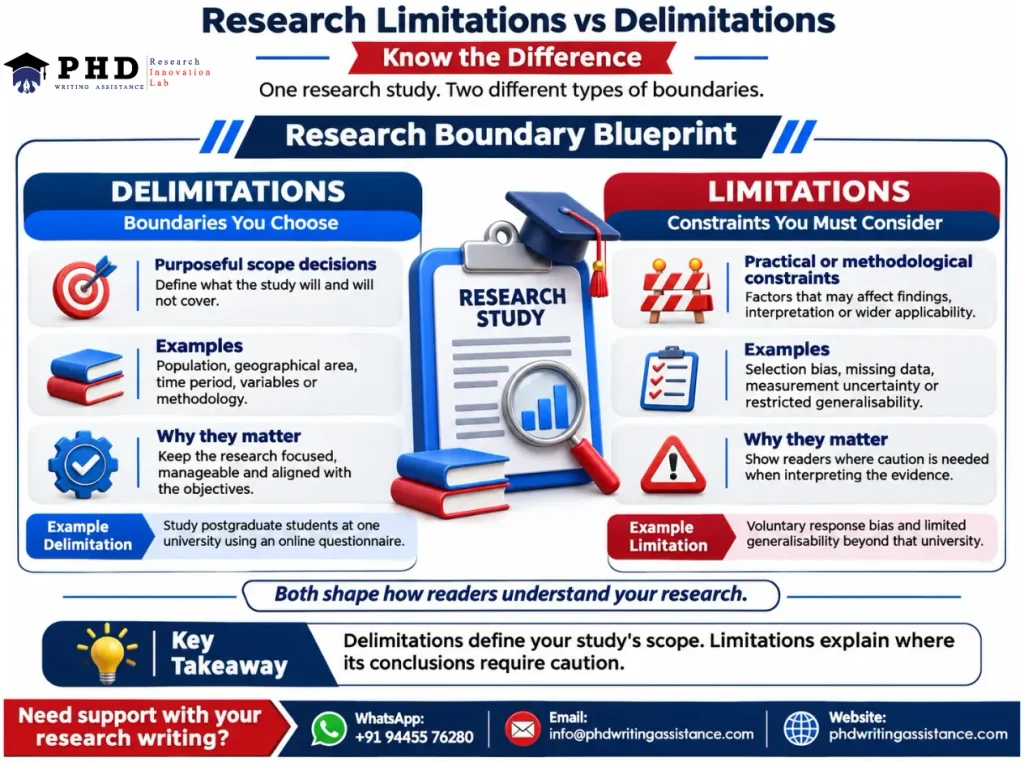
Research limitations are weaknesses or constraints that may influence a study’s findings, interpretation or wider applicability. They can arise from the research design, data collection, measurement tools, sample characteristics or practical conditions. A limitation does not automatically invalidate a study; it identifies a factor readers should consider when judging its conclusions.
Delimitations are the boundaries researchers intentionally establish to define what a study will and will not cover. They may include the target population, geographical area, time period, research questions, theoretical framework or selected methodology. Delimitations help keep an investigation manageable and focused on its stated purpose.
The essential difference is control and intention. Limitations concern constraints affecting the evidence, whereas delimitations describe purposeful decisions about the study’s scope. The two can also interact: choosing to examine one university is a delimitation, while the restricted transferability of findings beyond that university may be a limitation.
Why Do These Boundaries Matter in Academic Research?
Discussing research limitations and delimitations demonstrates that the researcher understands the strengths and boundaries of the investigation. It allows readers to see why certain decisions were made, what the evidence can support and where caution is needed.
Clearly defined delimitations also prevent the project from becoming too broad. A dissertation exploring remote work experiences among early-career employees, for example, might focus on one industry and a specified period. Without these boundaries, the research questions and data requirements could become difficult to manage.
Limitations serve a different purpose. They encourage researchers to examine whether the sampling approach, measurement accuracy or study design could have shaped the findings. This transparency supports credible conclusions.
How to Write the Limitations of a Research Study
When explaining the limitations of a research study, focus on constraints that have a meaningful relationship to the research question. Simply listing common weaknesses such as ‘limited time’ or ‘small sample’ provides little insight unless their consequences are explained.
Identify the Most Relevant Constraints
Review the methodology and consider whether sampling, response rates, measurement tools, missing data or the research setting introduced important uncertainty. In quantitative studies, limited statistical power, unmeasured confounding and reliance on self-reported responses may matter. In qualitative studies, limited access to certain perspectives, interview conditions and the researcher’s interpretive position may require discussion.
Distinguish a genuine weakness from a normal feature of the chosen approach. Qualitative research, for instance, is not automatically deficient because it does not aim for statistical representativeness. Its limitations should be assessed against its actual purpose and methodological standards.
Explain the Consequence of Each Limitation
State how the constraint may affect interpretation. If participants were recruited through convenience sampling, explain that their characteristics may differ from those of the wider population. If data were collected at one point in time, acknowledge that the design cannot establish how experiences changed over a longer period.
Use measured language. A survey’s results may have limited generalisability, but this does not mean they are necessarily inaccurate. Be specific about which conclusions require caution and why.
Describe Mitigation Without Dismissing the Issue
Where relevant, explain what you did to reduce the limitation. Pilot testing a questionnaire, checking data quality or comparing multiple sources may improve the study, but these steps rarely remove every concern. A credible account recognises both the precaution taken and the uncertainty that remains.
How to Define Delimitations in Research
Delimitations begin with the study’s aims and research questions. Explain the decisions that establish its scope: who will be studied, where and when the research will take place, which variables or experiences will be examined and what will be excluded.
Each decision should have a rationale. If a project focuses on postgraduate students rather than all university students, explain how that population relates to the research problem. If the study uses interviews rather than a survey, clarify why in-depth accounts are more appropriate for answering its questions.
Useful examples identify both the chosen boundary and its purpose, rather than vaguely describing ‘a selected area’ or ‘certain respondents’. Readers should understand why the boundaries were chosen.
Practical Examples of Limitations and Delimitations
The following scenarios are illustrative and do not describe findings from published studies. They show how to move from a general statement to a defensible academic explanation.
Quantitative Survey Example
Imagine a study examining the relationship between digital learning habits and academic engagement among postgraduate students at one institution. Its delimitations might specify enrolled postgraduate students, a single academic year and an online questionnaire measuring engagement.
A relevant limitation could be the use of voluntary responses. Students who choose to participate may differ from those who do not, creating potential selection bias. The researcher should explain how this affects wider interpretation rather than claim that the findings represent all postgraduate students.
Qualitative Interview Example
Consider a study exploring how first-time managers experience remote team leadership. The researcher may deliberately limit participation to managers employed in medium-sized organisations and use semi-structured interviews to obtain detailed accounts. These are delimitations linked to the research purpose.
A limitation might arise if participants are reluctant to discuss workplace conflict openly. The researcher can describe steps taken to protect confidentiality while recognising that some experiences may remain underreported.
Literature Review Example
A literature review may be delimited to peer-reviewed English-language publications from a defined period and databases relevant to the research topic. Those are deliberate eligibility choices, which should be justified and reported transparently.
A related limitation is that relevant evidence outside the selected languages, databases or publication types may have been missed. Explaining the possible impact is more useful than simply repeating the inclusion criteria.
Writing the Scope and Limitations of Research
The scope and limitations of research are closely related but should not be treated as interchangeable. Scope describes the area covered by a study, including its population, concepts and setting. Delimitations explain the deliberate boundaries used to establish that scope. Limitations identify factors that constrain the evidence or conclusions.
In a methodology chapter, discuss the planned scope and justify the main delimitations. In a discussion chapter, revisit the limitations in light of how the research was actually conducted. Follow your university’s dissertation structure.
Common Mistakes to Avoid
One mistake is describing every deliberate research decision as a weakness. Restricting a study to a particular population may be necessary to answer a focused question. Another is making vague claims such as ‘the sample was small’ without discussing the effect on precision, thematic breadth or transferability.
Researchers should also avoid apologetic language, unsupported assurances that limitations had no effect, or recommendations that are disconnected from the identified constraints. Most importantly, do not introduce new boundaries after seeing the results merely to make unexpected findings appear intentional.
Presenting Limitations in a Dissertation With Confidence
When discussing limitations in dissertation writing, prioritise clarity over defensiveness. Describe the relevant constraint, explain its possible influence and, where appropriate, identify a realistic direction for future investigation. Give readers an accurate account of the evidence.
Research limitations and delimitations should remain consistent with the research questions, methodology and conclusions. That consistency shows that the investigator has made purposeful choices and assessed the resulting evidence critically.
Academic Research Support From PhD Writing Assistance
PhD Writing Assistance (PWA) offers guidance with research methodology, dissertation structure and academic editing. This support can help researchers explain their own sampling choices, justify study boundaries and communicate limitations with greater precision while retaining responsibility for their research decisions and academic integrity.
Conclusion
Knowing how to write research limitations and delimitations means recognising the difference between unavoidable constraints and deliberate research boundaries. Both are essential to credible reporting. By stating what the study covers, justifying its choices and explaining where conclusions require caution, researchers can present a focused, transparent and academically stronger investigation.
Frequently Asked Questions
1. What is the difference between research limitations and delimitations?
Limitations are constraints that may affect a study’s findings or interpretation. Delimitations are intentional decisions that define its scope, such as the population, setting or period examined.
2. What are common limitations of a research study?
Common limitations include selection bias, missing data, measurement uncertainty and restricted generalisability. Their importance depends on the study’s objectives and design.
3. What are useful research delimitations examples?
Examples include selecting a particular participant group, limiting the study to one geographical area or examining a defined time period. Each boundary should have a clear rationale.
4. Where should limitations in dissertation writing appear?
Universities vary, but planned boundaries often appear in the methodology chapter, while limitations affecting the completed findings are commonly discussed in the discussion chapter.
5. How do I explain the scope and limitations of research?
Define what your study includes, justify its deliberate boundaries and describe constraints that affect interpretation. Connect each important point to the research objectives.