Introduction
Selecting the right research methodology is one of the most important decisions in any academic or scientific study. Whether you are preparing a university assignment, master’s dissertation, PhD thesis, or journal article, the methodology you choose determines how your research is conducted, how data is collected, and how your findings are interpreted. Understanding the types of research methodology helps researchers select the most suitable approach for answering their research questions and achieving reliable results.
Many students find research methodology confusing because it involves different research designs, data collection techniques, and analytical methods. Without a clear understanding of the types of methodology, researchers may choose an unsuitable approach that affects the validity and credibility of their study. Therefore, learning the fundamentals of research methodology is essential before beginning any research project.
Every research study follows a systematic process. From identifying a research problem to analysing data and presenting findings, each stage depends on well-defined research methodology steps. A structured methodology ensures consistency, improves research quality, and enables other researchers to replicate the study if necessary.
Another important aspect of academic research is selecting the appropriate design research methodology. Research design acts as the blueprint of a study by outlining how data will be collected, measured, and analysed. Choosing the right research design ensures that the study aligns with the research objectives and produces meaningful conclusions.
Students often rely on academic resources to strengthen their understanding of research methods. Reading research methodology books written by experienced scholars provides practical guidance on research design, data collection, sampling techniques, and statistical analysis. Choosing the best book for research methodology can significantly improve both theoretical knowledge and practical research skills.
This comprehensive guide explains the types of research methodology, explores different research designs, outlines essential research methodology steps, discusses design research methodology, and recommends valuable research methodology books to help students and researchers conduct high-quality academic research.
What Is Research Methodology?
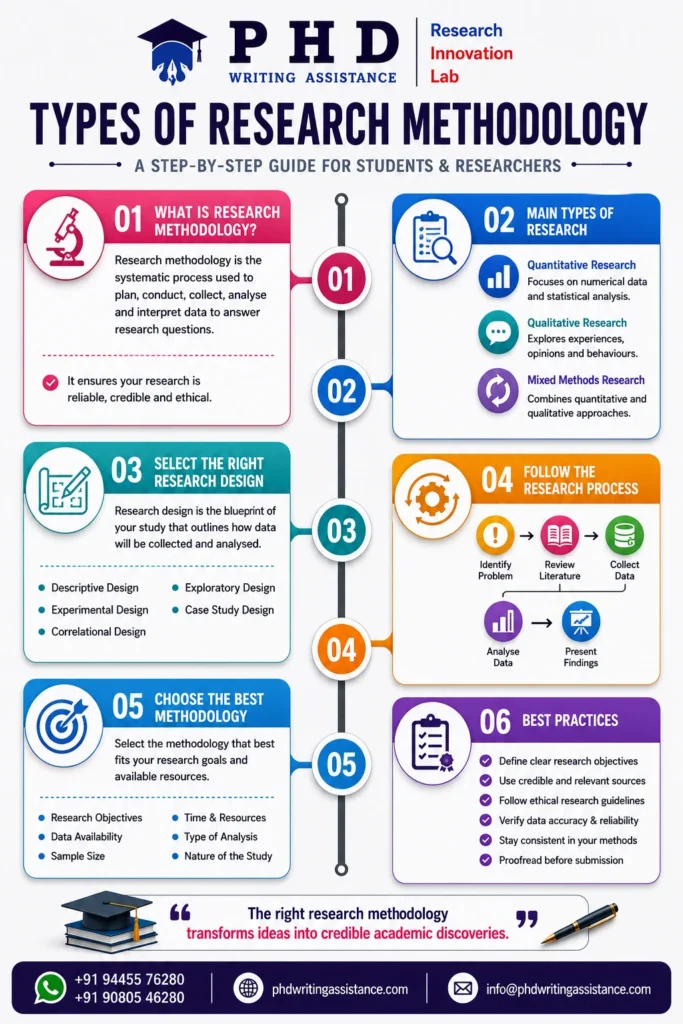
Research methodology refers to the systematic process used to conduct research. It includes the principles, methods, techniques, and procedures researchers follow to collect, analyse, and interpret data.
Unlike research methods, which describe specific techniques such as surveys or interviews, research methodology explains why particular methods are selected and how they contribute to achieving the research objectives.
A well-planned methodology helps researchers:
- Define clear research objectives
- Select appropriate research methods
- Collect reliable data
- Analyse findings accurately
- Draw evidence-based conclusions
- Maintain academic integrity
A strong research methodology forms the foundation of every successful research project.
Understanding the Types of Research Methodology
There are several types of research methodology, each designed to answer different kinds of research questions. Selecting the appropriate methodology depends on the research objectives, available data, and the nature of the study.
The most commonly used types of methodology include:
- Quantitative Research
- Qualitative Research
- Mixed Methods Research
Each approach has its own strengths, limitations, and applications.
Quantitative Research Methodology
Quantitative research focuses on numerical data, statistical analysis, and measurable variables. It is commonly used when researchers aim to test hypotheses, identify patterns, or establish relationships between variables.
Common characteristics include:
- Structured questionnaires
- Surveys
- Experiments
- Statistical analysis
- Large sample sizes
- Objective measurements
Advantages
- Produces measurable results.
- Supports statistical testing.
- Easy to compare findings.
- Suitable for large populations.
Limitations
- Limited exploration of participant experiences.
- May overlook social or emotional factors.
- Requires carefully designed instruments.
Quantitative methodology is widely used in engineering, medicine, economics, business, and social science research.
Qualitative Research Methodology
Qualitative research explores people’s experiences, opinions, behaviours, and perceptions. Instead of focusing on numerical data, it aims to understand why and how certain phenomena occur.
Common methods include:
- Interviews
- Focus groups
- Observations
- Case studies
- Document analysis
Advantages
- Provides detailed insights.
- Explores complex issues.
- Captures participant perspectives.
- Offers flexibility during data collection.
Limitations
- Smaller sample sizes.
- Findings may not be generalisable.
- Analysis can be time-consuming.
Qualitative research is frequently applied in education, psychology, sociology, healthcare, and management studies.
Mixed Methods Research Methodology
Mixed methods research combines quantitative and qualitative approaches within a single study.
Researchers use this methodology when numerical data alone cannot fully explain the research problem.
For example, a researcher may conduct a survey to collect statistical information and then interview selected participants to understand their experiences in greater depth.
Benefits
- Provides comprehensive findings.
- Improves research validity.
- Combines statistical evidence with human perspectives.
- Supports stronger conclusions.
Although mixed methods require additional planning and analysis, they offer a more complete understanding of complex research questions.
Understanding Design Research Methodology
Design research methodology refers to the overall strategy that guides the research process. It explains how the researcher will collect data, analyse information, and answer the research questions.
Common research designs include:
Descriptive Research
Descriptive research explains characteristics, behaviours, or situations without influencing variables.
Example:
Studying student satisfaction with online learning.
Experimental Research
Experimental research investigates cause-and-effect relationships by manipulating variables under controlled conditions.
Example:
Testing the effectiveness of a new teaching method.
Correlational Research
Correlational research examines relationships between variables without establishing causation.
Example:
Analysing the relationship between study habits and academic performance.
Exploratory Research
Exploratory research investigates topics with limited existing knowledge.
It helps researchers identify research gaps and generate future research questions.
Case Study Research
Case studies provide an in-depth examination of a particular individual, organisation, event, or phenomenon within its real-world context.
This research design is commonly used in business, healthcare, education, and social sciences.
Research Methodology Steps
Following structured research methodology steps helps researchers conduct systematic, reliable, and ethical research. Although the process may vary slightly across disciplines, most research projects include the following stages.
Step 1: Identify the Research Problem
The first step is to define a clear and relevant research problem. A well-defined problem guides the direction of the entire study and helps establish specific research objectives.
Step 2: Review Existing Literature
Conduct a comprehensive literature review to understand previous studies, identify research gaps, and develop a theoretical foundation for your research.
Reviewing scholarly sources also helps refine research questions and avoid duplication.
Step 3: Define Research Objectives and Questions
Clearly state what your research aims to achieve.
Well-written research objectives and questions ensure that the methodology, data collection, and analysis remain focused throughout the study.
Step 4: Select the Appropriate Research Methodology
Choose one of the types of research methodology that best aligns with your research objectives.
For example:
- Quantitative research for measurable data.
- Qualitative research for exploring experiences and perceptions.
- Mixed methods research for combining numerical and descriptive data.
Selecting the right methodology improves the reliability and validity of your findings.
Step 5: Develop the Research Design
The design research methodology outlines how the study will be conducted.
This includes:
- Sampling techniques
- Data collection methods
- Research instruments
- Ethical considerations
- Data analysis procedures
A well-planned research design ensures consistency throughout the project.
Step 6: Collect Data
Researchers gather information using appropriate methods such as:
- Surveys
- Interviews
- Questionnaires
- Observations
- Experiments
- Secondary data sources
The choice depends on the selected methodology and research objectives.
Step 7: Analyse the Data
Once data has been collected, researchers analyse it using suitable techniques.
Examples include:
- Statistical analysis for quantitative studies.
- Thematic analysis for qualitative studies.
- Combined analytical approaches for mixed methods research.
Accurate analysis helps answer the research questions effectively.
Step 8: Present Findings and Draw Conclusions
The final stage involves presenting the research findings, discussing their implications, acknowledging limitations, and making recommendations for future research.
Clear presentation allows readers to understand the significance of the study.
How to Choose the Right Research Methodology
Choosing among the types of methodology depends on several factors.
Consider the following before making your decision:
- Research objectives
- Nature of the research problem
- Availability of data
- Sample size
- Time constraints
- Available resources
- Required level of analysis
Selecting the most appropriate methodology improves research quality and strengthens the credibility of your conclusions.
Recommended Research Methodology Books
Reading high-quality research methodology books helps students understand research concepts more effectively and apply them correctly.
Some widely recommended books include:
- Research Design: Qualitative, Quantitative, and Mixed Methods Approaches by John W. Creswell and J. David Creswell
- Research Methodology: Methods and Techniques by C. R. Kothari
- The Research Methods Knowledge Base by William M. Trochim
- Doing Your Research Project by Judith Bell and Stephen Waters
- Social Research Methods by Alan Bryman
These books cover research design, sampling, data collection, data analysis, and academic writing in detail.
Choosing the Best Book for Research Methodology
Selecting the best book for research methodology depends on your level of study and research discipline.
When choosing a book, consider whether it:
- Covers both qualitative and quantitative research.
- Includes practical examples and case studies.
- Explains research design clearly.
- Discusses modern research methods.
- Provides guidance on data analysis and reporting.
For most postgraduate and PhD students, books by Creswell and Kothari are considered valuable starting points because they combine theoretical concepts with practical applications.
Common Mistakes to Avoid
Understanding the types of research methodology also means avoiding common research mistakes.
Choosing an Inappropriate Methodology
Selecting a methodology that does not align with your research objectives may lead to inaccurate or unreliable findings.
Ignoring Research Design
A weak design research methodology can affect data quality, analysis, and overall research validity.
Always develop a clear research design before collecting data.
Poor Literature Review
Failing to review relevant literature may result in duplicated research or poorly defined research questions.
A strong literature review supports better methodological decisions.
Using Unreliable Data Sources
Collect data from credible, reliable, and ethically approved sources to maintain research integrity.
Inadequate Data Analysis
Applying incorrect analytical techniques can produce misleading conclusions.
Ensure your chosen analysis method matches your research methodology.
Best Practices for Conducting Research
To improve the quality of your research:
- Clearly define your research objectives.
- Choose the appropriate types of research methodology.
- Follow systematic research methodology steps.
- Develop a robust design research methodology.
- Consult authoritative research methodology books.
- Maintain ethical research practices.
- Verify data accuracy before analysis.
- Proofread and review your research before submission.
Following these practices improves the reliability, credibility, and academic quality of your work.
Conclusion
Understanding the types of research methodology is fundamental for conducting effective academic research. The methodology you choose influences every stage of the research process, from defining the research problem to collecting data, analysing results, and drawing meaningful conclusions. By selecting the appropriate types of methodology, researchers can ensure their studies are systematic, reliable, and aligned with their research objectives.
Following well-defined research methodology steps provides a structured approach that improves research quality and enhances the credibility of findings. Likewise, developing an appropriate design research methodology helps researchers select suitable data collection and analysis techniques while maintaining consistency throughout the study.
Students and researchers can further strengthen their knowledge by consulting reputable research methodology books and choosing the best book for research methodology that matches their academic level and discipline. Building a solid understanding of research methodology not only improves academic performance but also contributes to producing ethical, high-quality, and impactful research.
Frequently Asked Questions
1. What are the main types of research methodology?
The main types of research methodology are quantitative, qualitative, and mixed methods research. Each approach is selected based on the research objectives and the type of data required.
2. What are the basic research methodology steps?
The basic research methodology steps include identifying the research problem, reviewing the literature, defining objectives, selecting the methodology, designing the study, collecting data, analysing results, and presenting conclusions.
3. What is design research methodology?
Design research methodology is the overall framework that explains how a research study will be planned, conducted, and analysed to answer specific research questions.
4. Which is the best book for research methodology?
The best book for research methodology depends on your discipline, but widely recommended options include books by John W. Creswell and C. R. Kothari because they provide comprehensive guidance on research design and methods.
5. Why are research methodology books important?
Research methodology books help students and researchers understand research principles, choose appropriate methods, apply correct data analysis techniques, and conduct high-quality academic research.