Introduction
A research report is a structured academic document that presents the purpose, methodology, findings, analysis, and conclusions of a research study. Understanding the types of research report helps students and researchers select an appropriate format for communicating their research to academic, professional, or organisational audiences.
The type of report depends on factors such as the research purpose, methodology, target audience, research design, and nature of the findings. A well-written research report should present the research process logically and explain how the findings address the research objectives.
What Is a Research Report?
A research report is a formal document that communicates the results of a research investigation.
It generally explains:
- What the research investigated
- Why the study was conducted
- What methodology was used
- How data was collected
- How the data was analysed
- What the research found
- What the findings mean
- What conclusions can be drawn
A research report should allow readers to understand how the study was conducted and how the conclusions were reached.
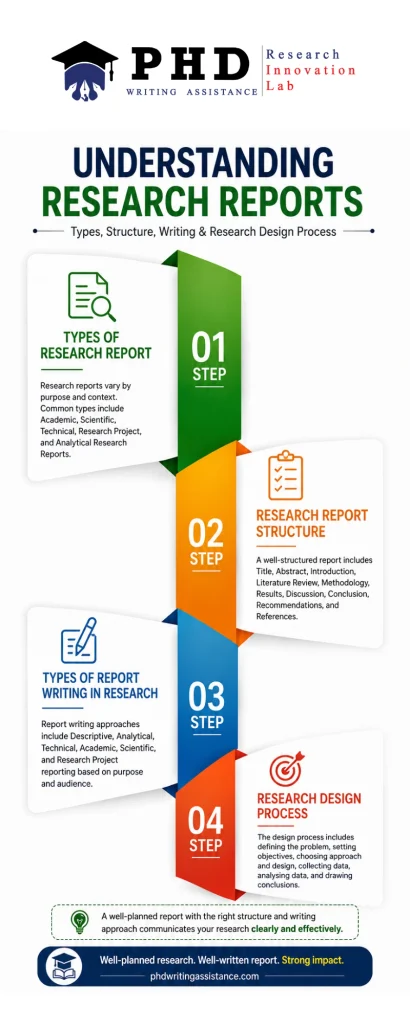
Types of Research Report
There are several types of research report, and the appropriate type depends on the purpose and context of the research.
1. Academic Research Report
An academic research report presents research conducted for a university, academic programme, dissertation, thesis, or research project.
It usually provides detailed information about the research problem, literature, methodology, analysis, findings, and conclusions.
2. Scientific Research Report
Scientific research reports communicate findings from scientific investigations. They generally emphasise systematic methodology, evidence, results, analysis, and reproducibility.
3. Technical Research Report
A technical report presents detailed information about technical research, experiments, systems, processes, or projects.
It may be prepared for researchers, engineers, organisations, or specialised professional audiences.
4. Research Project Report
A research project report documents the development and outcomes of a specific research project. It may include the project objectives, research methodology, activities, findings, limitations, and recommendations.
5. Analytical Research Report
An analytical report focuses strongly on interpreting evidence and explaining what the findings mean. It may compare information, identify patterns, evaluate alternatives, and develop conclusions based on the analysis.
Types of Report Writing in Research
The types of report writing used in research can differ depending on the purpose and audience.
Common approaches include:
- Descriptive report writing
- Analytical report writing
- Technical report writing
- Academic report writing
- Scientific report writing
- Research project reporting
Descriptive reports mainly communicate information and findings, whereas analytical reports place greater emphasis on interpretation, relationships, evaluation, and conclusions.
The writing style should therefore match the purpose of the research report.
Research Report Structure
Although structures vary between disciplines, a research report commonly includes the following sections:
Title
The title should clearly communicate the subject of the research.
Abstract or Executive Summary
Summarises the research purpose, methodology, major findings, and conclusions.
Introduction
Introduces the research problem, background, objectives, research questions, and significance of the study.
Literature Review
Reviews relevant previous research and identifies the research gap addressed by the study.
Research Methodology
Explains how the study was conducted, including the research design, participants or data sources, data collection methods, and analysis techniques.
Results or Findings
Presents the results of the research using appropriate text, tables, figures, or statistical information.
Discussion
Interprets the findings and relates them to the research questions and existing literature.
Conclusion
Summarises the main findings and explains the research contribution.
Recommendations
Where appropriate, provides practical or research-related recommendations.
References
Lists the sources cited in the report according to the required referencing style.
Research Design Process in a Research Report
The research design process establishes how the research will be conducted to answer its research questions.
A typical process involves:
- Defining the research problem
- Developing research questions or objectives
- Selecting a research approach
- Choosing an appropriate research design
- Identifying participants or data sources
- Selecting data collection methods
- Planning data analysis
- Considering ethical requirements
The research design should align with the research objectives and determine how evidence will be collected and analysed.
Research Methodology Steps
The research methodology steps explain the practical methods used to conduct the study.
Depending on the research, the methodology may describe:
- Research approach
- Research design
- Population and sample
- Sampling method
- Data collection instruments
- Data collection procedure
- Data analysis techniques
- Ethical considerations
- Reliability or validity measures where applicable
A strong methodology section should provide enough information for readers to understand how the research was conducted and why particular methods were selected.
Data Analysis in Research
Data analysis in research involves examining collected data to identify patterns, relationships, themes, differences, or other findings relevant to the research questions.
The analysis method depends on the type of data collected.
Quantitative Data Analysis
May involve:
- Descriptive statistics
- Inferential statistics
- Correlation
- Regression
- Statistical testing
Qualitative Data Analysis
May involve:
- Coding
- Categorisation
- Thematic analysis
- Narrative analysis
- Content analysis
Researchers should select analysis techniques that are appropriate for their research design and data.
Research Analysis and Interpretation
Research analysis goes beyond presenting raw results. Researchers need to interpret the evidence and explain its significance.
A strong analysis should address:
- What do the findings show?
- How do they answer the research questions?
- How do they compare with previous research?
- Were any unexpected findings identified?
- What might explain the findings?
- What are the implications of the results?
The discussion should distinguish between what the data demonstrates and what the researcher infers from it.
How to Write a Research Report
A systematic writing process can make research reporting clearer and more effective.
1. Understand the Research Objectives
Keep the research objectives visible while writing each section.
2. Organise the Evidence
Arrange literature, data, findings, tables, and supporting evidence logically.
3. Follow the Required Structure
Use the structure specified by your university, supervisor, organisation, or target publication.
4. Present Findings Clearly
Use appropriate tables, figures, quotations, or statistical results where necessary.
5. Analyse Rather Than Simply Describe
Explain the significance of the findings instead of merely repeating the results.
6. Connect the Conclusion to the Evidence
Ensure that conclusions are supported by the research findings.
7. Edit and Proofread
Check grammar, structure, terminology, references, formatting, and consistency before submission.
Common Mistakes in Research Report Writing
Researchers should avoid several common problems.
Weak Research Objectives
Unclear objectives can make the entire report difficult to structure.
Poor Methodology Explanation
Readers should understand how and why the research methods were selected.
Excessive Description
A research report should include critical analysis rather than simply summarising information.
Unclear Findings
Results should be presented in a logical and understandable way.
Unsupported Conclusions
Conclusions should be based on the evidence presented in the study.
Inconsistent Referencing
References and citations should follow the required academic style consistently.
Poor Organisation
Each section should connect logically to the research question and overall argument.
Research Reports in PhD Research
For PhD students, research reports can support several stages of doctoral research. They may be used to communicate research progress, document findings, present project outcomes, or develop material that contributes to a thesis or research publication.
A PhD-level research report should demonstrate:
- Clear research objectives
- Strong engagement with literature
- Appropriate methodology
- Critical analysis
- Evidence-based conclusions
- A clearly stated research contribution
The exact requirements depend on the university, discipline, programme, and purpose of the report.
Need Support With Your Research Report?
Preparing a research report can involve several stages, from structuring the methodology and organising findings to academic editing and proofreading.
Professional PhD writing assistance can support researchers with areas such as research report structure, methodology presentation, academic editing, proofreading, literature organisation, and research documentation.
The support should maintain the researcher’s original ideas, data, analysis, and academic contribution while improving the clarity and presentation of the work.
Conclusion
Understanding the types of research report helps researchers choose an appropriate way to communicate their research findings. Academic, scientific, technical, project, and analytical reports can differ in structure and purpose, but all should present the research process and evidence clearly.
A strong research report connects the research design process, research methodology steps, data collection, data analysis in research, findings, and research analysis into a logical academic document.
By selecting an appropriate report structure, presenting evidence clearly, analysing findings critically, and carefully reviewing the final document, researchers can communicate their research more effectively to their intended audience.
Frequently Asked Questions
1. What are the main types of research report?
The main types include academic, scientific, technical, research project, and analytical research reports. The appropriate type depends on the research purpose and target audience.
2. What should a research report include?
A research report typically includes an introduction, literature review, methodology, findings, data analysis, discussion, conclusion, and references.
3. What are the steps in writing a research report?
The main steps include defining the research problem, reviewing literature, selecting the research design and methodology, collecting and analysing data, presenting findings, and writing the conclusion.
4. What is the difference between research analysis and data analysis?
Data analysis involves examining collected data to identify patterns or findings, while research analysis interprets those findings in relation to the research questions, objectives, and existing research.
5. Why is research methodology important in a research report?
Research methodology explains how the study was conducted and why specific research methods were selected. It helps readers assess the reliability and credibility of the research.