Introduction
Publishing academic research in an international journal is an important step for researchers who want to share their findings with the wider academic community. However, successful publication involves more than simply writing a manuscript and sending it to a journal. Researchers need to identify a suitable journal, prepare the paper according to its requirements, complete the submission process and respond appropriately to peer-review feedback.
For PhD students, postgraduate researchers and independent researchers, understanding the international journal publication process can make submission more structured and manageable. This guide explains how to publish a research paper in an international journal, from preparing the manuscript and selecting a suitable journal to submission, peer review and final publication.
How to Publish a Research Paper in an International Journal
To publish a research paper in an international journal, researchers generally need to complete several stages: prepare a well-structured manuscript, identify an appropriate journal, check its author guidelines, format the paper, submit it through the required system, respond to peer review and complete any final revisions requested by the journal.
The exact process differs between journals and disciplines, so researchers should always follow the specific instructions provided by their chosen journal.
Step 1: Prepare Your Research Paper for Publication
Before looking for a journal, make sure the research paper is sufficiently developed for submission. A typical research article includes a title, abstract, introduction, literature review or theoretical background, methodology, results, discussion and conclusion. The exact structure depends on the discipline and journal.
The research should present a clear research problem, appropriate methodology and meaningful findings. References should also be accurate, relevant and consistently formatted.
Before submission, review the manuscript for grammar, academic clarity, logical flow, formatting and potential plagiarism issues. A paper that communicates its research clearly is easier for editors and reviewers to assess.
Step 2: Find the Right Journal to Publish Your Research Paper
Choosing the right journal to publish a research paper is one of the most important decisions in the publication process.
Start by identifying journals that regularly publish research within your subject area. Examine their aims and scope, recently published articles and manuscript requirements. This helps determine whether your research fits the journal’s academic focus.
Researchers should also examine the journal’s publication model, peer-review process, indexing information, publication fees and expected article types before submission.
Avoid choosing a journal solely because it claims to offer rapid publication or has a high number of citations. The journal should be relevant to your research and have transparent publication practices.
Step 3: Check the International Journal’s Author Guidelines
Once you have shortlisted a journal, carefully read its author guidelines. These instructions can specify the manuscript structure, word count, referencing style, formatting, figures, tables, supplementary files and ethical declarations.
Some journals require specific sections or reporting standards depending on the research design. Others may have particular requirements for abstracts, keywords or references.
Following these instructions before submission reduces the risk of administrative delays and allows the editorial team to assess the manuscript more efficiently.
Step 4: Format Your Manuscript Correctly
Formatting is an important part of preparing to submit a research paper for publication.
Check the journal’s requirements for font, headings, line spacing, page layout, references, figures and supplementary material. If the journal provides a manuscript template, use it where appropriate.
Authors should also check that all references cited in the paper appear in the reference list and that the required citation style has been followed consistently.
If the journal uses a blinded peer-review process, remove identifying information from the manuscript where required and provide author details in the separate submission fields or title page.
Step 5: Check Research Ethics and Originality
Before submitting a paper, confirm that the research meets the relevant ethical and academic requirements.
Research involving human participants, animals or sensitive data may require appropriate ethical approval or declarations. Authors should follow the requirements applicable to their institution, research field and target journal.
The manuscript should also be original and should not be submitted to multiple journals simultaneously unless the journal’s policies explicitly allow such a practice.
Authors should disclose relevant conflicts of interest and provide information about funding, data availability or other declarations when required.
Step 6: Submit Your Research Paper for Publication
After preparing the manuscript, authors can submit their research paper for publication through the journal’s designated submission system.
The submission process commonly requires the manuscript, author information, abstract, keywords and supporting documents. Some journals may also request a cover letter, declarations or suggested reviewer information.
The corresponding author is generally responsible for completing the submission and communicating with the journal during the review process.
After submission, the manuscript may first undergo an editorial or technical check. The editor then determines whether it is suitable for further peer review.
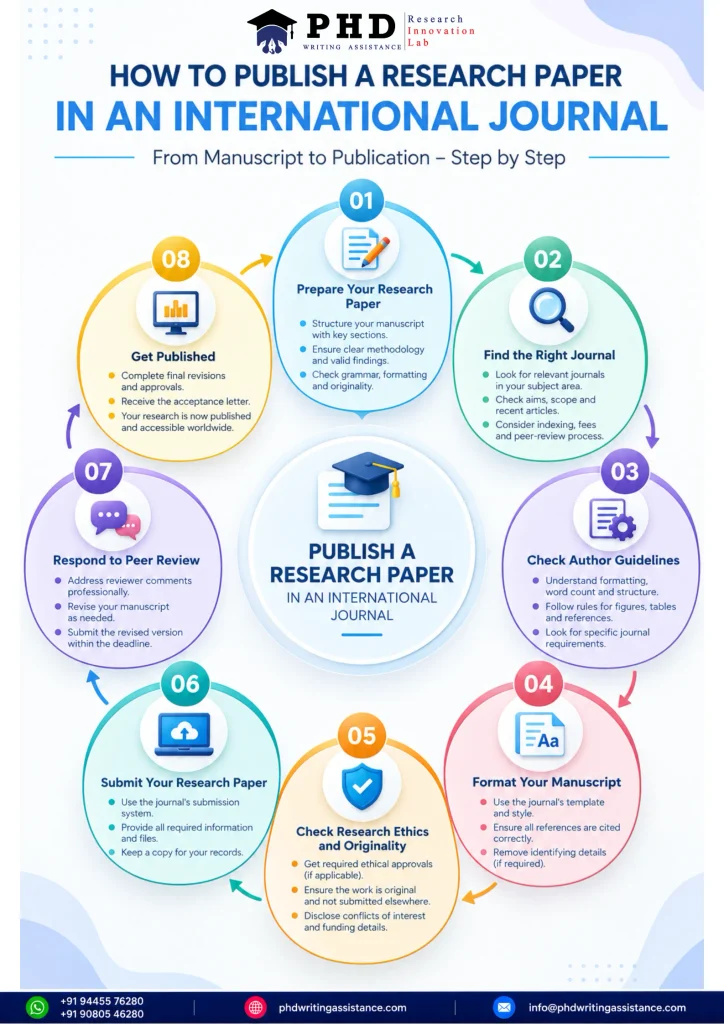
Understanding the International Journal Publication Process
The international journal for research paper publication process commonly involves several stages.
First, the journal checks whether the manuscript meets basic submission and formatting requirements. An editor may then assess its relevance, originality and suitability for the journal.
If the manuscript passes the initial editorial assessment, it may be sent to independent reviewers. Reviewers evaluate aspects such as the research methodology, originality, evidence, analysis and interpretation.
The editor then makes a decision based on the reviews and the journal’s editorial standards. Possible decisions may include acceptance, revision or rejection.
If revisions are requested, authors should carefully address each reviewer comment and explain the changes made. A revised manuscript may be returned to the reviewers for another assessment.
How Long Does It Take to Publish a Research Paper in an International Journal?
The time required for international journal publication varies considerably between journals, disciplines and manuscripts.
The process can take several weeks or months, particularly when peer review involves multiple rounds of revision. Additional time may be required after acceptance for copy-editing, typesetting and online publication.
Researchers should therefore check the journal’s stated review and publication timelines rather than relying on a fixed general timeframe.
A journal offering a very short publication timeline should also be evaluated carefully to ensure that its peer-review and editorial processes are clearly explained.
Why Do International Journals Reject Research Papers?
There are several possible reasons why an international journal may reject a manuscript. These can include poor alignment with the journal’s scope, insufficient originality, methodological weaknesses, inadequate analysis or unclear presentation of the findings.
A manuscript can also be rejected before peer review if the editor determines that it does not fit the journal’s readership or publishing focus.
Rejection does not necessarily mean that the research has no academic value. Authors should carefully examine the editorial decision and reviewer comments where available, improve the manuscript and consider whether another suitable journal may be appropriate.
How to Improve Your Chances of Research Paper Acceptance
Researchers can strengthen their manuscript by clearly presenting the research problem, explaining the research gap and using an appropriate methodology.
The results should directly address the research questions, while the discussion should explain what the findings mean and how they relate to existing research.
It is also important to follow the target journal’s guidelines precisely. Before submission, researchers should proofread the manuscript, verify references, check figures and ensure that all required declarations and supporting documents have been included.
Selecting a journal that genuinely matches the research topic can also make the submission process more focused.
Can You Publish a Research Paper Without a PhD?
Yes. Having a PhD is not generally a universal requirement for publishing a research paper. Publication eligibility depends on the journal’s policies and the quality and suitability of the submitted research.
Postgraduate students, researchers, academics and independent researchers may publish research when they meet the journal’s submission requirements.
However, researchers should carefully understand authorship requirements, research ethics and any institutional or supervisory requirements that apply to their work.
Research Paper Publication Support
Preparing a manuscript for an international journal can involve several stages, including literature review, research methodology, data analysis, academic writing, editing and submission preparation.
Researchers may seek PhD research assistance or academic writing support when they need help structuring their research, refining academic language, reviewing methodology or preparing a manuscript for journal submission.
Professional PhD writing assistance, editing and proofreading can also help researchers improve clarity and consistency while ensuring that the final manuscript remains aligned with their own research and the target journal’s requirements.
Conclusion
Learning how to publish a research paper in an international journal involves understanding the complete publication process rather than focusing only on manuscript submission. Researchers should prepare a rigorous paper, identify an appropriate journal to publish a research paper, follow its author guidelines and carefully complete the submission process.
After submission, the manuscript may go through editorial screening, peer review and one or more rounds of revision before a final publication decision is reached. By approaching each stage systematically and responding carefully to editorial and reviewer feedback, researchers can navigate the international journal publication process more effectively.
Frequently Asked Questions
1. How can I publish my research paper in an international journal step by step?
Prepare your manuscript, choose a suitable journal, follow its author guidelines, submit the paper, complete peer review and make any required revisions before publication.
2. Which international journals are best for publishing research papers?
The right international journal is one that matches your research topic, scope, article type and academic requirements. Check its indexing, peer-review process and publication policies before submitting.
3. How long does it take to publish a research paper in an international journal?
International journal publication can take several weeks to several months, depending on editorial screening, peer review, revisions and the journal’s publication schedule.
4. What are the main reasons international journals reject research papers?
Common reasons include poor journal fit, limited originality, methodological weaknesses, inadequate analysis, unclear writing and failure to follow the journal’s submission guidelines.
5. Is it possible to publish a research paper in an international journal without a PhD?
Yes. A PhD is not generally required to publish a research paper. Researchers without a PhD can publish if their manuscript meets the journal’s academic, ethical and submission requirements.