Introduction
Artificial intelligence (AI) has become an important area of research across computer science, healthcare, finance, education, engineering, business, social sciences and many other disciplines. As AI technologies continue to develop, researchers have access to a wide range of potential research directions, from machine learning and natural language processing to intelligent data analysis, generative AI and edge-based computing.
However, choosing suitable artificial intelligence topics requires more than selecting a popular technology. A strong research topic should address a meaningful problem, have a clearly defined research gap, and provide sufficient scope for collecting and analysing data.
For PhD and postgraduate researchers, the challenge is often transforming a broad AI area into a focused research question. This guide explores potential AI research areas, artificial intelligence research questions, analytical tools and emerging technologies that can support the development of a strong research project.
What Are Artificial Intelligence Topics for Research?
Artificial intelligence topics for research are focused areas of investigation that examine how AI technologies can solve problems, improve decision-making, automate processes or generate new knowledge.
Common AI topics include machine learning, deep learning, natural language processing, computer vision, robotics, generative AI, explainable AI, AI ethics and intelligent data analysis. These areas can be applied to specific domains such as medical diagnosis, financial forecasting, cybersecurity, education or business analytics.
The strongest topic is not necessarily the newest technology. Instead, researchers should consider whether the topic addresses a genuine problem and whether the proposed research can produce measurable and academically meaningful results.
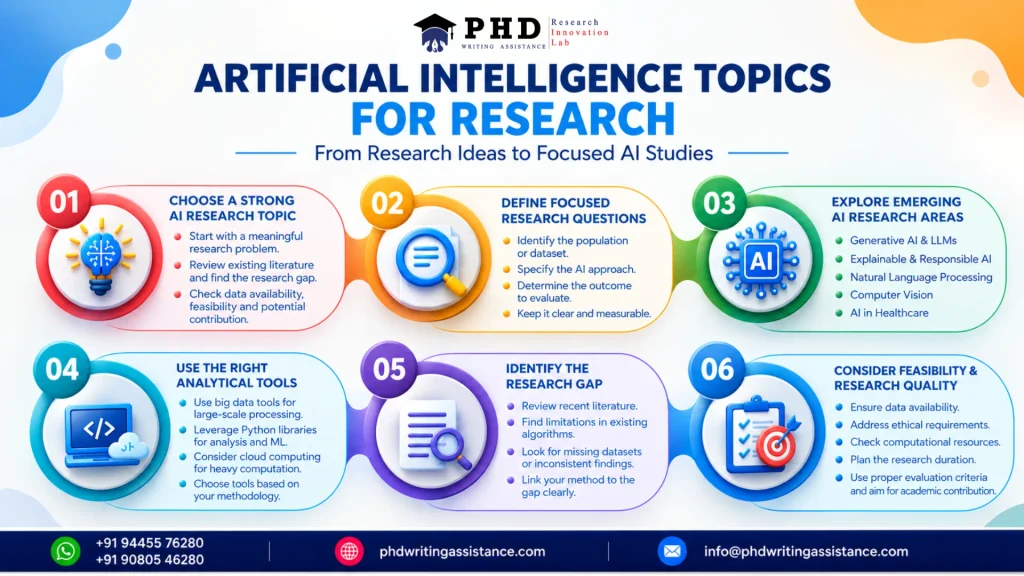
How to Choose a Strong AI Research Topic
Selecting an AI topic should begin with a problem rather than a technology. Instead of starting with “I want to research machine learning”, a researcher can identify a specific problem where machine learning may provide a useful solution.
A practical topic-selection process involves reviewing existing literature, identifying limitations in previous studies, assessing available datasets and determining which AI techniques could address the identified problem.
Researchers should also consider the feasibility of the study. Data availability, computational requirements, ethical considerations, research duration and access to appropriate tools can all influence whether a proposed AI project is realistic.
For doctoral research, the topic should ideally provide sufficient scope for an original contribution rather than simply applying an existing algorithm to a familiar dataset.
Artificial Intelligence Research Questions
A well-defined research question provides direction for the entire study. Artificial intelligence research questions can investigate the effectiveness, accuracy, explainability, efficiency or real-world impact of AI systems.
For example, a researcher might investigate how accurately a machine learning model can predict a particular outcome, whether an explainable AI technique improves user trust, or how different models perform when analysing a large and complex dataset.
A useful research question should identify the research population or dataset, the AI approach being investigated and the outcome that will be evaluated.
Rather than asking a broad question such as “How can AI improve healthcare?”, a more focused question could examine whether a particular machine learning approach improves the early prediction of a defined medical condition using a specific type of clinical data.
This level of specificity makes the research easier to design, measure and evaluate.
Emerging Artificial Intelligence Topics for Research
AI research covers a rapidly expanding range of technologies. Several areas provide substantial opportunities for postgraduate and doctoral research.
Generative AI and Large Language Models
Generative AI has created new research opportunities involving text, images, code, audio and multimodal content. Researchers can investigate areas such as AI-generated content quality, hallucination detection, human-AI collaboration, prompt engineering, domain-specific language models and responsible use of generative systems.
Research can also examine how generative AI affects academic writing, software development, customer service or professional decision-making.
Explainable and Responsible AI
As AI systems increasingly influence important decisions, researchers are investigating how models can become more transparent and accountable.
Explainable AI focuses on methods that help users understand why a model produced a particular prediction. Research in this area can explore the relationship between model interpretability, accuracy, fairness and user trust.
Responsible AI extends the discussion to areas such as bias, privacy, transparency, accountability and ethical deployment.
Natural Language Processing
Natural language processing (NLP) enables computers to analyse and generate human language. Research topics can include sentiment analysis, text classification, information extraction, document summarisation, question answering and domain-specific language processing.
NLP can be applied to research problems involving academic literature, customer feedback, healthcare records, legal documents and social media content.
Computer Vision
Computer vision focuses on enabling machines to interpret visual information. Research opportunities include image classification, object detection, medical image analysis, facial recognition, defect detection and automated visual inspection.
A strong computer vision study should define a specific application and evaluation objective rather than simply comparing several models without a clear research problem.
AI in Healthcare
Healthcare provides numerous applications for artificial intelligence research, including disease prediction, medical imaging, personalised treatment, patient monitoring and clinical decision support.
Researchers must also consider data privacy, clinical validation, interpretability and ethical implications when designing healthcare-related AI studies.
Big Data Analytics Tools in AI Research
AI research frequently involves large and complex datasets. Consequently, big data analytics tools can play an important role in data processing, feature engineering and model development.
Platforms such as Apache Spark can support large-scale data processing, while Python-based libraries provide tools for statistical analysis, machine learning and data visualisation. Depending on the research requirements, researchers may also use cloud computing environments for handling computationally intensive workloads.
The choice of tool should follow the research methodology rather than determine it. Researchers should first establish what data needs to be processed and what analytical objectives need to be achieved before selecting the most appropriate technology.
Intelligent Data Analysis
Intelligent data analysis combines computational methods with statistical and machine learning techniques to identify patterns, relationships and useful insights within datasets.
Traditional data analysis may rely heavily on predefined statistical procedures, whereas intelligent approaches can identify complex relationships and patterns that may not be immediately visible.
For research projects, intelligent data analysis can support classification, prediction, clustering, anomaly detection and forecasting. However, researchers should still establish appropriate validation methods and explain why a particular analytical technique is suitable for the research question.
An AI model producing a high prediction score does not automatically mean that the research is academically strong. The methodology, data quality, evaluation criteria and interpretation of findings remain equally important.
TinyML and Edge AI Research
TinyML is an emerging area that focuses on running machine learning models on small, resource-constrained devices such as microcontrollers. Instead of sending every piece of data to a remote server, some processing can occur directly on the device.
This creates research opportunities in areas such as smart sensors, healthcare monitoring, industrial systems, agriculture and Internet of Things (IoT) applications.
Researchers can investigate model compression, energy efficiency, latency, accuracy and privacy when deploying machine learning models on edge devices.
TinyML is particularly interesting where continuous data processing is required but network connectivity, computing resources or power consumption are limited.
How to Turn an AI Topic Into a Research Question
Once an area has been selected, the next step is narrowing it into a researchable problem. Researchers can begin by reviewing recent literature and identifying what existing studies have not adequately addressed.
The research gap may relate to limitations in existing algorithms, insufficient datasets, inconsistent findings, limited real-world validation or the lack of research within a particular application area.
The proposed AI method should then be connected directly to this gap. The researcher should be able to explain what is being investigated, why the problem matters and how the results will be evaluated.
This approach prevents the research from becoming simply an exercise in applying a popular AI model.
Common Mistakes When Selecting AI Topics
One common mistake is choosing a topic solely because a technology is currently popular. Popularity does not necessarily indicate research suitability.
Another issue is selecting a topic that is too broad. Areas such as “AI in business” or “machine learning in healthcare” may provide useful starting points, but they normally need to be narrowed to a specific problem, population, dataset or application.
Researchers should also avoid selecting an AI technique before understanding the research problem. The methodology should support the research question rather than become the research question itself.
Finally, researchers should consider data availability and ethical requirements at the beginning of the project. A technically interesting topic may become impractical if suitable data cannot be accessed or used responsibly.
AI Research Support for PhD and Postgraduate Researchers
Developing an AI research project often involves several connected stages, including topic selection, literature review, research gap identification, methodology development, data analysis and academic writing.
PhD Writing Assistance can support researchers in structuring and refining their research documents, while PhD Research Assistance can help with research topic development, methodology planning and literature-based research. Researchers may also require support with statistical analysis, coding, interpretation, editing and proofreading depending on the requirements of their project.
The objective should always be to strengthen the researcher’s own academic work while maintaining appropriate research standards and methodological transparency.
Conclusion
The range of artificial intelligence topics available for academic research continues to expand across technologies and application areas. Machine learning, generative AI, explainable AI, natural language processing, computer vision, intelligent data analysis and TinyML all provide potential research directions.
However, selecting a strong AI topic requires more than following technological trends. Researchers should identify a meaningful problem, examine existing literature, establish a clear research gap and formulate focused artificial intelligence research questions.
The most effective research projects connect the AI technology with a clearly defined academic or practical problem. By combining an appropriate research methodology with suitable analytical tools and rigorous evaluation, researchers can develop AI studies that make a meaningful contribution to their field.
Frequently Asked Questions
1. What are good artificial intelligence topics for research?
Good AI research topics include generative AI, machine learning, natural language processing, computer vision, explainable AI, intelligent data analysis and TinyML.
2. How do I choose an artificial intelligence research topic?
Choose an AI topic based on a clear research problem, existing research gap, available data, suitable methodology and potential academic contribution.
3. What are artificial intelligence research questions?
Artificial intelligence research questions investigate specific AI problems, methods or applications, such as model accuracy, explainability, prediction, efficiency or real-world performance.
4. What are big data analytics tools used in AI research?
Big data analytics tools such as Apache Spark and Python-based data analysis libraries can help researchers process, analyse and interpret large datasets for AI research.
5. What is TinyML in artificial intelligence research?
TinyML is the use of machine learning on small, resource-constrained devices such as microcontrollers, enabling AI processing closer to where data is generated.