Introduction
Choosing the best journal to publish research paper is an important step in academic publishing. A suitable journal should match your research topic, target audience, article type, and publication requirements.
However, selecting a journal should not be based only on its impact factor or reputation. Researchers should also consider the journal’s scope, indexing, peer-review process, publication model, fees, and credibility.
Understanding how to publish a research paper and how to evaluate potential journals can help PhD students and researchers make better publication decisions.
How to Make a Research Paper Ready for Publication
Before choosing a journal, make sure your manuscript is publication-ready.
A strong research paper should have:
- A clear and focused research question
- A well-defined research gap
- Relevant and recent literature
- An appropriate research methodology
- Clearly presented findings
- Critical discussion of the results
- A meaningful research contribution
- Accurate citations and references
- Clear academic writing
The manuscript should also follow a logical structure and communicate why the research matters to the field.
How to Choose the Best Journal to Publish Research Paper
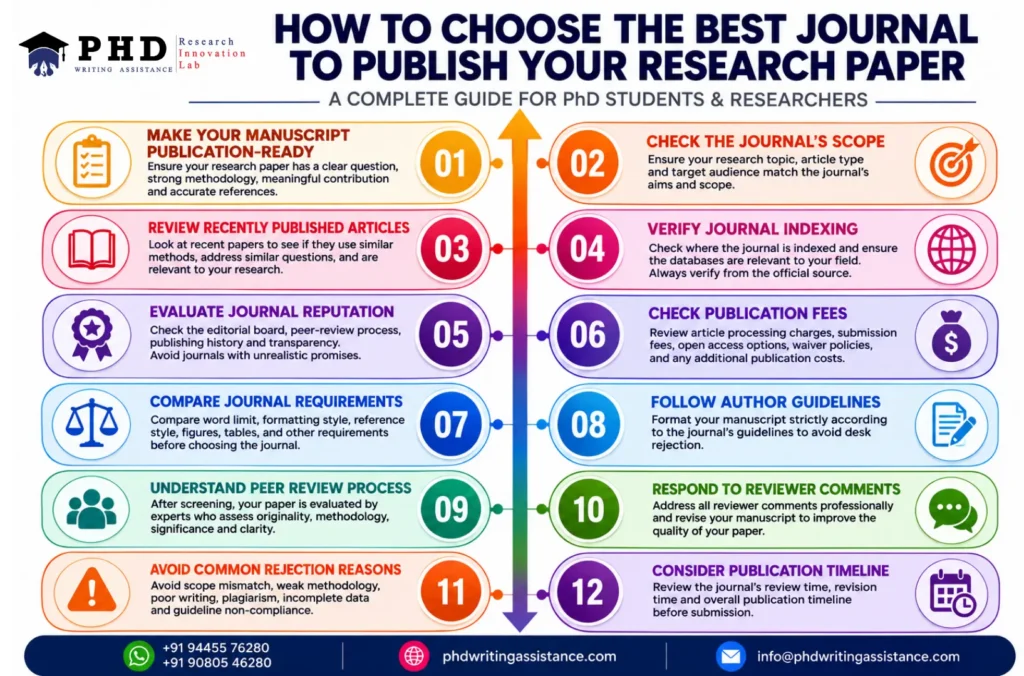
The best journal to publish research paper is not necessarily the journal with the highest impact factor. It is the journal that provides a strong fit for your research and meets your publication requirements.
Consider the following factors before selecting a journal.
Check the Journal’s Scope
Read the journal’s aims and scope carefully.
Ask:
- Does the journal publish research in your subject area?
- Has it published similar studies?
- Does your research match its preferred topics?
- Does it accept your article type?
A strong match between your manuscript and the journal’s scope can make the submission more relevant.
Review Recently Published Articles
Look at recent papers published by the journal.
Check whether they:
- Address similar research questions
- Use similar methodologies
- Target a similar academic audience
- Discuss topics related to your research
This can help you determine whether your manuscript fits the journal.
Check Journal Indexing
Researchers should verify where the journal is indexed and whether those databases are relevant to their field.
Depending on the discipline, researchers may consider recognised databases and indexing services relevant to their institution or research area.
Do not rely solely on claims displayed on a journal’s website. Verify indexing information through the relevant database where possible.
Consider Journal Reputation and Quality
Evaluate the journal’s editorial board, peer-review practices, publishing history, transparency, and academic reputation.
Be cautious of journals that make unrealistic promises about extremely fast publication or guaranteed acceptance.
Check Publication Fees
Some journals charge article processing charges or other publication fees, while others may not.
Before submitting, check:
- Article processing charges
- Submission fees
- Open-access options
- Waiver policies
- Additional publication costs
Understanding the costs beforehand can prevent unexpected expenses later.
How to Publish a Research Paper Successfully
Knowing how to publish a research paper involves more than submitting a manuscript.
A typical process includes:
- Complete and review the manuscript.
- Identify suitable journals.
- Compare journal requirements.
- Select the most appropriate journal.
- Format the manuscript according to the guidelines.
- Prepare the required submission documents.
- Submit the manuscript.
- Respond to editorial or reviewer comments.
- Revise the manuscript when required.
- Receive the final editorial decision.
The exact process can vary between journals and disciplines.
Research Paper Publication Process: Step by Step
Understanding the research paper publication process helps researchers know what to expect after submission.
1. Manuscript Preparation
Prepare the paper according to the journal’s author guidelines.
Check:
- Word count
- Formatting
- Reference style
- Figures and tables
- Abstract requirements
- Ethical declarations
- Supplementary materials
2. Journal Submission
Submit the manuscript through the journal’s specified submission system.
Depending on the journal, you may need a cover letter, declarations, author information, data statements, or other supporting documents.
3. Editorial Screening
The editor may initially assess whether the manuscript fits the journal’s scope and basic requirements.
Some papers are rejected at this stage without external peer review.
4. Peer Review
If the manuscript passes initial screening, it may be sent to reviewers who evaluate aspects such as methodology, originality, significance, clarity, and contribution.
5. Revision
The editor may request revisions based on reviewer comments.
Researchers should respond to each comment carefully and explain the changes made.
6. Final Decision
The editor may decide to:
- Accept the manuscript
- Request further revisions
- Reject the manuscript
If accepted, the paper moves into the journal’s production and publication stages.
How to Improve Your Chances of Getting a Paper Published
Researchers can improve their chances by focusing on both research quality and journal fit.
Match the Journal Carefully
Do not submit the same manuscript randomly to multiple journals. Identify journals where your research genuinely fits.
Follow Author Guidelines
Failure to follow formatting and submission requirements can create avoidable problems.
Strengthen the Research Contribution
Clearly explain what your study adds to existing knowledge.
Improve Academic Writing
The manuscript should be clear, coherent, and logically organised.
Check References Carefully
Make sure citations are accurate, relevant, and consistently formatted.
Address Reviewer Comments Professionally
When revisions are requested, respond systematically and provide a clear explanation of the changes.
Common Reasons Journals Reject Research Papers
Understanding why journals reject papers can help researchers avoid preventable problems.
Common reasons include:
- Poor journal fit
- Limited originality
- Weak research methodology
- Insufficient research contribution
- Poorly defined research questions
- Inadequate literature review
- Unsupported conclusions
- Poor academic writing
- Failure to follow journal guidelines
- Ethical or research integrity concerns
A technically well-written paper can still be rejected if it does not match the journal’s scope or audience.
How to Publish a Paper in a Journal Without Choosing the Wrong One
Researchers sometimes focus heavily on journal rankings and overlook practical suitability.
Before you publish paper in journal, create a shortlist of potential journals and compare them using a simple checklist:
| Factor | What to Check |
| Scope | Does the topic fit? |
| Audience | Who reads the journal? |
| Indexing | Where is it indexed? |
| Article type | Does it accept your manuscript type? |
| Peer review | How is the review process described? |
| Publication fees | Are there mandatory charges? |
| Open access | What options are available? |
| Guidelines | Can you meet the requirements? |
| Reputation | Is the journal credible in your field? |
This approach makes journal selection more systematic.
How Long Does Research Paper Publication Take?
There is no single publication timeline that applies to every journal.
The process can depend on:
- Editorial screening
- Reviewer availability
- Number of review rounds
- Manuscript revisions
- Editorial decisions
- Production and publication schedules
Some manuscripts may move through the process relatively quickly, while others can take several months or longer.
Researchers should check the journal’s published information about its review and publication timelines, but should avoid choosing a journal solely because it promises unusually rapid publication.
PhD Research Paper Publication Support
PhD students may need support with different stages of preparing a manuscript for publication, including research paper structure, academic editing, proofreading, literature organisation, referencing, and manuscript preparation.
Professional PhD writing assistance can help improve the clarity, structure, and academic presentation of research work while preserving the researcher’s original research, data, analysis, and contribution.
Conclusion
Finding the best journal to publish research paper requires more than comparing journal metrics. Researchers should evaluate journal scope, research fit, indexing, audience, peer-review practices, publication costs, author guidelines, and overall credibility.
A successful research paper publication process begins with a strong manuscript and continues through appropriate journal selection, submission, peer review, revisions, and final publication.
By understanding how to make research paper content publication-ready and carefully evaluating potential journals, PhD students and researchers can make more informed decisions about where to submit their work.
Frequently Asked Questions
1. How do I write a research paper that gets published?
Develop a clear research question, conduct rigorous research, present a meaningful contribution, follow the target journal’s guidelines, and ensure the manuscript is well structured and edited.
2. What makes a research paper publishable?
A publishable paper generally offers a clear research contribution, sound methodology, relevant evidence, strong analysis, and a well-written manuscript that fits the target journal.
3. How do I improve acceptance chances of my research paper?
Choose a suitable journal, strengthen the research contribution, follow submission guidelines, improve academic writing, and respond carefully to reviewer feedback.
4. What are the main reasons journals reject papers?
Common reasons include poor journal fit, limited originality, methodological weaknesses, unclear research questions, insufficient contribution, poor writing, and failure to follow journal requirements.
5. How many revisions are usually required before publication?
There is no fixed number. A manuscript may require one or several rounds of revisions depending on reviewer comments and the editor’s decision.