Introduction
TinyML is an emerging area of artificial intelligence that enables machine learning models to operate on small, resource-constrained devices such as microcontrollers, sensors and embedded systems. By bringing intelligence closer to where data is generated, TinyML allows devices to analyse information locally without always relying on cloud-based computing. This approach can support faster responses, lower communication costs and improved privacy in applications where transmitting sensitive data to external servers may be undesirable.
The growing adoption of the Internet of Things (IoT), smart sensors, wearable devices and edge computing has increased interest in TinyML research. From environmental monitoring and predictive maintenance to healthcare devices and smart agriculture, TinyML offers opportunities to develop intelligent systems that operate with limited memory, processing power and energy.
For computer science students, postgraduate scholars and PhD researchers, TinyML provides a range of potential research directions. These include model compression, energy-efficient machine learning, intelligent data analysis, edge AI security and real-time prediction. However, selecting an appropriate topic requires an understanding of the technology, its limitations and the research gaps that remain.
This article explores TinyML applications, emerging artificial intelligence topics, research questions and dissertation ideas to help researchers identify a focused and feasible academic project.
What Is TinyML?
TinyML refers to techniques and technologies that enable machine learning inference on low-power, resource-constrained hardware. These devices may include microcontrollers, wearable electronics, embedded processors and small sensor-based systems.
Traditional machine learning often depends on powerful computers or cloud infrastructure to process large datasets and run complex models. TinyML aims to make selected machine learning tasks possible directly on smaller devices, where memory, computing capacity and battery life are limited.
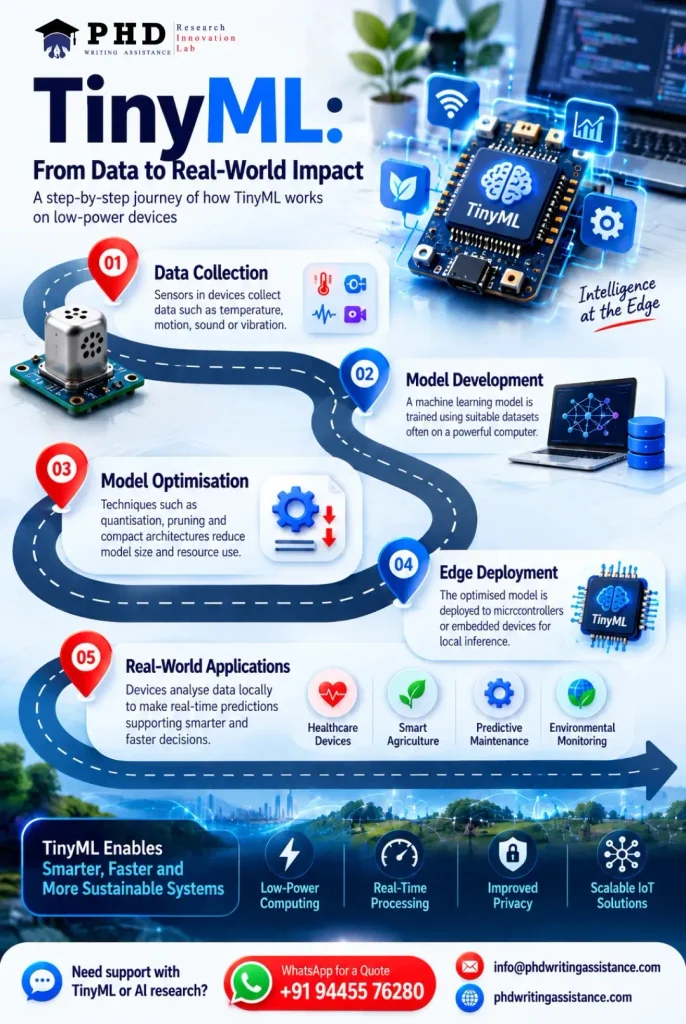
A typical TinyML system involves four main components:
- Data collection: Sensors or embedded devices collect information such as temperature, movement, sound or vibration.
- Model development: A machine learning model is trained using suitable datasets, often on a more powerful computer.
- Model optimisation: Techniques such as quantisation, pruning and compact model architectures reduce resource requirements.
- Edge deployment: The optimised model is deployed to compatible hardware to make predictions locally.
TinyML primarily concerns running inference on constrained devices. Training a model directly on the device is possible in some settings, but it introduces additional challenges related to memory, energy consumption and computational resources.
Why Is TinyML Important in Artificial Intelligence Research?
TinyML addresses a central challenge in modern artificial intelligence: how to deliver useful predictive capabilities without depending on substantial computing infrastructure.
Its importance can be understood through several factors.
1. Low-Power Computing
Many embedded devices operate using batteries or energy-harvesting systems. TinyML research explores how models can perform useful tasks while consuming minimal energy. This is particularly relevant for remote sensors and devices that must operate for extended periods without frequent maintenance.
2. Real-Time Data Processing
Processing information locally can reduce the time needed to send data to a remote server and receive a response. This can be valuable in applications such as machine fault detection, motion recognition and environmental monitoring.
However, actual latency depends on hardware capabilities, model complexity and the surrounding system architecture.
3. Privacy and Data Protection
Local inference can reduce the need to transmit raw sensor data to cloud services. This may be beneficial when processing personal, medical or location-related information. Nevertheless, local processing does not automatically guarantee security; appropriate data protection and device security measures are still required.
4. IoT and Edge AI Integration
TinyML can support intelligent IoT systems by enabling individual devices to identify patterns and respond to local conditions. Researchers can investigate how these systems perform when connectivity is unreliable or cloud access is limited.
5. Scalable Intelligent Systems
Compact machine learning models may enable intelligence to be deployed across many low-cost devices. Research can explore the trade-offs between model accuracy, deployment cost, energy use and system reliability.
Latest TinyML Research Topics
The following areas offer promising directions for contemporary research. Their suitability depends on the literature, hardware availability, datasets and the research gap identified.
1. Energy-Efficient Machine Learning Models
Energy efficiency is a major consideration in TinyML because many devices have limited battery capacity and processing power. Researchers investigate how model design and optimisation techniques influence energy consumption while preserving useful predictive performance.
Possible research topics include:
- Comparing energy consumption across compact machine learning models on microcontrollers.
- Evaluating quantisation techniques for low-power edge inference.
- Investigating the relationship between model size, accuracy and inference latency.
- Developing energy-aware model selection methods for embedded applications.
- Assessing the performance of lightweight neural networks on resource-constrained hardware.
A strong project should measure energy consumption under defined conditions rather than relying only on model size or theoretical complexity.
2. Model Compression and Optimisation
Model compression reduces the resources required to deploy machine learning models on embedded devices. Common techniques include quantisation, pruning and knowledge distillation.
Quantisation represents model values using lower numerical precision. Pruning removes selected parameters or connections, while knowledge distillation transfers useful behaviour from a larger model to a smaller one.
Potential research topics include:
- Comparative analysis of quantisation methods for TinyML applications.
- Evaluating pruning techniques for compact neural networks.
- Knowledge distillation for resource-constrained machine learning.
- Investigating the effect of model compression on prediction reliability.
- Developing an optimisation framework for balancing accuracy and memory requirements.
These studies should consider deployment performance, not just results obtained during model training.
3. TinyML for Healthcare and Wearable Devices
Wearable sensors can collect information about movement, activity, heart rate and other physiological signals. TinyML may help analyse selected signals locally, potentially supporting continuous monitoring and timely alerts.
Possible research topics include:
- TinyML-based activity recognition using wearable sensor data.
- Lightweight machine learning for analysing physiological time-series data.
- Comparing compact models for wearable motion classification.
- Evaluating energy-efficient inference for wearable health monitoring.
- Investigating privacy-aware edge analytics for wearable devices.
Healthcare research requires particular care when interpreting results. A model that classifies a dataset accurately does not necessarily constitute a clinically validated diagnostic system. Appropriate datasets, validation procedures and ethical safeguards are essential.
4. TinyML in Smart Agriculture and Environmental Monitoring
Agricultural and environmental monitoring systems often use distributed sensors to collect data across large areas. TinyML can help process selected measurements locally, reducing dependence on continuous connectivity.
Potential dissertation topics include:
- Lightweight machine learning for soil condition classification.
- TinyML-based environmental anomaly detection using sensor data.
- Comparing compact models for plant disease classification on edge hardware.
- Energy-efficient prediction of agricultural sensor measurements.
- Evaluating local inference for temperature and air-quality monitoring.
The feasibility of these topics depends on access to reliable data, appropriate sensors and, where required, physical deployment facilities.
5. TinyML for Predictive Maintenance
Predictive maintenance uses sensor data to identify patterns that may indicate equipment deterioration or abnormal operation. TinyML offers an opportunity to deploy selected detection models directly on industrial sensors or embedded devices.
Possible research topics include:
- TinyML-based vibration anomaly detection for industrial equipment.
- Comparing lightweight classifiers for machine condition monitoring.
- Evaluating edge inference for fault detection under limited memory.
- Investigating model robustness when sensor conditions change.
- Analysing the trade-off between detection accuracy and energy consumption.
A useful study should clearly define the equipment or dataset, the fault categories and the evaluation metrics. Researchers should also distinguish between detecting anomalies and reliably predicting the remaining useful life of a machine.
Artificial Intelligence Topics and Computer Science Research Questions
TinyML connects with broader artificial intelligence and computer science research areas. It provides opportunities to investigate algorithms, embedded systems, software optimisation and intelligent data analysis within a practical deployment environment.
The following research questions can help students develop a focused project.
1. Model Performance and Resource Constraints
- How does quantisation affect classification accuracy on a resource-constrained device?
- Which compact model architecture offers the best balance between accuracy and inference latency for a defined task?
- How does model pruning influence memory usage and prediction performance?
- What trade-offs emerge when deploying the same model across different microcontrollers?
2. Intelligent Data Analysis at the Edge
Intelligent data analysis involves identifying meaningful patterns, trends or anomalies in data using computational methods. TinyML enables selected analysis tasks to be performed close to the source of data.
Possible research questions include:
- How effectively can lightweight models detect anomalies in streaming sensor data?
- How does local data processing compare with cloud-based inference in latency and communication requirements?
- Can compact machine learning models maintain reliable performance when sensor data is noisy or incomplete?
- Which feature extraction methods are most suitable for resource-constrained time-series analysis?
These questions can be investigated using public datasets, controlled experiments or embedded hardware, depending on the project’s scope.
3. Security and Reliability of TinyML Systems
TinyML devices may operate in environments where physical access, limited update mechanisms or insecure communication create risks. Researchers can examine how to improve system reliability without exceeding hardware constraints.
Potential questions include:
- How robust are compact models to noise and changes in sensor conditions?
- What are the performance costs of selected security measures in embedded AI systems?
- How does quantisation affect model robustness under defined test conditions?
- Which approaches can help identify model performance degradation in long-running sensor applications?
Security-related projects should use authorised testing environments and clearly defined evaluation criteria.
How to Choose a Suitable TinyML Dissertation Topic
Selecting a dissertation topic requires more than choosing a popular technology. The project should address a meaningful research question that can be investigated using appropriate methods and available resources.
1. Identify a Research Gap
Start by reviewing recent studies on TinyML, edge AI, model compression or embedded machine learning. Identify limitations, inconsistent findings or unanswered questions that matter to the chosen application.
For example, rather than choosing the broad topic “TinyML in healthcare”, a more focused question could examine how different quantisation methods affect the accuracy and energy consumption of a lightweight activity-recognition model.
2. Define the Application and Research Objective
Choose a specific problem, such as sensor anomaly detection, wearable activity recognition or environmental classification. Define what the study will measure and what comparison or contribution it intends to make.
3. Assess Datasets and Hardware
Check whether suitable datasets, microcontrollers, development boards and software frameworks are available. A simulation-based study may be more feasible where physical hardware is inaccessible, but the limitations of simulated deployment should be acknowledged.
4. Select Evaluation Metrics
Depending on the research question, relevant metrics may include:
- Model accuracy, precision, recall and F1-score.
- Model size and memory usage.
- Inference latency.
- Energy consumption per inference.
- Robustness to noise or changes in input conditions.
Metrics should match the research objective. A model with slightly lower accuracy may still be preferable in some applications if it offers substantial improvements in energy consumption or latency.
5. Plan Validation and Reproducibility
Document the dataset, preprocessing, model architecture, training configuration, optimisation settings and deployment environment. Where possible, use appropriate baselines and repeatable experiments.
A well-defined methodology helps readers understand how the results were obtained and whether the conclusions are supported by the evidence.
Common Challenges in TinyML Research
TinyML projects involve several technical and methodological challenges.
Limited hardware resources: Devices may have strict memory, processing and energy constraints.
Accuracy–efficiency trade-offs: Reducing model size or numerical precision may affect predictive performance.
Hardware-dependent results: Inference time and energy use can vary across devices and deployment configurations.
Dataset limitations: Models trained on narrow datasets may perform poorly under real-world conditions.
Deployment complexity: A model that performs well on a desktop computer may require additional optimisation before running successfully on a microcontroller.
Reproducibility: Incomplete reporting of hardware, software versions, model settings and evaluation procedures can make comparisons unreliable.
Addressing these issues through controlled experiments, transparent reporting and careful interpretation strengthens the academic value of a TinyML study.
Publication Support for TinyML and Artificial Intelligence Research
Preparing TinyML research for publication requires a clear explanation of the research problem, the technical approach, the evaluation framework and the contribution to existing knowledge.
A strong manuscript should describe the model and optimisation methods, specify the hardware and software environment, report appropriate performance metrics and discuss limitations. Researchers should compare their findings with relevant published studies and avoid claiming improvements that are not supported by the experiments.
Before submitting a manuscript, students should review the target journal or conference scope, formatting requirements, data-sharing policies and publication ethics. Results should be reported accurately, and authors should retain responsibility for the originality and validity of their work.
PhD Writing Assistance can support researchers with literature review development, research question refinement, methodology presentation, academic editing and manuscript preparation. This support can help improve clarity and organisation while preserving the researcher’s intellectual contribution and responsibility for the research.
Conclusion
TinyML is an important research area within artificial intelligence, combining machine learning with embedded systems and edge computing. Its applications in healthcare, environmental monitoring, smart agriculture, predictive maintenance and intelligent sensor analysis provide a wide range of potential dissertation topics.
For computer science students and PhD scholars, promising research directions include model compression, energy-efficient inference, robust sensor analytics and privacy-aware edge intelligence. However, a successful project must be based on a focused research question, an appropriate methodology and realistic evaluation criteria.
By identifying a meaningful research gap, assessing available resources and reporting results transparently, researchers can develop TinyML studies that contribute useful evidence to the wider fields of artificial intelligence and computer science.
Frequently Asked Questions
1. What is TinyML in artificial intelligence?
TinyML enables machine learning models to run on low-power devices such as microcontrollers and sensors.
2. What are the latest research topics in TinyML?
Key research topics include model compression, energy-efficient AI, edge computing, sensor analytics, and TinyML security.
3. Which TinyML topics are suitable for a computer science dissertation?
Suitable topics include model quantisation, lightweight neural networks, sensor anomaly detection, and energy-efficient edge AI.
4. How is TinyML used for intelligent data analysis?
TinyML analyses sensor data locally to perform tasks such as classification, anomaly detection, and activity recognition.
5. How can researchers prepare a TinyML paper for publication?
Researchers should present a clear research question, reproducible methodology, validated results, and relevant comparisons with existing studies.