Introduction
Publishing a research paper in a recognised academic journal or conference is an important step for researchers, postgraduate students and academics. In engineering, computer science, electronics and related technical disciplines, the Institute of Electrical and Electronics Engineers (IEEE) is a widely recognised professional organisation that publishes journals, conference proceedings and other technical research.
However, before submitting a manuscript, many researchers want to understand the IEEE paper publishing cost in India. Publication expenses can vary depending on the journal or conference, open-access requirements, page limits and additional services. Understanding these costs in advance can help researchers select a suitable publication route and plan their research budget.
This guide explains the factors that influence IEEE publication charges, the difference between journal and conference publication, the submission process and how to identify suitable journals for your research.
What Is IEEE Paper Publishing?
IEEE paper publishing refers to the process of submitting original technical research to an IEEE journal, magazine or conference publication for editorial assessment, peer review and possible publication.
IEEE publishes research across several technical fields, including:
- Electrical and electronic engineering
- Computer science and information technology
- Artificial intelligence and machine learning
- Robotics and automation
- Telecommunications and networking
- Signal processing
- Power systems and renewable energy
- Biomedical engineering
Researchers can publish through different routes depending on the subject, research contribution and publication requirements.
An IEEE paper publication normally involves preparing a manuscript according to the relevant publication guidelines, submitting it through the official submission system, responding to reviewer comments and completing the required publication formalities after acceptance.
It is important to understand that submitting a paper does not guarantee acceptance. The manuscript must meet the publication’s technical scope, originality requirements and quality standards.
IEEE Paper Publishing Cost in India: What Should Researchers Expect?
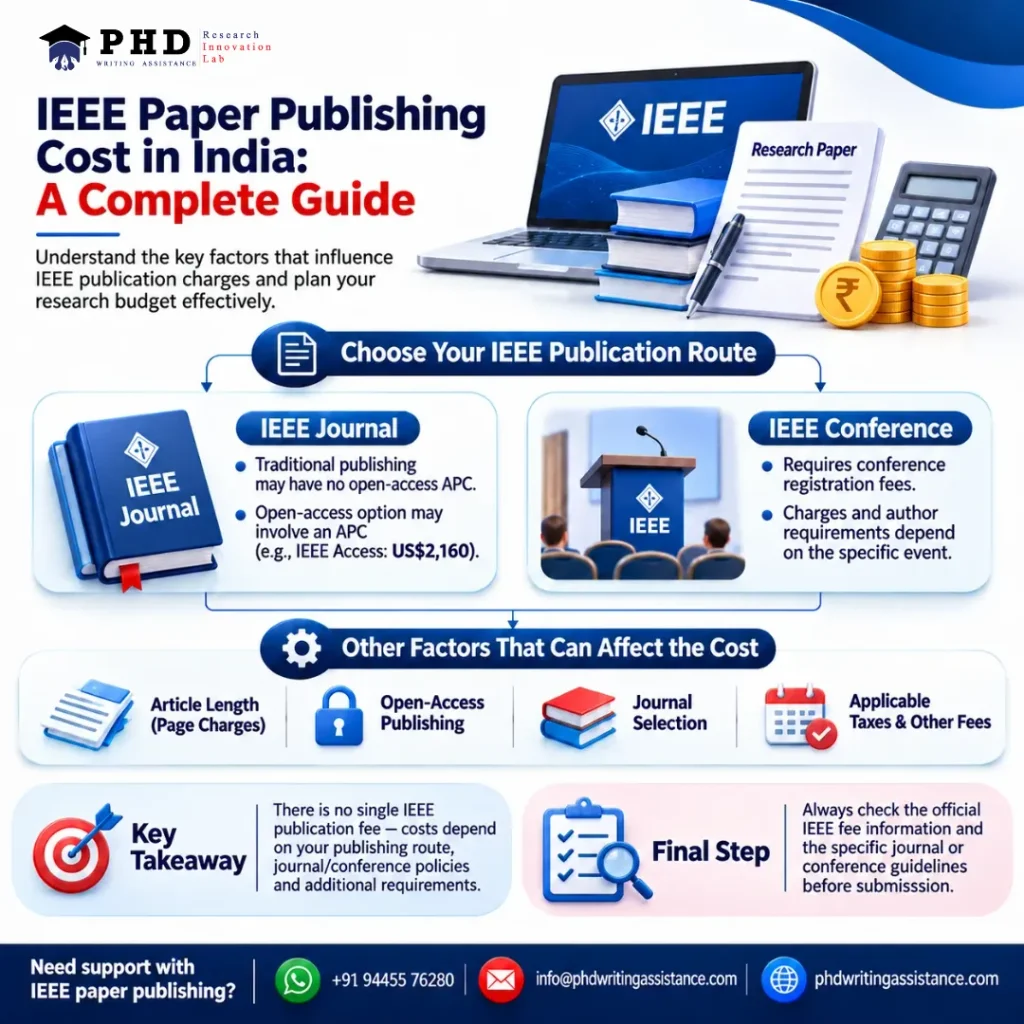
The IEEE paper publishing cost in India depends on the specific publication and the publishing option selected by the author. There is no single fee that applies to every IEEE journal or conference.
Some IEEE journal publishing routes do not require an article processing charge (APC), while optional open-access publishing involves a separate fee. Additional charges may apply depending on article length, publication policies and other requirements.
For 2026, IEEE lists the following open-access article processing charges:
- IEEE Access: US$2,160.
- Most fully open-access IEEE journals: US$2,160, with exceptions for certain titles.
- Hybrid IEEE journals offering open access: US$2,800.
These are official open-access charges, not a universal price for every IEEE paper. Applicable local taxes and publication-specific charges may also affect the final amount.
Researchers in India should check the official IEEE fee information and the individual journal’s author instructions before submitting their manuscript. The final amount in Indian rupees may vary with the applicable exchange rate, taxes and payment arrangements.
It is also important to distinguish publication charges from research paper preparation or publication-support service fees. These are separate costs and should not be presented as official IEEE charges.
Factors That Affect IEEE Paper Publication Costs
Several factors can influence the total amount a researcher may need to budget for publication.
1. Journal Selection
Different IEEE journals have different publication policies, subject areas and fee structures. Some offer traditional subscription-based publication, while others provide fully open-access or hybrid publishing options.
Before choosing a journal, review its author guidelines and publication charges. Do not assume that every IEEE journal has the same APC.
2. Open-Access Publishing
Open access allows readers to access the final published research article without a subscription. IEEE offers different open-access options, including fully open-access journals and open-access publication in selected hybrid journals.
An APC may apply when authors choose an open-access route. Depending on the publication, the fee may be paid by the author, their institution or a research funding organisation.
Researchers should decide whether open access is necessary for their research goals, institutional requirements or funding conditions before making a selection.
3. Article Length and Page Charges
Some IEEE journals have limits on the number of pages permitted for different manuscript types. Additional charges may apply when an article exceeds the permitted length.
Researchers should review the page limits and formatting instructions before submission. Keeping the manuscript concise and following the required structure can help avoid unnecessary overlength charges.
4. Conference Registration Fees
IEEE conference publication involves a different cost structure from journal publication.
Conference organisers establish registration and participation fees according to the event’s policies. Some conferences require an accepted-paper registration before the paper can be included in the proceedings.
Therefore, researchers should check the official conference website for registration deadlines, author requirements and publication conditions.
Conference registration fees should not be confused with IEEE journal APCs.
5. Additional Publication Requirements
Other expenses may arise from specific publication requirements, such as optional print colour charges, additional pages or other publication-related services.
Authors should review the applicable fee information rather than relying on general estimates from third-party websites.
Difference Between IEEE Journal and Conference Publication
Researchers often consider both journals and conferences when deciding where to submit their work. Although both can provide opportunities to communicate technical research, their publication processes and requirements differ.
IEEE Journal Publication
IEEE journals generally publish research articles that undergo editorial evaluation and peer review. They may be suitable for detailed studies involving substantial technical contributions, experiments, theoretical development or comprehensive analysis.
Before submitting, researchers should examine the journal’s scope, manuscript categories, review process and publication policies.
IEEE Conference Publication
IEEE conferences provide opportunities for researchers to present and discuss their work with academics, professionals and other participants.
Conference papers are generally prepared according to the event’s submission requirements. Accepted papers may be included in the conference proceedings, subject to the organiser’s publication arrangements and applicable requirements.
A conference should not be selected solely because it advertises a short publication timeline. Researchers should verify its technical relevance, organising committee, review process and publication history.
The appropriate choice depends on the research contribution, academic objectives, available budget and submission requirements.
How to Publish an IEEE Research Paper
Understanding the submission process can help researchers prepare their manuscripts more effectively. Although specific requirements vary across publications, the following steps provide a general overview.
Step 1: Select a Suitable Research Topic
Begin with a research problem that is relevant to your technical discipline. Your topic should address a clearly defined problem and offer a meaningful contribution to existing knowledge.
For example, possible research areas include machine learning applications, renewable energy systems, wireless communication, cybersecurity and intelligent automation.
A focused research question makes it easier to identify suitable publications and develop a clear manuscript.
Step 2: Conduct a Literature Review
Review relevant academic publications to understand existing research, established methods and unresolved problems.
Use credible academic sources and examine recent studies alongside important foundational research. Identify how your work differs from previous studies and what contribution it can make.
A strong literature review also helps you establish the research gap and justify your methodology.
Step 3: Prepare the Research Manuscript
Organise the paper according to the selected publication’s author guidelines. A typical technical research paper may include:
- Title and abstract
- Keywords
- Introduction
- Literature review or related work
- Research methodology
- Results and discussion
- Conclusion
- References
The manuscript should communicate the research problem, methods, findings and contribution clearly. Use the official IEEE template where required, and check formatting, figures, equations, references and technical terminology.
Step 4: Select the Right IEEE Journal or Conference
Identify publications that match your research subject and manuscript type.
Read their aims and scope, author instructions, review policies and publication charges. You can explore relevant publications through IEEE Xplore and the IEEE Publication Recommender.
Do not select a journal based only on a claim of rapid acceptance or guaranteed indexing. Verify the publication through official IEEE resources.
Step 5: Submit the Manuscript
Follow the submission instructions on the selected journal or conference website. Provide the required manuscript files, author information, declarations and supporting documents.
Ensure that all authors have reviewed and approved the submitted version. The manuscript should also comply with originality, research ethics and copyright requirements.
Step 6: Respond to Peer Review
Reviewers may request clarification, technical improvements, additional analysis or corrections. Read each comment carefully and prepare a structured response explaining how the manuscript has been revised.
If the paper is rejected, review the feedback and consider whether the manuscript needs further improvement or a different publication venue.
Step 7: Complete the Publication Formalities
After acceptance, authors may need to complete copyright or publication agreements, final manuscript checks and other required formalities.
If an open-access option or additional publication charge applies, follow the official payment instructions provided through the publisher’s authorised process.
For conference papers, also follow the organiser’s final-submission and registration requirements.
How to Find the Best Journals to Publish Research Papers
Selecting an appropriate publication is just as important as preparing a good manuscript. Researchers searching for the best journals to publish research papers should evaluate several factors before making a decision.
Subject relevance: Check whether the journal regularly publishes research related to your technical field and research question.
Publication credibility: Verify that the journal is an authentic IEEE publication or an officially recognised publication partner. Be cautious of websites that imitate established publishers.
Peer-review process: Understand the journal’s editorial and peer-review policies. A credible publication should explain its review process clearly.
Publication charges: Review APCs, page charges and optional publishing costs before submission.
Indexing information: Verify indexing through the relevant database itself. Publication in IEEE Xplore does not automatically guarantee inclusion in every external indexing database.
Author guidelines: Check manuscript length, reference style, formatting, copyright and research ethics requirements.
Researchers should prioritise publication quality and subject relevance rather than selecting a journal based only on its advertised acceptance rate or publication speed.
Common Mistakes to Avoid During IEEE Paper Submission
A technically strong manuscript may still face problems if authors overlook publication requirements.
Some common mistakes include:
- Submitting a paper that does not match the journal’s scope.
- Using an incorrect manuscript template.
- Failing to explain the originality of the research.
- Including incomplete or inconsistent references.
- Overlooking plagiarism and research ethics requirements.
- Ignoring reviewer comments during revision.
- Paying unofficial agents who promise guaranteed publication.
- Assuming that every IEEE publication has the same charges.
- Trusting claims of guaranteed indexing or acceptance.
Before submission, carefully review the journal or conference guidelines and confirm all fees through official sources.
How Research Paper Publication Services Can Help
Preparing a technical research manuscript for publication can involve several stages, from organising the research findings to improving academic presentation and meeting formatting requirements.
Researchers may need assistance with manuscript structure, language clarity, literature review organisation, reference formatting and understanding journal submission guidelines.
Professional research paper publication services may provide guidance on these areas, depending on the scope of the service. Such assistance can help authors identify presentation issues and understand the publication process.
Publication support should not involve fabricated research results, misleading authorship, manipulated citations or guaranteed acceptance claims. Researchers remain responsible for the originality, accuracy and integrity of their work.
For students and researchers who need academic guidance, PhD Writing Assistance provides research and writing support resources, including guidance relevant to technical research and publication preparation. Any support should be used in accordance with the author’s institutional policies and publication ethics.
Conclusion
Understanding the IEEE paper publishing cost in India requires more than looking for a single estimated fee. Publication expenses depend on the selected journal or conference, open-access options, article length, conference registration and other applicable requirements.
Researchers should verify official charges, review publication guidelines and select a suitable venue based on research quality and subject relevance. A well-prepared manuscript, clear research contribution and careful submission process can help authors approach IEEE publication with greater confidence.
Whether you are preparing your first technical manuscript or planning your next academic publication, understanding the IEEE paper publication process and its associated costs is an important part of responsible research publishing.
Frequently Asked Questions
1. What is the IEEE paper publishing cost in India?
IEEE publication costs vary by journal, conference and publishing option. Check the official IEEE fee details before submission.
2. Can I publish an IEEE paper without paying an APC?
Yes. Some IEEE journals offer traditional publication without an open-access APC.
3. What is the difference between IEEE journal and conference publication?
Journals publish peer-reviewed research articles, while conferences publish accepted papers presented at academic events.
4. How can I find the best journals to publish research papers?
Check the journal’s scope, peer-review process, indexing, publication fees and author guidelines.
5. Can research paper publication services guarantee IEEE paper acceptance?
No. Acceptance depends on the journal’s or conference’s review process.