Introduction
Finishing data collection and analysis is a major achievement, but a dissertation is not complete until its findings have been explained. Readers need to understand not only what the research revealed, but also why those results matter and how they relate to the original questions. Knowing how to write a dissertation discussion helps researchers turn a collection of findings into a convincing academic argument.
This guide explains how to organise the chapter, interpret results critically and learn from practical examples without overstating the conclusions.
What Is a Dissertation Discussion Chapter?
A dissertation discussion is the part of the research report that interprets the findings in relation to the study’s aims, questions and existing literature. Whereas the results chapter presents what the data showed, the discussion examines what those findings mean. It considers possible explanations, evaluates their significance and identifies the limits of the conclusions.
For example, a survey might reveal that students who receive frequent feedback report greater confidence in their academic work. Reporting that association belongs in the results. Discussing why it might exist, whether earlier studies found something similar and what other factors could explain it belongs in the discussion.
The discussion section in research should therefore build an argument around the evidence rather than reproduce tables, interview quotations or statistical outputs. Some universities combine the two chapters, but their purposes remain distinct.
How to Write a Dissertation Discussion: A Clear Chapter Structure
There is no single structure that suits every discipline. However, researchers learning how to write a discussion chapter can use the following sequence to move logically from the findings to their wider contribution.
1. Open With the Most Important Findings
Begin by briefly reminding readers of the research purpose and identifying the findings that best answer the research questions. Select the central patterns or relationships rather than summarising every result. This opening should provide direction for the analysis that follows.
For instance, a study of online postgraduate learning might find that flexible access improves participation for some students, while limited interaction creates difficulties for others. The opening discussion could identify this tension as the central finding and signal how the chapter will examine it.
2. Explain What the Findings Mean
The interpretation of research findings is the heart of the discussion. For each major result, consider what it suggests, why it may have occurred and how closely the explanation follows from the evidence. Connect the interpretation to the research objectives rather than offering a series of unrelated observations.
A positive relationship between study routines and academic performance, for example, may suggest that consistent preparation supports learning. Yet motivation, prior achievement or access to resources could influence both variables. Unless the research design establishes causality, describe an association rather than claiming that one factor caused the other.
In quantitative studies, consider effect sizes and uncertainty; in qualitative work, interpret themes within participants’ particular contexts.
3. Connect Results With Existing Literature
The discussion should return to the studies and theories introduced in the literature review. Explain whether the new findings support, challenge or extend previous research, and why that relationship matters. Merely stating that a result is “consistent with earlier studies” offers little critical insight.
If two studies reach different conclusions, examine meaningful differences in methods, populations, settings or measures. For example, contrasting findings about digital learning may reflect variation in internet access or teaching practices. These possibilities should be presented as interpretations unless evidence confirms them.
Use relevant, verifiable academic sources to support comparisons. Show how the evidence contributes to the scholarly conversation rather than repeating the literature review.
4. Address Unexpected Outcomes
Results that contradict expectations are not necessarily weaknesses. They can reveal overlooked conditions, limitations in an existing theory or questions worth investigating further. Acknowledge them rather than selecting only the findings that support the original hypothesis.
Suppose a workplace study finds that introducing new software does not improve productivity. A careful discussion might consider training, implementation time and the suitability of performance measures. It should also recognise when the available data cannot distinguish between these explanations.
5. Discuss Research Implications
After interpreting the evidence, explain what it contributes. Theoretical implications concern how the findings inform an existing concept or framework. Practical implications concern possible lessons for institutions, professionals or policymakers. Methodological implications may reveal better ways to investigate the topic.
For example, findings about difficulties accessing online learning resources could inform decisions about student support. However, recommendations should reflect the study’s setting and strength of evidence. A small observational study cannot justify universal policy claims, even when its findings are useful.
6. Evaluate Limitations Honestly
Every study has boundaries. These may involve sample selection, measurement quality, available data, time constraints or the context in which the research was conducted. Explain how the most important limitations affect interpretation instead of simply listing them.
A study involving one university, for example, may offer valuable insight into that institution while providing limited grounds for generalising to all universities. A cross-sectional survey can identify relationships at one point in time but may not establish their direction. Acknowledging these constraints makes the conclusions more trustworthy.
7. Identify Useful Directions for Future Research
Future research recommendations should follow directly from unresolved questions and study limitations. Instead of writing that “further studies are required”, specify what they could investigate and why.
If participants describe changing experiences with digital research tools, a longitudinal study might examine how those experiences develop. If findings come from a single institution, research across different settings could test whether similar patterns occur. Keep recommendations focused and feasible.
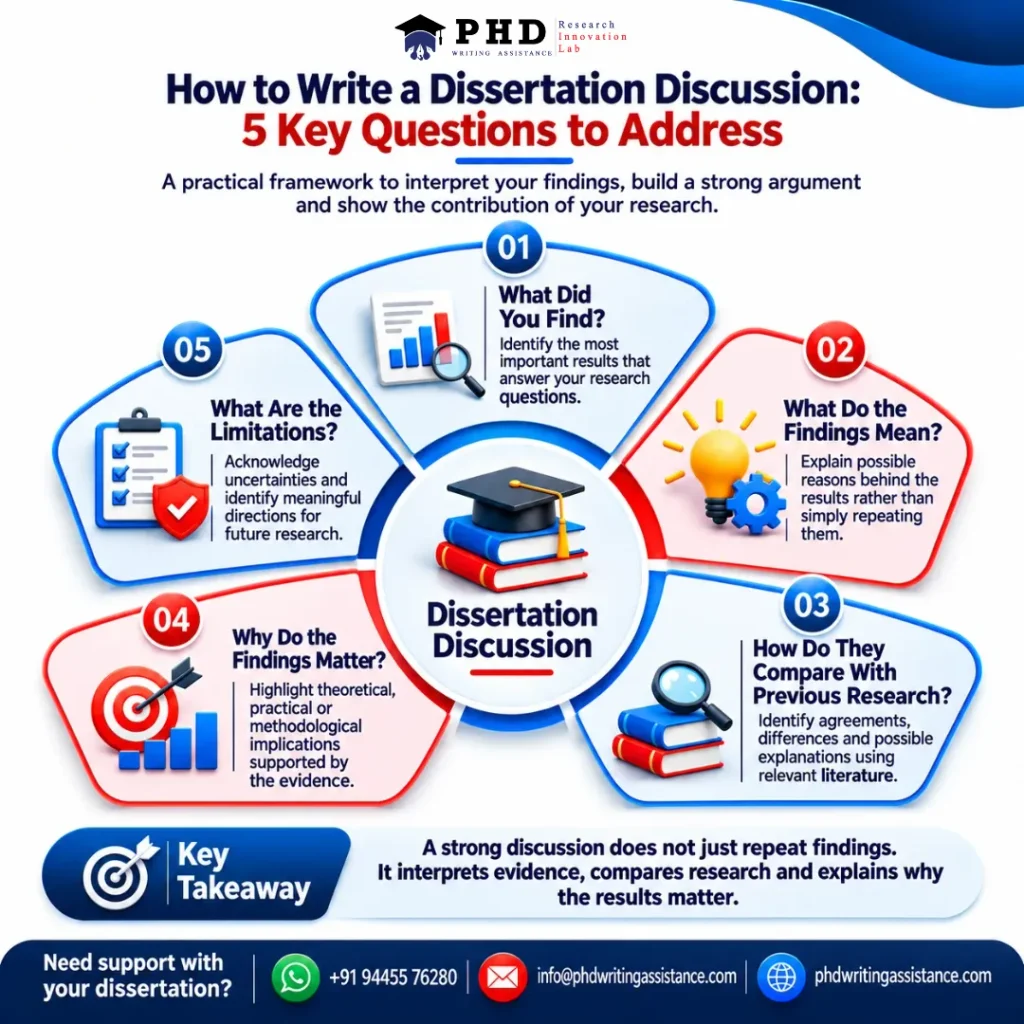
Research Discussion Examples: Moving From Results to Analysis
Good research discussion examples show the difference between repeating a finding and explaining its significance. The following situations are illustrative, not claims drawn from published research.
Quantitative Research Example
Imagine a survey showing that postgraduate students with regular study schedules achieve higher average marks. A descriptive sentence would simply restate this relationship. An analytical discussion would explain that structured routines may support consistent engagement with coursework, while recognising that motivation and prior preparation could also influence performance. The researcher would compare the pattern with relevant literature and avoid implying causation without suitable evidence.
Qualitative Research Example
Imagine interviews in which doctoral students say that online databases make literature searching faster but also make it harder to assess source quality. A discussion could interpret these accounts as evidence that easier access does not automatically produce stronger research skills. It might explore the importance of information literacy, while recognising that the interpretation reflects the participants and context studied.
Experimental Research Example
Imagine an instructional intervention followed by higher assessment scores in the intervention group. The discussion should consider whether group differences existed before the intervention, whether the observed improvement was meaningful and whether other influences were controlled. The interpretation should reflect the design and analysis, not simply declare the intervention effective.
Common Mistakes That Weaken a Discussion
One frequent mistake is repeating the results chapter instead of analysing it. Another is using previous literature as a substitute for explaining the researcher’s own findings. Link each result to its interpretation, relevant scholarship and implications.
Avoid introducing unsupported explanations, overlooking contradictory findings or making claims that extend beyond the sample and methodology. Keep the chapter connected to the research questions, and use cautious language where conclusions remain uncertain. Clear transitions between related findings also help readers follow the developing argument.
Academic Support for Dissertation Discussion Writing
Developing an effective discussion requires careful interpretation, a clear structure and consistent academic writing. PhD Writing Assistance (PWA) offers guidance in dissertation organisation, research methodology, literature review development, data interpretation and academic editing. Such support can help researchers strengthen the presentation of their own work while retaining responsibility for their arguments, findings and academic integrity.
Explore the available research support at PhD Writing Assistance.
Conclusion
Understanding how to write a dissertation discussion means learning to explain the significance of findings rather than simply repeating them. An effective chapter connects evidence to research questions, compares results with relevant literature and considers alternative interpretations, implications and limitations. When these elements are organised into a coherent argument, the discussion shows both what the study contributes and where its conclusions must remain cautious.
Frequently Asked Questions
1. What should a dissertation discussion include?
It should interpret the main findings, relate them to previous research, discuss implications and explain important limitations. Recommendations for future research should follow from the evidence.
2. How is the discussion different from the results chapter?
The results chapter reports what the research found. The discussion explains what those findings mean, why they may have occurred and how they relate to the research questions.
3. How can I improve the interpretation of research findings?
Start with each key result, consider plausible explanations and compare it with relevant literature. Distinguish clearly between conclusions supported by the data and possibilities requiring further investigation.
4. Should unexpected findings be included in the discussion?
Yes. Explain why they matter, consider evidence-based explanations and acknowledge uncertainty where the study cannot establish a clear reason.
5. How long should a dissertation discussion chapter be?
Length varies by discipline, programme and the complexity of the findings. Follow university guidance and prioritise sufficient critical analysis over a fixed percentage of the dissertation.