Introduction
Choosing a suitable PhD research topic is one of the most important decisions in doctoral research. A strong topic provides direction for the research process, helps define the research problem and determines the type of literature, methodology and data required. However, selecting from a wide range of PhD research topics can be challenging, particularly when a scholar is still exploring a research area.
A suitable PhD topic should address a meaningful research problem, contribute to existing knowledge and remain practical within the available time, resources and methodological requirements. This guide explains how to select a research topic, evaluate potential ideas and develop a topic that can support a focused and academically valuable doctoral study.
What Are PhD Research Topics?
PhD research topics are focused areas of investigation that form the foundation of doctoral research. A topic may emerge from an existing research gap, an unresolved problem, limitations identified in previous studies or a new development within a particular academic field.
Unlike a broad subject area, a PhD topic needs to be sufficiently specific to allow a scholar to develop clear research questions and objectives. For example, artificial intelligence may be a broad research area, while the adoption of artificial intelligence in healthcare decision-making among public hospitals represents a more focused research direction.
A well-defined topic therefore connects the broader academic field with a specific problem that can be investigated systematically.
How to Choose PhD Research Topics
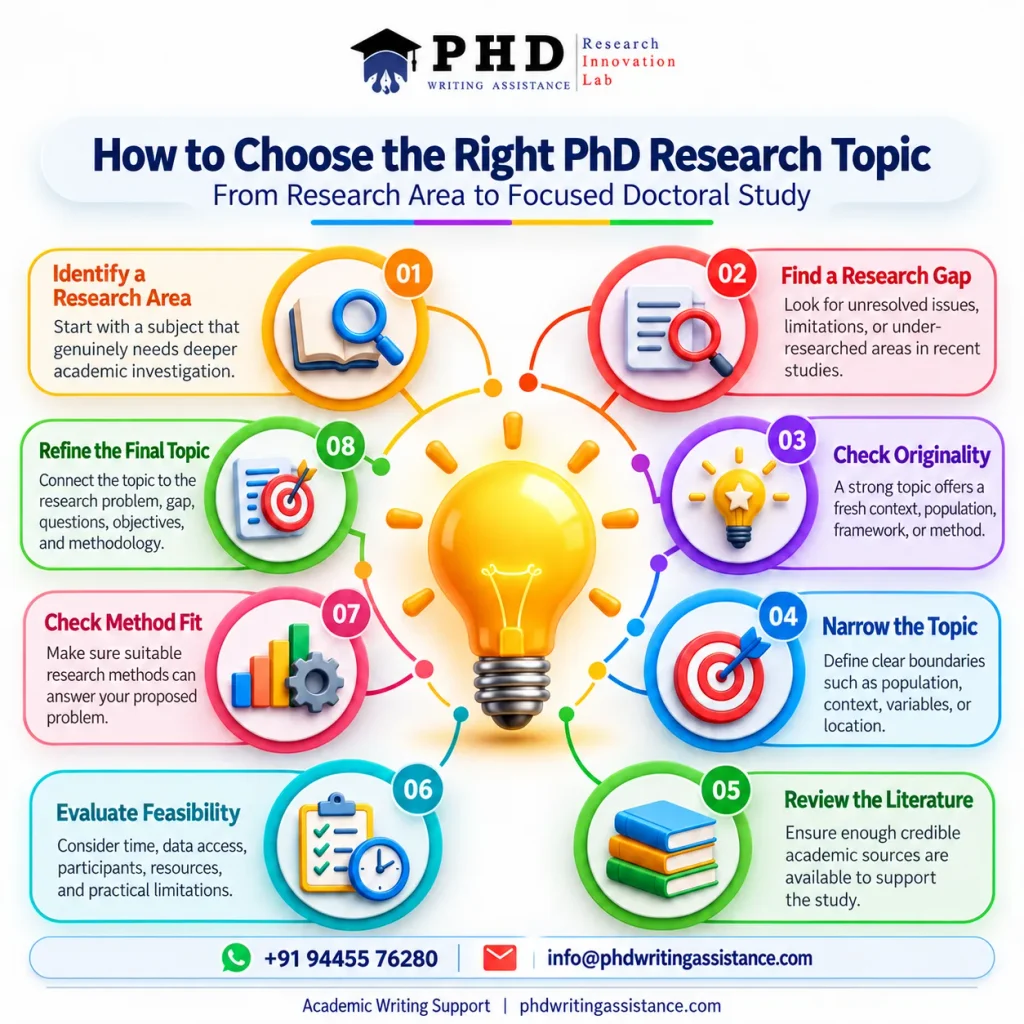
The process of selecting a PhD topic should begin with identifying an area that genuinely requires further investigation. Scholars can start by reviewing recent academic literature, identifying recurring limitations and examining areas where researchers have recommended further studies.
The next step is to narrow the broad research area into a specific problem. A topic should not attempt to address too many issues simultaneously. Instead, it should establish a clear research boundary in terms of the population, context, variables, industry, geographical setting or theoretical perspective being examined.
It is also important to consider whether sufficient academic literature and reliable sources are available. A topic with very limited existing research may be difficult to establish theoretically, while an excessively researched topic may require a clearly identifiable gap to demonstrate originality.
How to Identify a Strong PhD Research Topic
A strong doctoral topic generally has several characteristics. First, it should address a meaningful research problem rather than simply describe an established concept. Second, it should provide an opportunity to contribute to existing academic knowledge. Third, it should be feasible to investigate using appropriate research methods and available resources.
Originality is particularly important at PhD level. This does not necessarily mean that the topic must introduce an entirely new subject. Originality can come from examining an existing problem in a different context, applying a different theoretical framework, studying a new population or using a different methodological approach.
The topic should also be sufficiently focused. A narrowly defined research topic is generally easier to develop into research questions, objectives, methodology and a coherent thesis structure.
Exploring Different PhD Topics
The appropriate choice of PhD topics depends on the scholar’s academic discipline, research interests and identified research gaps. Rather than selecting a topic simply because it is currently popular, researchers should consider whether the subject has a meaningful academic problem that can be investigated.
For example, research opportunities may exist in areas such as digital transformation, sustainability, artificial intelligence, healthcare, education, finance, organisational behaviour and emerging technologies. Within each area, the researcher should move from a broad subject towards a specific research problem.
This approach prevents the topic from becoming too general and helps establish a clear connection between the research problem and the proposed study.
PhD Topics in Commerce
Commerce provides a broad range of potential doctoral research areas involving business, finance, accounting, economics, marketing and organisational practices.
Potential PhD topics in commerce can examine emerging changes in business environments, consumer behaviour, digital commerce, financial technologies, corporate governance, sustainable business practices or changes in accounting and financial management.
However, selecting a commerce topic should involve more than identifying a popular business trend. The researcher should examine existing literature and determine what remains insufficiently understood. For example, a study may investigate how a particular technological or regulatory change affects a specific group of organisations or consumers.
The final topic should therefore be developed around a clearly defined research problem rather than simply around a broad commercial trend.
PhD Topics in Computer Science
Computer science offers extensive opportunities for doctoral research because of continuous developments in artificial intelligence, machine learning, cybersecurity, data science, cloud computing, Internet of Things and related technologies.
When considering PhD topics in computer science, researchers should first identify a technical or theoretical problem that requires further investigation. The topic should then be evaluated in terms of its novelty, technical feasibility, available datasets, computational requirements and appropriate evaluation methods.
A strong computer science topic should also establish how the proposed research will be evaluated. Depending on the research area, this may involve developing a model, algorithm, framework or system and assessing its performance against suitable benchmarks.
The availability of technical resources is equally important. A theoretically interesting topic may become difficult to complete if the required datasets, computing resources, software or experimental environment are unavailable.
PhD Research Topics in Management
Management research covers areas including organisational behaviour, human resource management, leadership, strategic management, innovation, entrepreneurship and digital transformation.
When developing PhD research topics in management, researchers should examine organisational problems that require deeper academic investigation. A useful topic may explore relationships between specific organisational factors, examine changes in management practices or investigate how organisations respond to emerging challenges.
For example, a broad interest in employee engagement could be narrowed into a specific investigation of employee engagement within a particular organisational context, workforce group or changing work environment.
The research topic should ultimately provide sufficient scope for developing a conceptual or theoretical framework while remaining focused enough to support rigorous empirical investigation.
How to Select a Research Topic from Existing Literature
A literature review is one of the most useful starting points when deciding how to select a research topic. Researchers should examine recent journal articles, systematic reviews, dissertations and other credible academic sources within their chosen field.
While reviewing the literature, researchers can look for several indicators of potential research opportunities. These include inconsistent findings, limitations in existing methodologies, under-researched populations, geographical gaps, emerging technologies and recommendations for future research.
It is also useful to compare studies rather than simply summarising them. Critical comparison can reveal where existing research agrees, where it differs and what questions remain unresolved.
This process allows the researcher to move from a general interest towards a defensible research problem.
Questions to Ask Before Finalising a PhD Topic
Before finalising a topic, PhD scholars should consider whether the proposed study answers several practical and academic questions.
Is the research problem clearly defined? Does the topic address a genuine gap or unresolved issue? Is there sufficient academic literature? Can appropriate data be obtained? Is the research feasible within the available time? Can suitable research methods be applied? Does the topic have sufficient originality for doctoral-level research?
The researcher should also consider whether the topic aligns with their academic background and research expertise. A topic that requires completely unfamiliar theoretical and methodological knowledge may require substantially more preparation.
Supervisor expertise is another relevant consideration. Discussing the proposed topic with a supervisor can help identify conceptual weaknesses, improve the scope and determine whether the research question is sufficiently focused.
Common Mistakes When Choosing PhD Topics
One common mistake is selecting a topic that is too broad. A broad topic can result in unclear research questions and an excessive amount of literature to review.
Another problem is choosing a topic based entirely on popularity. A current trend may appear attractive, but popularity alone does not establish a research gap or guarantee doctoral-level contribution.
Researchers may also overlook feasibility. Limited access to participants, datasets, technology, funding or research time can create difficulties later in the project.
Finally, some researchers choose a topic before conducting sufficient literature analysis. Reviewing existing research first allows scholars to understand what has already been studied and where meaningful opportunities for further research exist.
Finalising the Right PhD Research Topic
After identifying and evaluating several potential topics, the researcher can compare them based on originality, relevance, feasibility, available literature and potential contribution.
The selected topic should then be refined into a clear research problem. From this problem, the researcher can develop research questions and objectives that establish exactly what the study intends to investigate.
A strong progression is therefore:
Research area → Research problem → Research gap → Research questions → Research objectives → Research methodology
This progression helps ensure that the final PhD topic is not isolated from the rest of the research design.
PhD Research Topic and Research Support
Developing a suitable doctoral topic often requires extensive literature searching, critical analysis and research planning. PhD Research Assistance can support scholars in evaluating research gaps, refining research problems and developing a structured research direction.
Research support may also involve Research Methodology Assistance, literature review development, academic editing and guidance on connecting research questions with appropriate methodological approaches. Such support should complement the researcher’s own academic contribution and maintain appropriate research integrity.
Conclusion
Choosing suitable PhD research topics requires more than selecting an interesting subject. A successful doctoral topic should address a meaningful research problem, demonstrate potential originality, remain feasible and contribute to existing academic knowledge.
Whether researchers are exploring PhD topics in commerce, PhD topics in computer science or PhD research topics in management, the selection process should begin with a careful examination of existing literature and research gaps. By narrowing a broad research area into a clearly defined problem and connecting it with appropriate research questions and objectives, PhD scholars can establish a stronger foundation for their doctoral research.
Frequently Asked Questions
1. How do I choose PhD research topics?
Start by identifying a research area, reviewing existing literature, finding a research gap and narrowing it into a specific, original and feasible research problem.
2. What makes a good PhD research topic?
A good PhD topic should be relevant, original, clearly focused, supported by sufficient literature and feasible within the available time, resources and research methodology.
3. What are some PhD topics in commerce?
PhD topics in commerce can cover areas such as digital commerce, finance, accounting, consumer behaviour, corporate governance, sustainability and emerging business practices.
4. What are suitable PhD topics in computer science?
PhD topics in computer science may include artificial intelligence, machine learning, cybersecurity, data science, cloud computing, Internet of Things and other emerging computing technologies.
5. How can I select PhD research topics in management?
Review recent management research, identify an unresolved organisational problem or research gap, and narrow it into a focused topic that can be investigated using an appropriate theoretical and methodological approach.