Introduction
A literature review is a fundamental part of doctoral research. It provides the academic foundation for a study by examining what researchers already know, where evidence is limited, and which questions remain unanswered. However, a doctoral literature review is not simply a summary of published papers. It requires researchers to critically evaluate existing knowledge, compare different perspectives, identify patterns and contradictions, and establish a clear research gap.
For doctoral researchers, approaching the task systematically can make the writing process more manageable. This step by step literature review guide explains how to plan, search, evaluate, organise, synthesise, and write a literature review that supports a strong doctoral research argument.
What Is a Literature Review in Doctoral Research?
A literature review is a critical examination of academic research related to a particular research problem, question, or field of study. It brings together relevant theories, concepts, findings, and methodological approaches to demonstrate how knowledge has developed.
In doctoral research, the literature review also needs to establish the context and justification for the study. It should demonstrate that the researcher understands the existing academic debate and can identify a meaningful area for further investigation.
A strong doctoral literature review therefore answers four fundamental questions: What is already known? What are the limitations of existing research? Where is the research gap? How does the proposed study address that gap?
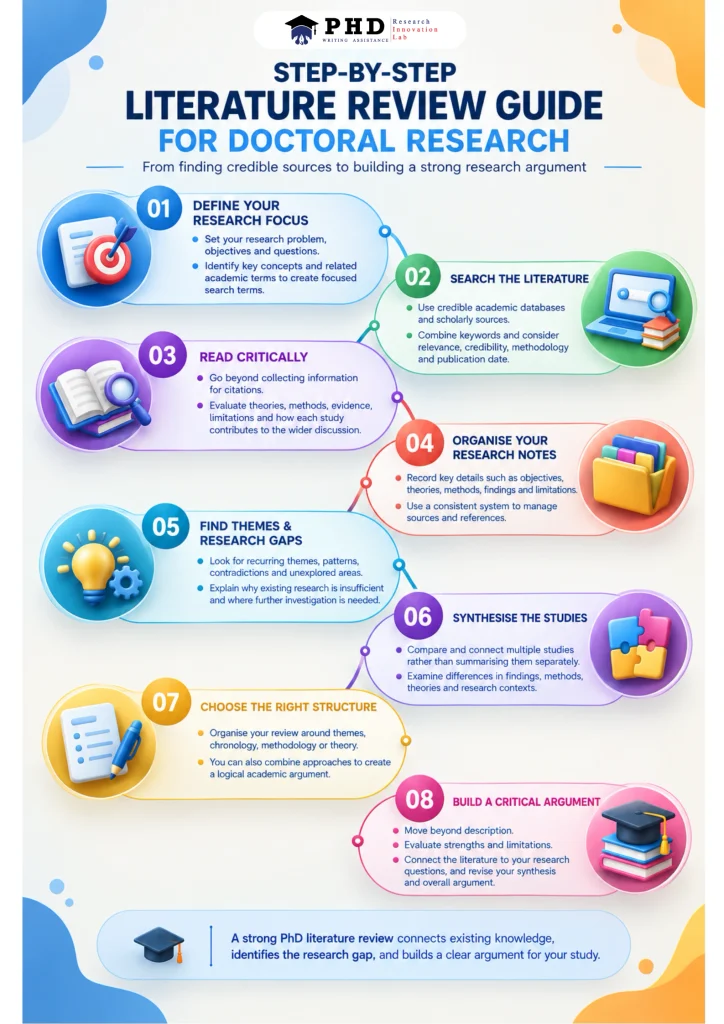
Step 1: Define the Research Focus
Before searching for literature, clearly establish the research problem, objectives, and research questions. These elements determine what literature is relevant to the study.
Start by identifying the main concepts associated with your research topic. Consider alternative terminology, related concepts, theoretical terms, and variations in academic language. These can then be developed into search terms for databases and scholarly search platforms.
A clearly defined research focus prevents the literature review from becoming too broad. Without clear boundaries, doctoral researchers can spend considerable time collecting sources that are academically interesting but have little relevance to the research questions.
The scope should also be reviewed throughout the research process. As your understanding of the field develops, you may discover that certain concepts need to be included, narrowed, or reconsidered.
Step 2: Conduct a Structured Literature Search
The next stage involves identifying relevant and credible academic sources. Depending on the discipline, these may include peer-reviewed journal articles, academic books, conference papers, doctoral theses, systematic reviews, and authoritative research reports.
Use appropriate academic databases and library resources rather than relying only on general web searches. Search using combinations of keywords and related terms, and record the searches that produce particularly useful results.
When selecting sources, consider their relevance, academic credibility, publication date, methodology, theoretical contribution, and relationship to other studies.
Recent research is important for understanding current developments, but older influential studies should not automatically be excluded. Foundational theories and landmark research may remain essential to understanding how a particular field developed.
Step 3: Read the Literature Critically
Finding sources is only the beginning of the process. The quality of the literature review depends heavily on how critically the sources are evaluated.
When writing a PhD literature review, avoid reading studies only to collect information for citation. Instead, consider what each study contributes to the wider academic discussion.
Ask questions such as:
- What was the purpose of the study?
- What theoretical perspective was adopted?
- Which methodology was used?
- How convincing is the evidence?
- What limitations affect the findings?
- How does the study compare with previous research?
- Does it support, challenge, or extend existing knowledge?
This approach helps transform the literature review from a descriptive collection of sources into a critical academic discussion.
Step 4: Organise Your Literature and Research Notes
A large doctoral project may involve hundreds of sources. Without an organised system, it can become difficult to remember which studies support particular arguments or where specific evidence was found.
Create a consistent system for managing your academic literature. Record key information about important studies, including their research objectives, theoretical framework, methodology, main findings, limitations, and relevance to your research.
Reference management software can also help maintain accurate citation information and reduce problems with inconsistent referencing.
At this stage, do not try to write the entire literature review. Focus first on understanding the literature and identifying relationships between studies.
Step 5: Identify Major Themes and Research Gaps
Once you have reviewed a substantial body of literature, begin looking for recurring themes, patterns, disagreements, and unexplored areas.
For example, several studies may examine the same research problem but use different theoretical frameworks. Other studies may produce conflicting findings because they were conducted in different populations, geographical settings, or methodological contexts.
These differences are valuable because they can reveal areas that require further investigation.
A research gap should not simply be a statement that “very little research exists”. A stronger doctoral literature review demonstrates why the existing research is insufficient and explains how the proposed study can contribute to the field.
The research gap should emerge naturally from the critical discussion rather than appearing as an isolated statement near the end of the chapter.
How to Synthesise Studies in a Literature Review
Synthesis is one of the most important elements of effective literature review writing for PhD research.
To synthesise means to bring multiple studies together and analyse their relationships. Instead of discussing each source independently, consider how researchers collectively understand the issue.
For example, imagine that several studies examine a particular factor but reach different conclusions. A strong synthesis would not simply report each finding separately. It would compare the studies, examine why their findings differ, and consider whether differences in methodology, sample characteristics, theoretical perspective, or research context could explain the results.
Synthesis can involve comparing similar findings, contrasting opposing conclusions, tracing changes in academic thinking, evaluating different methodologies, and connecting theoretical perspectives.
This process allows the researcher to develop an argument based on the literature rather than simply reproduce information from previous publications.
How to Organise a Doctoral Literature Review
There is no single structure that works for every doctoral research project. The organisation should reflect the research questions and the nature of the existing literature.
A thematic structure groups studies according to major concepts or research themes. This is often effective when the literature contains several interconnected areas.
A chronological structure examines how research has developed over time. It can be useful when theories, methods, or academic debates have changed significantly.
A methodological structure compares studies according to their research approaches, such as qualitative, quantitative, or mixed methods.
A theoretical structure may be appropriate when the research is built around competing theories or conceptual frameworks.
In practice, doctoral researchers often combine these approaches. For example, a literature review may be organised primarily by themes while discussing the methodological and theoretical differences between studies within each section.
A Practical Structure for a PhD Literature Review
A typical doctoral literature review may begin with an introduction explaining the purpose and scope of the chapter. This is followed by key concepts, theoretical perspectives, and major research themes.
The central sections should critically examine existing research and establish relationships between studies. Methodological approaches may also be evaluated where they are relevant to the research problem.
Towards the later part of the review, the discussion should become increasingly focused on limitations, inconsistencies, and gaps in existing knowledge. The chapter should then explain how these gaps provide the rationale for the current research.
The final section should summarise the main insights from the literature and establish a clear connection with the research questions and subsequent methodology.
A PhD literature review example can help researchers understand how these components are presented in an academic thesis. However, examples should be used as guides rather than templates because thesis structures vary between disciplines and universities.
How to Make a Literature Review More Critical
A common weakness in doctoral literature reviews is excessive description. A review may contain many citations but still lack critical depth if it only explains what individual researchers have found.
To make the writing more critical, compare studies rather than discussing them in isolation. Evaluate the strengths and limitations of different approaches and consider whether conclusions are supported by appropriate evidence.
Use analytical language to explain relationships between studies. For example, rather than simply stating that one researcher found a particular result, discuss how that result compares with other research and what the difference means for your research problem.
Critical writing does not mean criticising every study. It means demonstrating an informed understanding of the evidence, recognising both contributions and limitations.
Common Mistakes in Doctoral Literature Review Writing
Several mistakes can weaken an otherwise well-researched literature review.
One common problem is treating the review as an annotated bibliography. Listing studies one after another does not establish an academic argument.
Another problem is using sources that are relevant to the general topic but do not directly support the research questions. A large number of citations does not necessarily indicate a strong literature review.
Researchers may also identify a research gap too early and then select literature only to support that assumption. A stronger approach is to evaluate the evidence objectively and allow the research gap to emerge from the analysis.
Poor organisation, inconsistent referencing, excessive quotations, and insufficient connection between the literature and research questions can also reduce the effectiveness of the chapter.
Tips for Writing a Strong PhD Literature Review
When considering how to do literature review for PhD research, focus on developing an argument rather than trying to include every publication related to the topic.
Keep your research questions in view while searching and writing. Every major section should have a clear purpose and contribute to understanding the research problem.
Update the literature search when necessary, particularly during a long doctoral project. New publications may introduce important findings or change the academic discussion.
It is also useful to revise the literature review after developing the methodology and analysing your findings. Your understanding of the research gap may become more precise as the study progresses.
Most importantly, allow sufficient time for revision. A literature review often becomes significantly stronger when the researcher revisits earlier sections and improves the synthesis, transitions, and overall argument.
PhD Literature Review Support
Developing a comprehensive and critical literature review can be challenging, particularly when the research involves a large and complex body of academic literature.
Professional PhD Writing Assistance can support doctoral researchers with literature review organisation, academic writing, critical analysis, research methodology, editing, and proofreading. Such support can help improve the clarity and structure of the work while keeping the researcher’s original ideas and academic contribution at the centre of the thesis.
Conclusion
A doctoral literature review should demonstrate more than knowledge of published research. It should show how existing studies connect, where evidence is strong or limited, what debates remain unresolved, and why further research is necessary.
By following this step by step literature review guide, doctoral researchers can approach the process systematically from defining the research focus and finding credible sources to critically evaluating studies, synthesising evidence, identifying research gaps, and developing a coherent academic argument.
A well-structured literature review ultimately provides the foundation for the research methodology and demonstrates the significance of the doctoral study within the wider academic field.
Frequently Asked Questions
1. How do I write a literature review step by step for doctoral research?
Start by defining your research questions and scope, then search for relevant academic sources. Critically evaluate the literature, organise studies into themes, synthesise their findings, identify the research gap, and connect the review to your doctoral research.
2. What sources should I include in a doctoral literature review?
Prioritise relevant peer-reviewed journal articles, academic books, systematic reviews, authoritative research reports, and other credible scholarly sources. Include both recent research and important foundational studies where they contribute to your research topic.
3. How do I synthesise studies in a literature review?
Compare and contrast studies rather than summarising them individually. Look for common findings, disagreements, methodological differences, theoretical perspectives, and patterns that help explain the wider research landscape.
4. How long should a doctoral literature review be?
There is no universal word count. The appropriate length depends on your discipline, research topic, university requirements, and overall thesis structure. Follow your institution’s guidelines and your supervisor’s recommendations.
5. What is the best way to organise a literature review?
Organise the review around themes, theories, chronology, methodologies, or a combination of these approaches. The best structure is the one that creates a logical argument and clearly supports your research questions.