Introduction
Time management for PhD students is essential for balancing research, academic writing, deadlines, meetings, and personal responsibilities. Many PhD students spend a significant amount of time researching but struggle to convert that work into consistent writing progress.
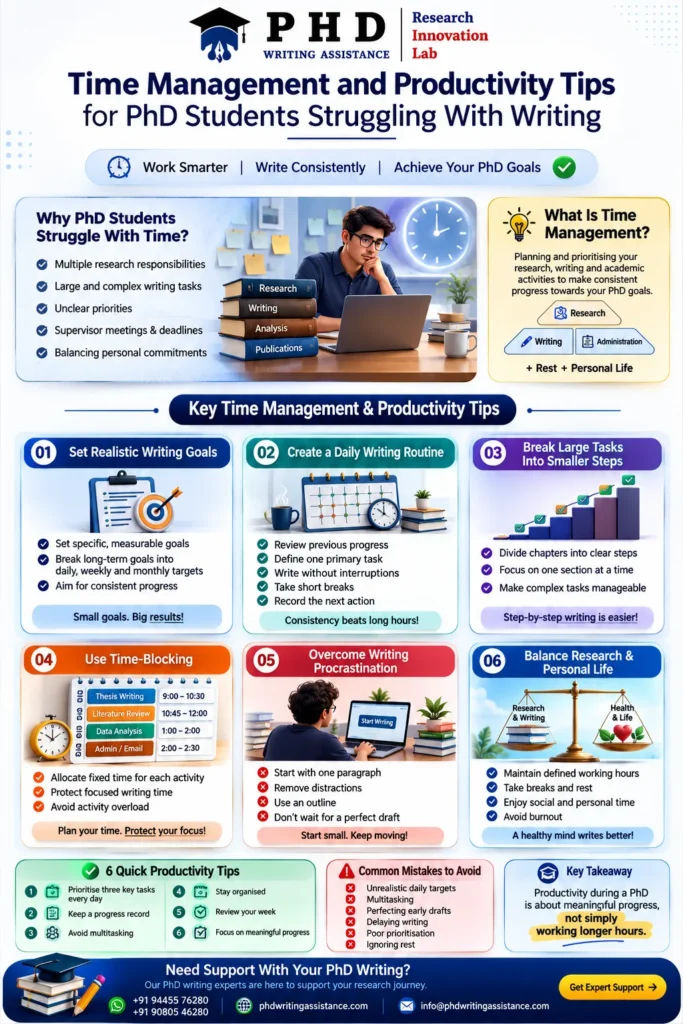
Writing a thesis is a long-term process, and waiting for large blocks of free time can make progress difficult. A more effective approach is to set realistic writing goals, divide large tasks into manageable steps, schedule focused writing sessions, and regularly review progress.
For PhD students struggling with writing, productivity is not about working longer hours. It is about using available time strategically and creating a sustainable routine that supports both research and writing.
Why Do PhD Students Struggle With Time Management?
PhD students often manage several responsibilities simultaneously. These may include:
- Literature reviews
- Data collection
- Data analysis
- Academic writing
- Supervisor meetings
- Conference preparation
- Journal publications
- Teaching or other academic responsibilities
- Personal commitments
Writing can become particularly difficult when the task feels too large or unclear. For example, “write the methodology chapter” is a much larger task than “draft the sampling subsection”.
Breaking large objectives into smaller actions can make writing sessions more focused and measurable.
What Is Time Management for PhD Students?
Time management for PhD students is the process of planning and prioritising research, writing, academic and personal activities to make consistent progress towards PhD goals.
Effective time management involves more than creating a timetable. It requires researchers to identify priorities, allocate realistic amounts of time, protect focused writing periods, and regularly adjust their plans.
A useful PhD schedule should balance:
Research + Writing + Administration + Rest + Personal Life
A schedule that ignores rest and personal commitments may be difficult to maintain over the long term.
Set Realistic PhD Writing Goals
One of the most useful time management tips is to create specific writing goals instead of vague objectives.
Instead of:
“Work on my thesis today.”
Set a goal such as:
“Draft 500 words for the literature review section.”
Or:
“Rewrite the subsection explaining the research gap.”
Specific goals make it easier to begin and measure progress.
Use Daily and Weekly Goals
Daily goals should be achievable within the available time, while weekly goals should contribute to larger thesis milestones.
For example:
Daily: Draft one subsection.
Weekly: Complete and review one chapter section.
Monthly: Finish a defined thesis milestone.
This approach makes a large PhD project easier to manage.
Create a Daily Writing Routine
A consistent routine can help reduce the mental effort required to decide when to write.
Choose a period when you are normally most focused. Some researchers prefer mornings, while others work better later in the day.
A simple routine could be:
- Review the previous day’s progress.
- Define one primary writing task.
- Work on the task without unnecessary interruptions.
- Take short breaks.
- Review what was completed.
- Record the next action before finishing.
The most important factor is consistency, rather than following a particular time of day.
Break Large Writing Tasks Into Smaller Steps
A thesis chapter can feel overwhelming because it contains many different tasks.
Instead of writing:
“Complete Chapter 2.”
Break it into:
- Identify relevant literature
- Organise sources
- Draft the introduction
- Write the theoretical framework
- Develop the literature themes
- Identify the research gap
- Review citations
- Edit the section
This method makes difficult writing projects more manageable and helps PhD students struggling with writing maintain momentum.
How to Overcome Writing Procrastination
Writing procrastination often occurs when the task feels difficult, unclear, or overwhelming.
One effective approach is to reduce the starting point.
Instead of thinking:
“I need to write my entire chapter.”
Start with:
“I will write the first paragraph.”
Other useful approaches include:
- Set a short starting session.
- Remove unnecessary distractions.
- Keep research materials organised.
- Use an outline before drafting.
- Accept that the first draft does not need to be perfect.
- Record the next writing task before ending a session.
The goal is to start writing, rather than waiting until you feel completely motivated.
How to Stay Productive During PhD Research
PhD research productivity depends on making steady progress towards meaningful research milestones.
Use a simple priority system:
High Priority
Tasks that directly affect an upcoming research milestone or deadline.
Medium Priority
Important tasks that can be scheduled after urgent research work.
Low Priority
Tasks that can be postponed, delegated, automated, or completed during less productive periods.
Researchers should also avoid confusing being busy with being productive. Reading emails for several hours may feel productive, but it may not contribute significantly to thesis progress.
At the end of each day, ask:
“What important research or writing task did I actually complete today?”
Productivity Tips for PhD Students
The following productivity tips for PhD students can help maintain consistent progress:
1. Prioritise Three Important Tasks
Identify the three most important tasks for the day rather than creating an unrealistic list.
2. Protect Writing Time
Treat scheduled writing sessions as important appointments.
3. Keep a Progress Record
Track completed sections, word counts, analysed datasets, completed readings, or other meaningful milestones.
4. Avoid Multitasking
Focus on one demanding research task at a time.
5. Keep Your Research Organised
Use consistent systems for references, datasets, notes, drafts, and research documents.
6. Review Your Week
At the end of each week, identify what was completed and adjust the following week’s priorities.
How to Balance Research, Writing and Personal Life
A PhD can become difficult to sustain when research occupies every part of the day.
Creating boundaries can help researchers maintain long-term productivity.
Consider:
- Setting defined working hours
- Scheduling breaks
- Taking regular days away from research
- Maintaining social activities
- Getting sufficient rest
- Avoiding unnecessary work outside planned hours
A sustainable routine is more valuable than repeatedly working extremely long hours.
PhD students should remember that productivity is measured by meaningful progress, not simply the number of hours spent at a desk.
Common Time Management Mistakes During a PhD
Some common mistakes include:
- Setting unrealistic daily targets
- Trying to complete several tasks simultaneously
- Spending too much time perfecting early drafts
- Delaying writing until research is “finished”
- Failing to prioritise important tasks
- Allowing emails and meetings to interrupt writing
- Ignoring rest and personal responsibilities
- Not reviewing progress regularly
One particularly important mistake is waiting until all research is complete before starting to write. Writing can be part of the research process itself and can help researchers identify gaps, refine arguments, and organise their thinking.
When PhD Students Need Writing Support
Some researchers may need additional academic support when they are struggling with thesis structure, academic language, editing, proofreading, or organising complex research material.
Professional PhD writing assistance can support areas such as academic editing, proofreading, chapter structure, research paper preparation, and improving the presentation of academic work.
Such support should complement the researcher’s own work while maintaining the researcher’s original ideas, analysis, data, and academic contribution.
Conclusion
Effective time management for PhD students is not about filling every hour with work. It is about prioritising important research activities, creating realistic writing goals, protecting focused writing time, and maintaining a sustainable routine.
For PhD students struggling with writing, breaking large tasks into smaller steps can make thesis writing less overwhelming. Time-blocking, weekly planning, focused writing sessions, and regular progress reviews can also improve PhD research productivity.
The most effective approach is one that can be maintained throughout the PhD journey. By combining realistic planning with consistent writing habits and appropriate productivity tips for PhD students, researchers can make steady progress while protecting their personal time and wellbeing.
Frequently Asked Questions
1. How can PhD students manage time effectively for writing?
Set specific writing goals, schedule focused writing sessions, prioritise important tasks, and break large chapters into smaller sections.
2. What is the best daily writing routine for PhD students?
There is no single best routine. A consistent schedule with a dedicated, distraction-free writing period is generally more useful than following a fixed number of hours.
3. How do I stay productive during PhD research?
Prioritise high-value research tasks, set realistic daily goals, avoid multitasking, track progress, and review your priorities each week.
4. How can PhD students overcome writing procrastination?
Start with a small, specific task, such as writing one paragraph or subsection, and focus on producing a first draft rather than trying to make every sentence perfect.
5. How do I balance research, writing, and personal life during PhD?
Create defined working hours, schedule writing and research priorities, take regular breaks, and protect time for rest, relationships, and personal activities.