Introduction
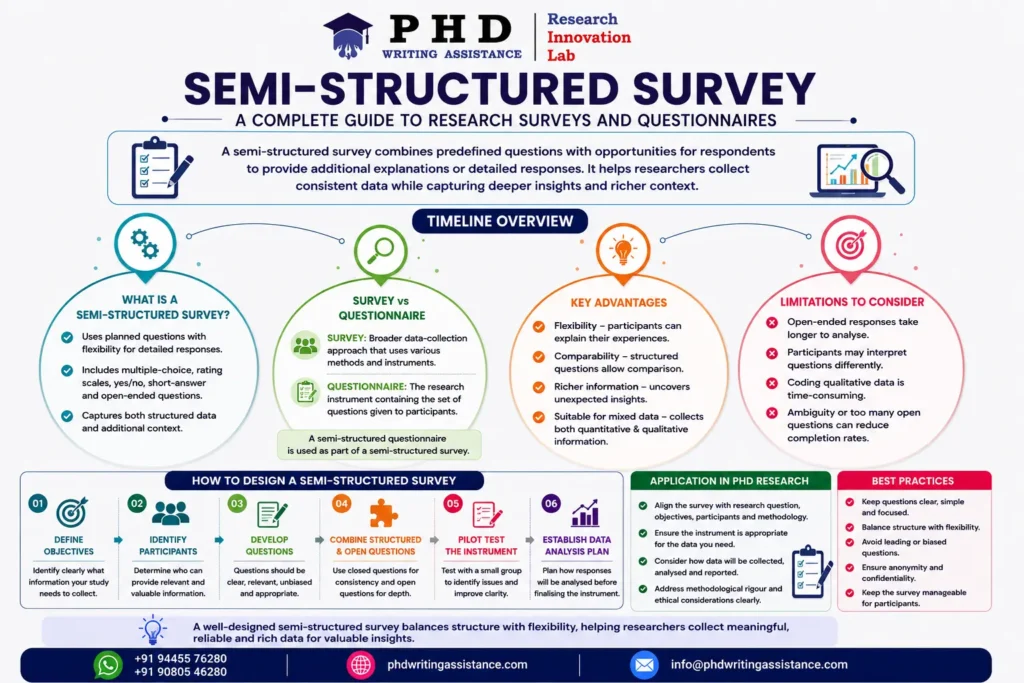
A semi structured survey combines predefined questions with opportunities for respondents to provide additional explanations or detailed responses. It can help researchers collect consistent information while also allowing participants to express their views in greater depth.
For PhD students and researchers, choosing an appropriate survey approach is important because the research instrument should align with the research question, methodology, target participants, and type of data required.
Understanding the difference between a semi-structured survey and a semi structured questionnaire can also help researchers design more effective research instruments and connect data collection with their broader research methodology.
What Is a Semi-Structured Survey?
A semi-structured survey uses a planned set of questions but provides flexibility for respondents to explain their answers.
A survey may include:
- Multiple-choice questions
- Rating-scale questions
- Yes/no questions
- Short-answer questions
- Open-ended questions
For example, a researcher may ask participants to rate their satisfaction on a scale and then provide an open-ended question asking them to explain their response.
This combination can produce structured information while capturing additional context.
Semi-Structured Survey vs Semi-Structured Questionnaire
The terms semi structured survey and semi structured questionnaire are closely related but should not always be treated as identical.
A survey is a broader data-collection approach that can involve a questionnaire as its research instrument. A questionnaire is the actual set of questions presented to participants.
Therefore:
Survey = broader data-collection approach
Questionnaire = research instrument containing questions
A semi-structured questionnaire can therefore be used as part of a semi-structured survey.
The terminology should be defined clearly in a PhD methodology chapter so that readers understand exactly how the data was collected.
What Is a Research Survey Questionnaire?
A research survey questionnaire is a structured research instrument used to collect information from participants.
It can contain different types of questions, including:
Closed-Ended Questions
Participants select from predefined answers.
Examples include:
- Yes/no questions
- Multiple-choice questions
- Rating scales
- Likert-scale questions
Open-Ended Questions
Participants provide their own responses rather than selecting from predefined options.
Semi-Structured Questions
A questionnaire can combine both approaches, allowing researchers to collect comparable responses while giving participants opportunities to provide additional information.
How to Design a Semi-Structured Survey
Researchers should begin by connecting the survey with their research objectives.
1. Define the Research Objectives
Clearly identify what information the study needs to collect.
2. Identify the Target Participants
Determine who can provide relevant information for the research question.
3. Develop the Questions
Questions should be clear, relevant, unbiased, and appropriate for the participants.
4. Combine Structured and Open Questions
Use closed questions when consistent responses are needed and open questions when detailed explanations are important.
5. Pilot Test the Instrument
Test the questionnaire with a small group before the main data collection where appropriate. This can help identify confusing questions or technical problems.
6. Establish a Data Analysis Plan
Consider how responses will be analysed before finalising the research instrument.
Advantages of Semi-Structured Surveys
A semi-structured approach can provide several benefits.
Flexibility
Participants can explain their experiences instead of being restricted entirely to predefined options.
Comparability
Structured questions allow researchers to compare responses across participants.
Richer Information
Open-ended questions can reveal perspectives or issues that researchers may not have anticipated.
Suitable for Mixed Data
Researchers can collect both structured responses and qualitative information within the same research instrument.
However, researchers should ensure that the instrument remains focused and manageable for participants.
Limitations of Semi-Structured Surveys
Semi-structured surveys can also create challenges.
- Open-ended responses may require more time to analyse.
- Different participants may interpret questions differently.
- Coding qualitative responses can be time-consuming.
- Poorly designed questions can introduce ambiguity.
- A large number of open-ended questions may reduce completion rates.
Researchers should therefore balance flexibility with clarity and consider the amount of data they can realistically analyse.
Semi-Structured Surveys and Research Approach Types
The choice of survey design should be connected to the broader research approach types used in the study.
Common approaches include:
- Quantitative research
- Qualitative research
- Mixed-methods research
A structured questionnaire is often associated with quantitative data collection, while open-ended questions can provide qualitative information.
A semi-structured instrument may therefore be useful when a researcher needs both comparable responses and additional contextual information. However, the research approach should be determined by the research question and study design rather than by the instrument alone.
Semi-Structured Surveys in Qualitative Research
Semi-structured data collection can be particularly useful when researchers want participants to describe experiences, opinions, or perceptions in their own words.
For example, a researcher studying doctoral students’ experiences may ask:
“How satisfied are you with your research supervision?”
followed by:
“Please explain the main reasons for your response.”
The first question produces a structured response, while the second can provide contextual information.
The researcher can then analyse the responses using an appropriate qualitative or mixed-methods approach.
Ethnographic Study and Survey Research
An ethnographic study focuses on understanding people, cultures, behaviours, and social contexts through detailed observation and interaction.
Ethnographic research commonly relies on methods such as:
- Participant observation
- Field notes
- Interviews
- Informal conversations
- Document analysis
A survey may sometimes complement ethnographic research by providing additional information from a broader group. However, a survey should not automatically be considered an ethnographic method.
Researchers should explain how each method contributes to the research objectives.
Narrative Research and Semi-Structured Data Collection
Narrative research focuses on people’s stories and experiences.
Researchers may use interviews or open-ended questions to allow participants to describe events, experiences, and personal perspectives.
For example, a study exploring the experiences of PhD students may ask participants to describe significant challenges during their doctoral journey.
The resulting responses can provide detailed narratives that researchers analyse according to the chosen narrative research framework.
Common Mistakes When Designing a Semi-Structured Survey
Researchers should avoid several common problems:
Leading Questions
Questions should not encourage participants towards a particular answer.
Ambiguous Wording
Participants should be able to understand exactly what each question asks.
Too Many Questions
A lengthy questionnaire can increase participant fatigue and incomplete responses.
Poor Alignment With Objectives
Every important question should have a clear connection with the research objectives.
No Analysis Plan
Researchers should consider how responses will be coded, categorised, or statistically analysed before collecting data.
Mixing Methods Without Explanation
If structured and qualitative data are collected together, the methodology should clearly explain why both types are required and how they will be analysed.
Using a Semi-Structured Survey in PhD Research
For PhD researchers, the methodology chapter should clearly explain:
- Why the survey approach was selected
- Who participated
- How participants were selected
- How the questionnaire was developed
- What types of questions were included
- How the instrument was tested
- How data was collected
- How responses were analysed
- What ethical considerations were addressed
This creates a clear connection between the research question, research design, data collection method, and data analysis.
Researchers should also justify their methodological choices rather than simply describing the steps they followed.
Need Support With Your PhD Research Methodology?
Designing a research instrument and explaining its methodology can be challenging, particularly when a PhD project involves multiple research methods.
Professional PhD writing assistance can support researchers with areas such as methodology structure, academic editing, questionnaire presentation, research documentation, proofreading, and manuscript preparation.
Academic support should help improve the clarity and presentation of the research while preserving the researcher’s original research design, data, analysis, and contribution.
Conclusion
A semi structured survey can combine consistent questions with opportunities for participants to provide additional explanations. This makes it useful when researchers need comparable information while also wanting to capture individual perspectives.
A semi structured questionnaire can serve as the instrument used within such a survey, while the broader research design determines how the collected information will be analysed.
Researchers should select their approach based on the research question, objectives, participants, and methodology. Whether a study involves survey research, an ethnographic study, narrative research, or another methodology, the data collection method should be clearly justified and appropriately aligned with the overall research design.
For PhD research, careful instrument design and clear methodological explanation can strengthen the transparency and credibility of the study.
Frequently Asked Questions
1.What is a semi-structured survey?
A semi-structured survey combines predefined questions with open-ended questions, allowing researchers to collect comparable information while giving participants space to explain their responses.
2.Is a semi-structured survey the same as a semi-structured questionnaire?
Not exactly. A survey is the broader data-collection approach, while a questionnaire is the research instrument containing the questions.
3.When should I use a semi-structured questionnaire?
Use a semi-structured questionnaire when you need consistent responses but also want participants to provide additional explanations, experiences, or opinions.
4.Can semi-structured surveys be used in PhD research?
Yes. They can be used in PhD research when the approach aligns with the research question, objectives, methodology, participants, and planned data analysis.
5.Can surveys be used in ethnographic or narrative research?
They can sometimes complement ethnographic or narrative research, but they do not replace the methods typically used to collect detailed observational or narrative data.